Contents — 13 parts
- Left-side player or left-hander: don’t mix them up
- What is the role of the left-side player in padel?
- What the left side asks of the racket
- The trade-offs: elbow and manoeuvrability
- And the right-side player?
- The case of the left-hander
- Table: left or right, which criteria?
- How to choose according to your level
- SCUD rackets for the left-side player
- Buying mistakes to avoid
- Try before you choose
- In short
- Frequently asked questions
The left-side player, the one who stands on the left half of the court, is usually the pair’s finisher: smashes, bandejas, viboras and winners go through them more often. Their racket should therefore help them close out points: a diamond or a pronounced teardrop shape, head-heavy balance, a fairly stiff frame and standard weight, around 360 to 375 g. On one condition: having the technique and the arm to make the most of it, because these settings come at a cost in manoeuvrability and strain on the elbow. And “left-side player” does not mean left-handed: a left-hander most often plays… on the right.
This guide explains the role of the left side, with figures to back it up, what it asks of the racket and the trade-offs that come with it, the profile of the right-side player for comparison, the special case of the left-hander, then how to choose according to your level, the SCUD rackets that suit, the buying mistakes to avoid and how to try before you decide.
Left-side player or left-hander: don’t mix them up
In padel, players are named after the side of the court they occupy, seen from the back of their own half: the left-side player, or backhand-side player (revés in Spanish), and the right-side player, or drive player. For a right-hander on the left, the backhand is on the side-glass side and the forehand towards the centre. Hence the name “backhand side”.
The left-hander, on the other hand, is a player who holds the racket in the left hand. The two notions overlap without being the same: a right-hander can play on the left or the right, and so can a left-hander. This guide first covers the left side played by a right-hander, the most common case, then the left-hander in a dedicated section. The rule to remember is simple: you choose your racket according to the role you play, not the side written on the score sheet.
What is the role of the left-side player in padel?
The pair’s finisher
Specialist sources all describe the same split. For Padel Point, the left-side player is “the more offensive” of the duo, in charge of finishing points with smashes and viboras, while the right-side player keeps things steady and builds. Padel Addict, in its guide to choosing your side, advises putting on the left whoever has the better overhead game, which, the site specifies, means the better smash. Padel Point also recalls a tradition: historically, the more experienced players were placed on the left, where points are often decided.
What the figures say
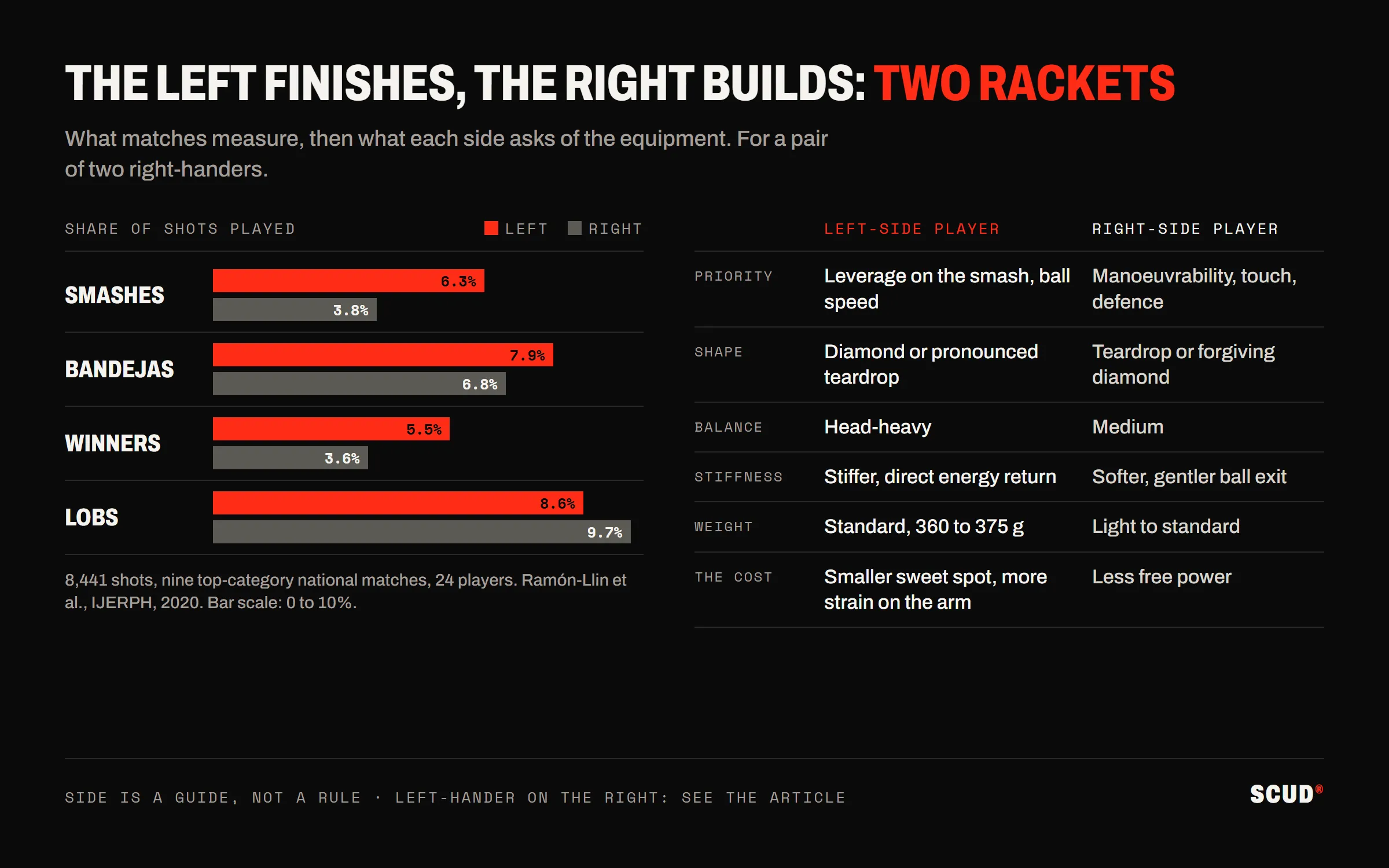
A study published in 2020 in the International Journal of Environmental Research and Public Health by Jesús Ramón-Llin and his co-authors analysed 8,441 shots played in nine top-category national matches by 24 male players. Left-side players hit more balls (53.4% of shots) and clearly stand out on attacking shots:
| Share of shots played | Left side | Right side |
|---|---|---|
| Smashes | 6.3% | 3.8% |
| Bandejas | 7.9% | 6.8% |
| Winners | 5.5% | 3.6% |
| Errors | 7.8% | 7.8% |
| Volleys | 24.7% | 27.4% |
| Lobs | 8.6% | 9.7% |
The authors see this as an offensive specialisation of the left side. They explain it partly by handedness: in a pair of two right-handers, the left-side player can smash from the centre with their strong arm, while the right-side player has their racket close to the side glass, which can get in the way. They also point out the limits of their work: handedness was not controlled and the sample is limited to high-level male players.
The smash, covering the centre and the forehand down the middle
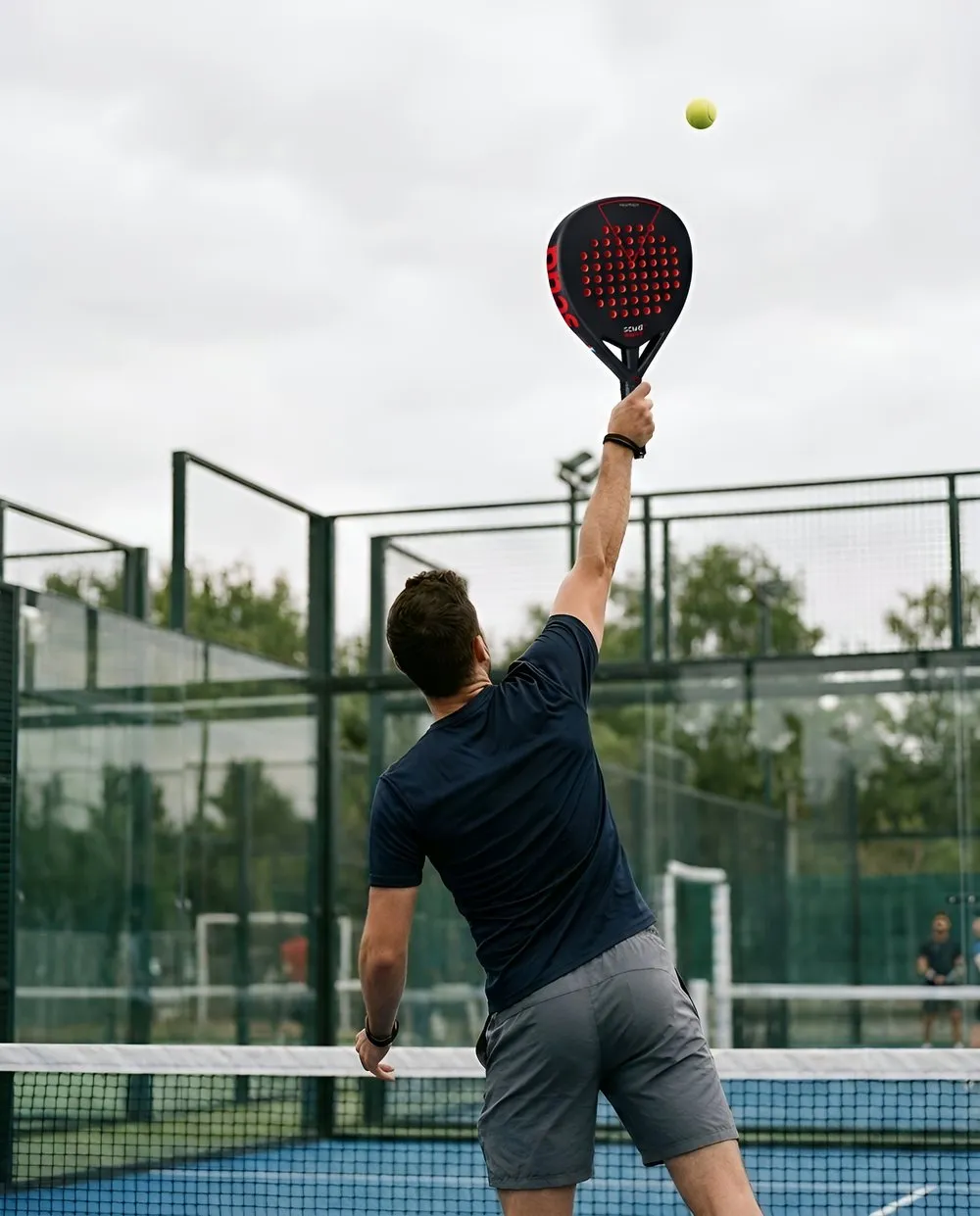
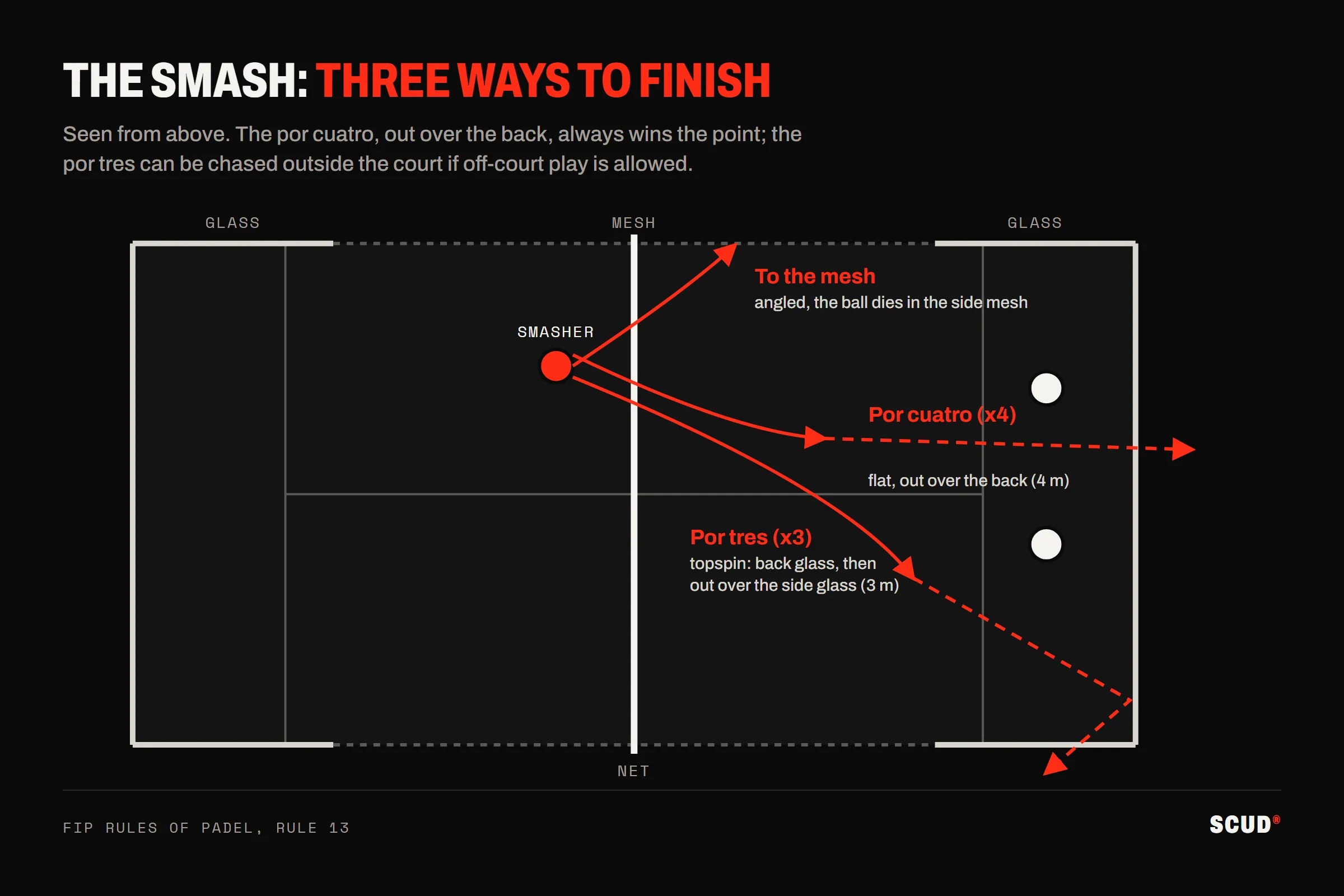
In practice, a right-handed left-side player combines three missions. They take most of the high balls in the centre, because that is where their strong arm is: a bandeja to hold the net, a vibora or smash to finish, up to the por tres or por cuatro smash that sends the ball out of the court, which we detail in our guide to the padel smash. They cover the middle of the court with their forehand, which, according to Padel Addict, lets them come into the centre more naturally than from the right. And they must also be able to defend on the backhand along their glass, something often forgotten when people only talk about their smashes. Where each player stands in these situations is the subject of our article on positioning in padel.
What the left side asks of the racket
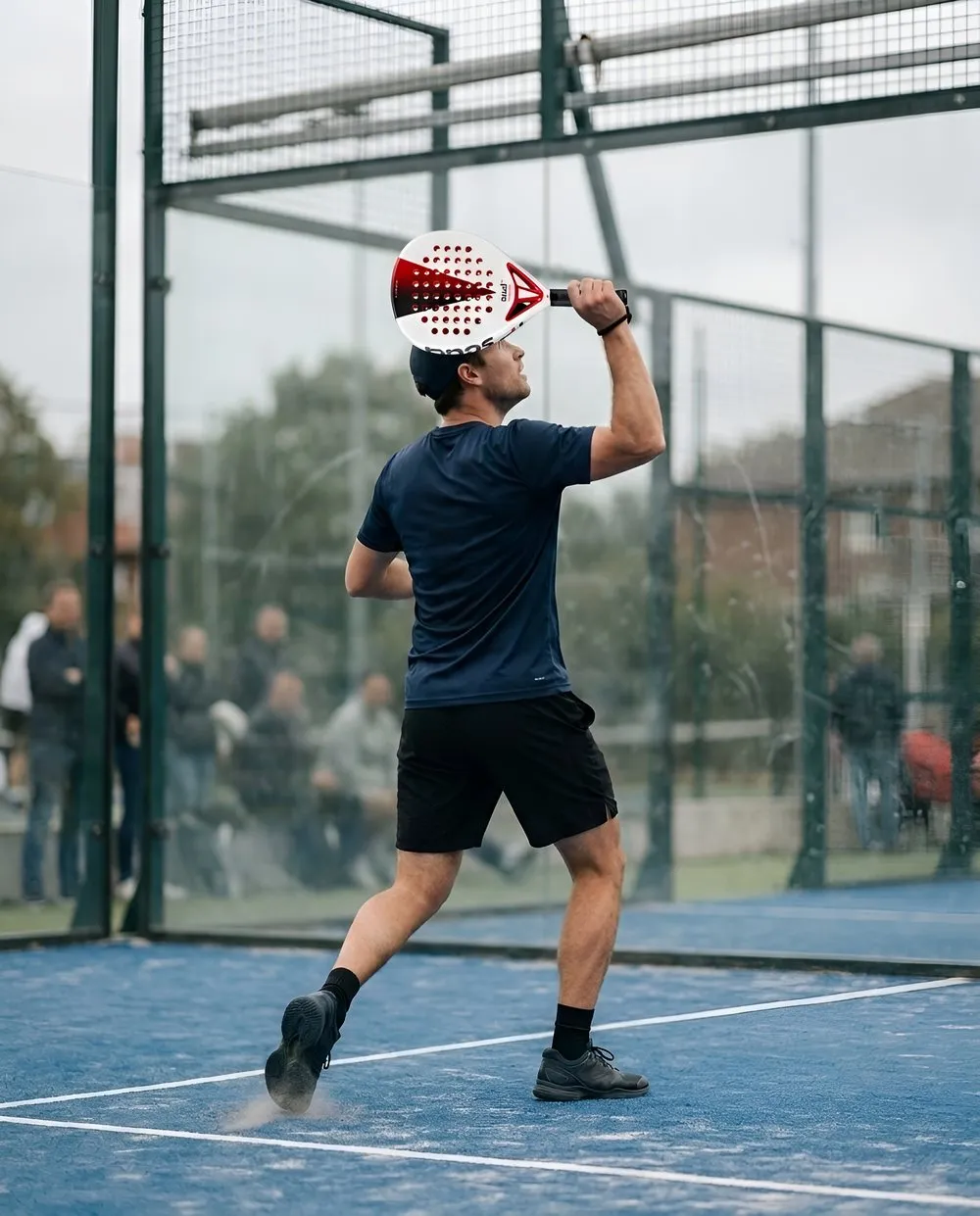
A racket replaces neither positioning nor technique, but it can amplify what the left-side player does most: hitting high balls with arm speed.
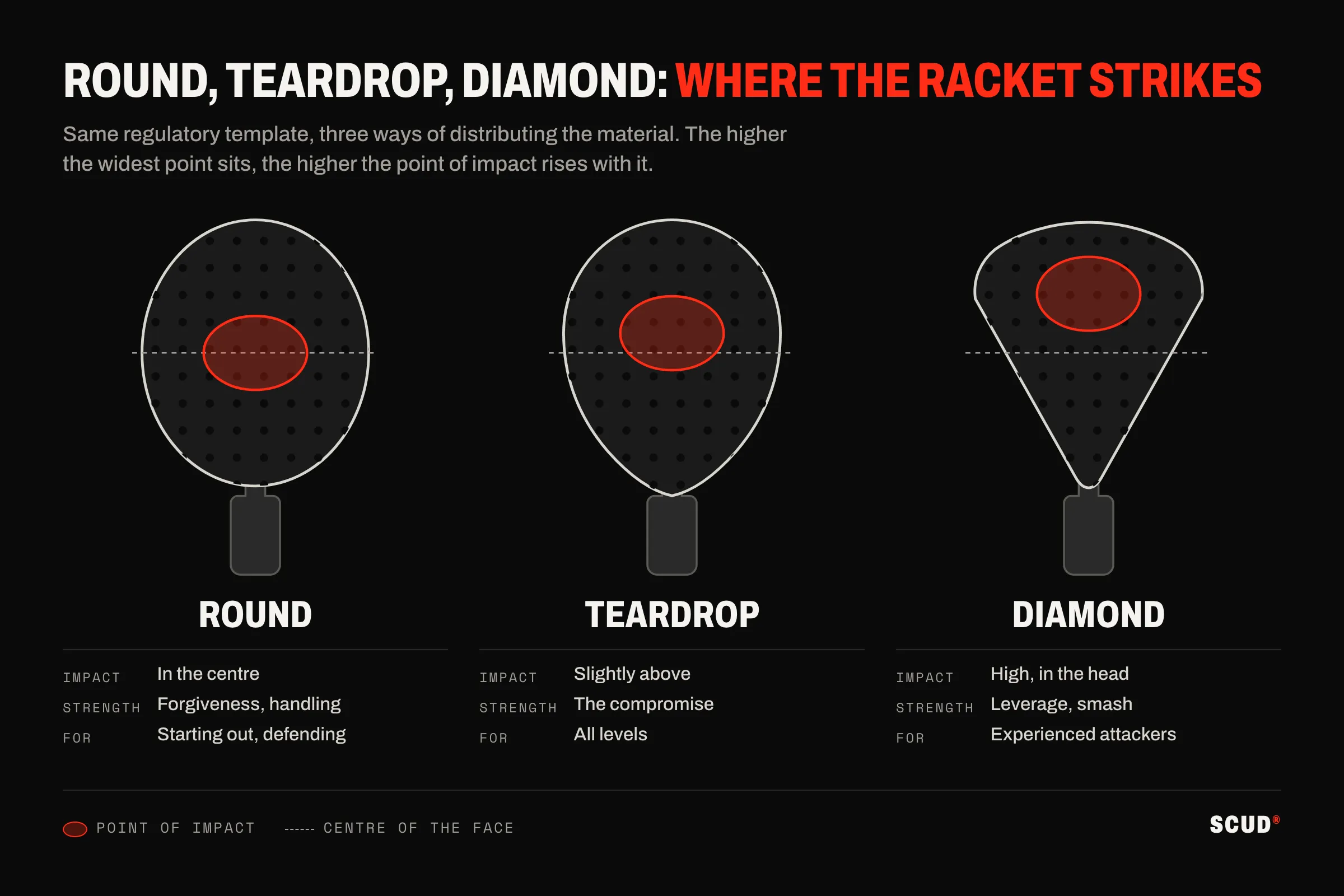
Shape: diamond or pronounced teardrop
The higher the widest point of the face, the further up towards the head the sweet spot and the mass move. The diamond gives maximum leverage on the smash; the pronounced teardrop keeps some of that leverage with a wider sweet spot. We compare the three silhouettes in round, teardrop or diamond shape.
Balance: head-heavy
At equal weight, a head-heavy racket hits harder on high balls and is slower to manoeuvre. It is a good trade-off for the left-side player, who hits more smashes and bandejas, provided their arm can handle that mass far from the hand. How balance works is detailed in weight and balance of a padel racket.
Stiffness: a frame that gives energy back
Stiffer carbon and firmer foam deform less at impact: the ball comes off more directly, provided you hit hard and cleanly. That is the logic of the power or control padel racket: a power racket only gives power to the player who supplies it.
Weight: standard, not heavy
By convention, a racket is called light below 360 g, standard between 360 and 375 g, and heavy above that. The left-side player does not need extra grams: power comes mainly from shape and balance. A racket that is too heavy slows the hand at the net, where they play a large share of their points.
Surface: grip for the vibora and the bandeja
The vibora and the bandeja are played with slice or sidespin. A rough surface grips the ball more for the same swing, as we explain in our article on the rough surface of rackets. It is a plus, not a deal-breaker.
The trade-offs: elbow and manoeuvrability
Each of these settings has its downside. A head-heavy diamond has a higher, smaller sweet spot: off-centre balls vibrate more. A stiff frame sends more shock into the arm. Mass in the head slows reflex volleys, and the left-side player plays a lot of them: nearly one shot in four in the Ramón-Llin study.
The elbow is the first to suffer. In their study on handedness, Javier Courel-Ibáñez and Bernardino Javier Sánchez-Alcaraz recommend conditioning and prevention programmes targeting repeated vibrations at the elbow and wrist on volleys and the fast rotations of the smash, especially for players in the finisher role. If you have already had elbow pain, a more forgiving racket, even on the left, is a sensible choice; our article on tennis elbow and the role of the racket details the settings, and pain that persists is a matter for a health professional.
And the right-side player?
The right-side player builds. Padel Addict describes them as a more patient player, who works the points so that their left-side partner can finish them; their weapons are the cross-court bandeja, the lob, precision on short balls and a good volley. They also play a lot of backhand volleys, since most of the balls they volley come through the centre, on their backhand side when they are right-handed.
Their racket therefore favours manoeuvrability, touch and forgiveness: a teardrop or a more forgiving diamond, medium balance, a slightly softer frame. Padel Point sums up the trend: the right-side player generally prefers control rackets, the left-side player power or all-round rackets.
The case of the left-hander
Which side does a left-hander play?
Most often the right. Padel Addict is categorical: if you are left-handed, you should play on the right, because it is the best way to cover the centre with your right-handed partner. A left-hander on the right indeed has their forehand and smashes towards the centre, exactly like a right-hander on the left. The left-hander/right-hander pair thus has two forehands down the middle, and neither player has their racket stuck against the side glass.
A left-hander on the right can be the finisher
This is where the “left-side player” label is misleading. The study by Courel-Ibáñez and Sánchez-Alcaraz, published in 2018 in the journal Motricidade, observed professional pairs on the 2014 World Padel Tour made up of a right-hander on the left and a left-hander on the right. The left-hander played the finisher role: 63.3% of their winning points came from the smash, against 40.7% for the right-hander, who defended more and played more lobs. The authors note that the pair who stayed at the top of the world rankings for thirteen years relied on this combination.
Padel Addict adds advantages specific to left-handers: the pair becomes more aggressive, either player can take the attacking role, the left-hander’s cross-court por tres smash opens the angle further, and their spin on the bandeja is hard to defend for opponents who are not used to it. In tennis, a study published by the International Tennis Federation points out that around 10% of the population is left-handed and that the left-hander’s advantage depends on their rarity: the more often you face one, the less they surprise you.
Which racket for a left-hander?
As Padel Point reminds us, padel rackets are symmetrical and can be played with either hand: there is no left-handed model. The left-hander chooses according to their role. If they play on the right as the finisher, this guide’s “left-side player” criteria apply to them; if they build and defend, those of the right-side player.
Table: left or right, which criteria?
| Criterion | Left-side player (finisher) | Right-side player (builder) |
|---|---|---|
| Role | Smash, bandeja, vibora, winners | Consistency, lob, cross-court bandeja, defence |
| Shape | Diamond or pronounced teardrop | Teardrop or forgiving diamond |
| Balance | High | Medium |
| Stiffness | Stiffer, direct ball exit | Softer, more touch |
| Weight | Standard, 360 to 375 g | Light to standard |
| Surface | Rough, for the vibora | Rough, for slice and the lob |
| Watch out for | Elbow, reflex volleys | Lack of power on balls to finish |
This table describes tendencies. A very attacking right-side player can play with a diamond, a left-side player who wins through placement may prefer a teardrop: the side is a guide, not a rule.
How to choose according to your level
You are a beginner. The side matters little: you will probably change position several times, and a demanding racket would cost you points. A forgiving racket, round or teardrop, with medium or low balance, will help you progress faster, even on the left. Our guide to the beginner’s racket details these criteria.
You play regularly on the left. Your smash is reliable, you finish some of your points overhead: a forgiving diamond or a pronounced teardrop, head-heavy balance, medium-stiffness carbon, is the right compromise between leverage and sweet spot.
You are experienced or compete. Your technique is stable and your arm conditioned: a high-balance diamond, a stiff frame and firm foam will give you the most direct energy return. We detail this profile in which racket for an advanced or competitive player.
SCUD rackets for the left-side player
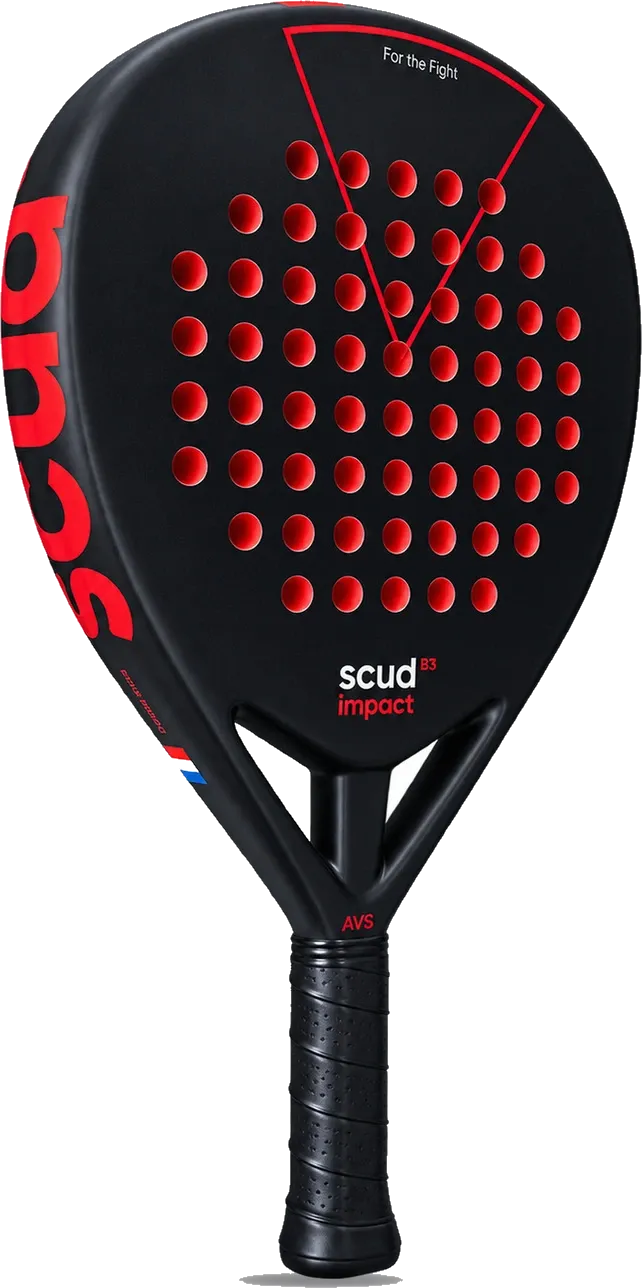
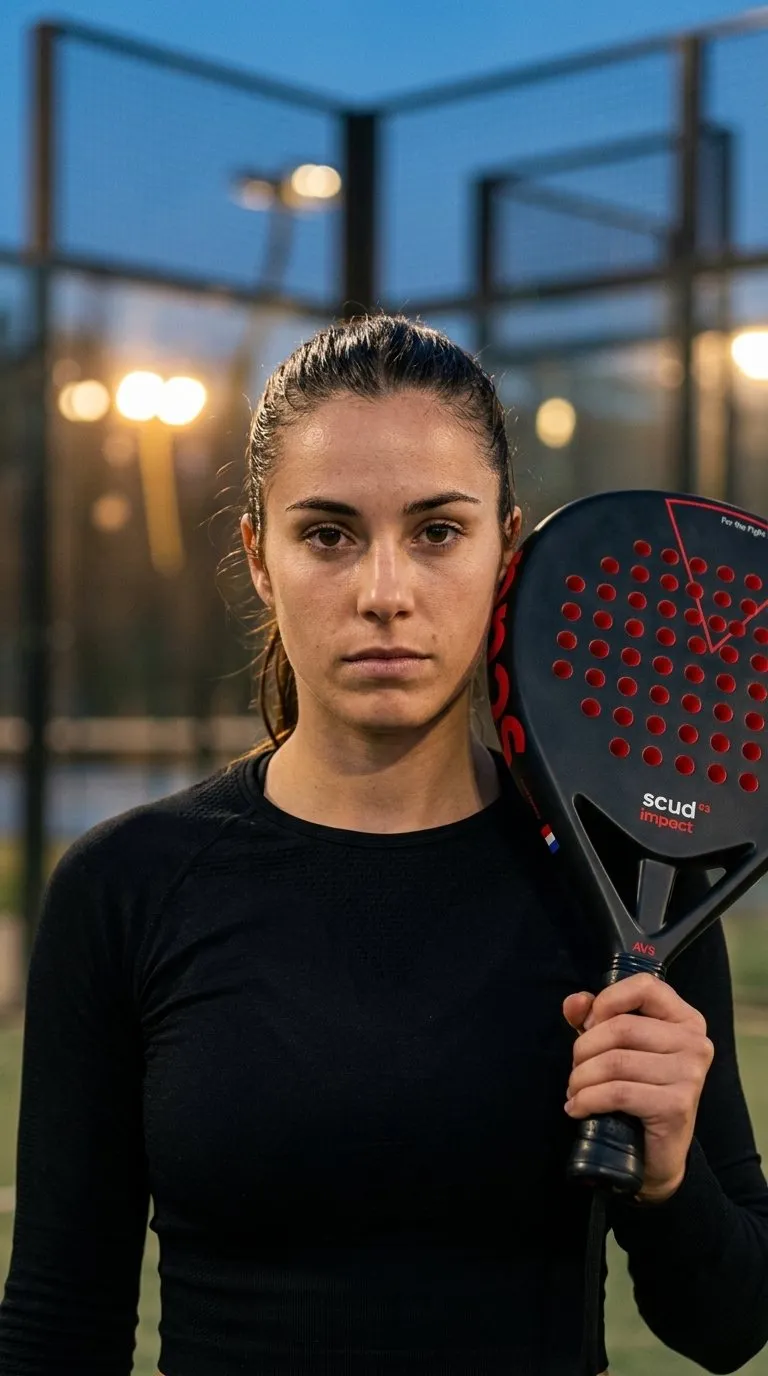
Two of our rackets match the left-side player’s profile. Both are diamond-shaped, with high balance, 365 g, EVA Hard Power foam, hand-applied sanding and the AVS anti-vibration system; they differ only in their shell.
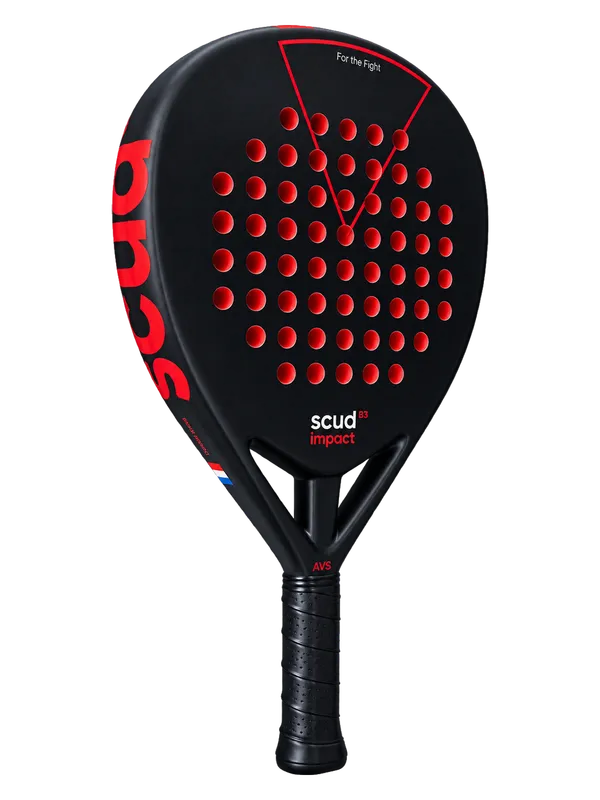
The SCUD Black Impact B3, in 18K carbon, is the most power-oriented in the range: it has the stiffest weave, for the most direct ball exit on the smash. It is aimed at the experienced left-side player who has the arm speed to load it and a healthy elbow.
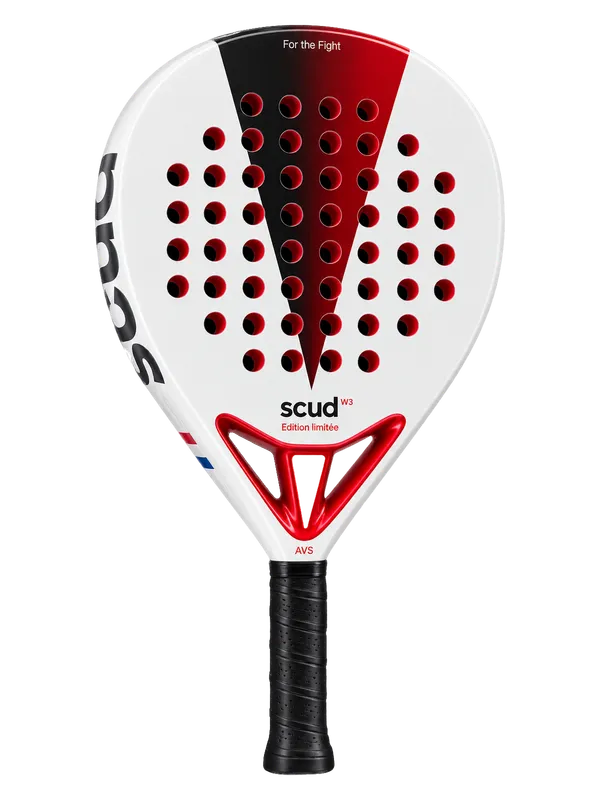
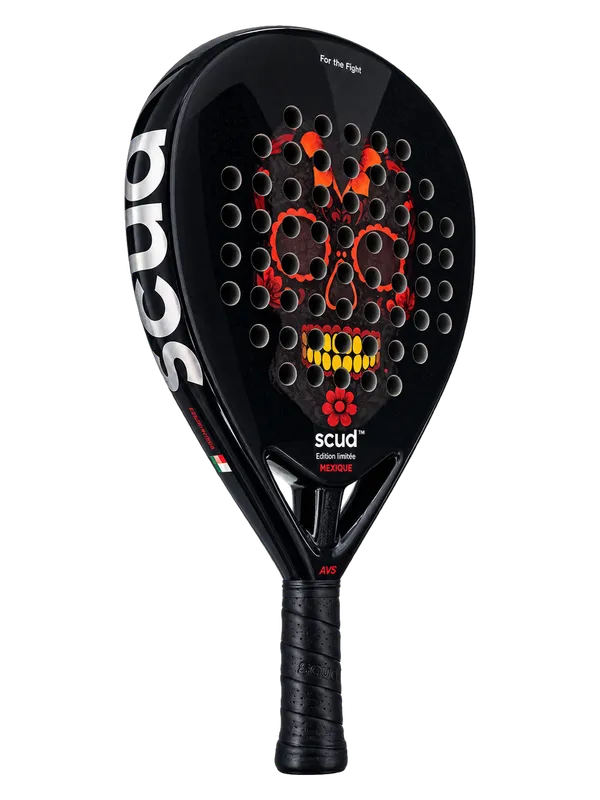
The SCUD White S3, in 12K carbon, keeps the same shape, the same weight and the same balance with more forgiveness and touch. It is the choice of the all-round left-side player who alternates bandeja, vibora and smash, or of the left-hander on the right who both finishes and builds. The SCUD Mexique M1, a high-balance diamond in 12K carbon with firm EVA foam, will join these two models in January 2027.
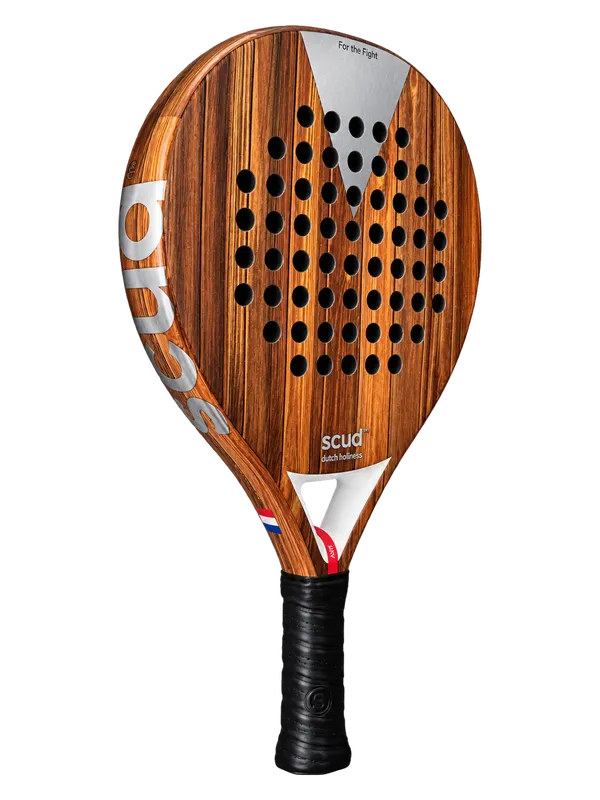
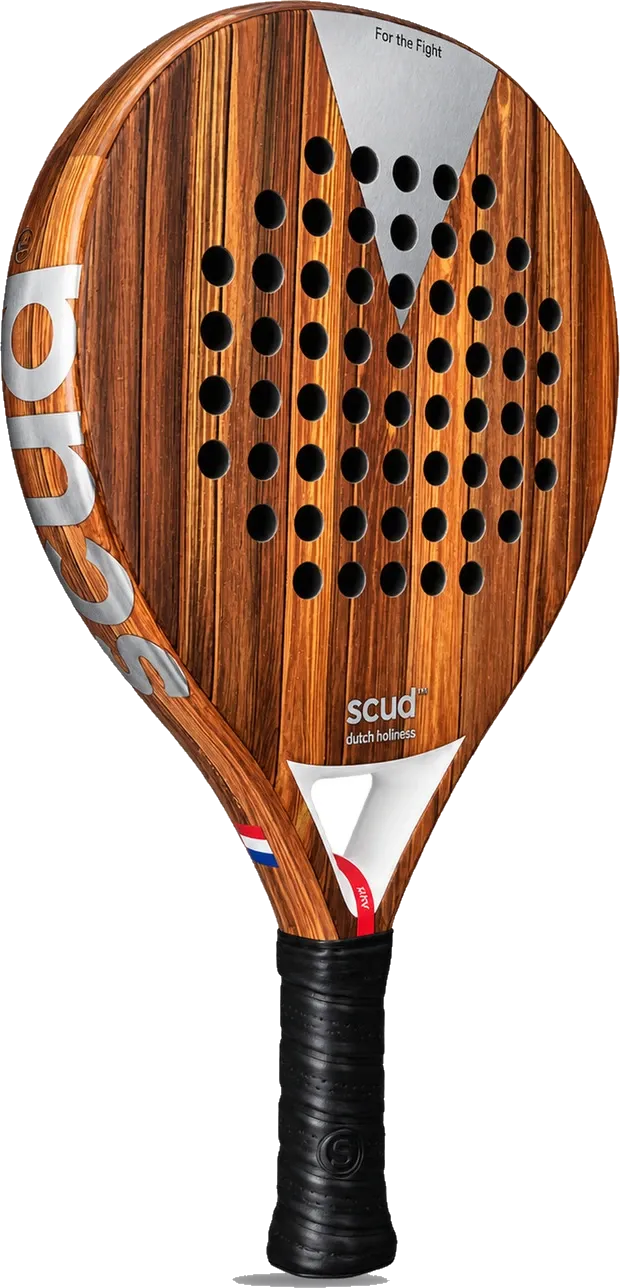
For the right-side player who favours defence and manoeuvrability, the SCUD Wood W1, teardrop-shaped, 350 g with medium balance, is the most forgiving in the range.
Buying mistakes to avoid
- Choosing a professional player’s power model. A stiff, head-heavy racket only gives power to a fast, clean swing.
- Confusing “left side” and “left-handed”. The racket is chosen according to the role, not the hand or the side label.
- Neglecting defence. The left-side player also defends along their glass; a racket that is impossible to play off the glass costs them points.
- Ignoring your elbow. Existing discomfort calls for a more forgiving racket, whatever the side.
- Buying heavier to hit harder. Grams slow the hand at the net; shape and balance provide the leverage.
- Not trying. A spec sheet does not tell you how your arm will react after an hour of smashes.
Try before you choose
The safest option is still to test. Our 30-minute test protocol includes a series of smashes, first at 70% then at full power, and off-centre volleys: two shots that reveal whether a left-side racket suits you. The Black Impact B3 and the White S3 lend themselves well to a side-by-side comparison, since they differ only in their shell. Also note how your elbow feels the next day: it is a criterion in its own right.
In short
- The left-side player is the one who occupies the left half of the court; they are not necessarily left-handed, and a left-hander most often plays on the right.
- In a pair of two right-handers, the left side smashes and wins more points: 6.3% smashes against 3.8% and 5.5% winners against 3.6% in the Ramón-Llin study.
- Their typical racket: diamond or pronounced teardrop, head-heavy balance, fairly stiff frame, standard weight of 360 to 375 g, rough surface.
- These settings come at a cost in manoeuvrability and strain on the elbow: adopt them when your technique and arm can keep up.
- At SCUD, the Black Impact B3 for the experienced finisher, the White S3 for the all-round left-side player.
Frequently asked questions
What is a left-side player in padel?
It is the player who stands on the left half of the court, seen from the back of their own half. They are also called the backhand-side player. In a pair of two right-handers, they have their forehand towards the centre and play most of the high balls: they are often the finisher.
What is the best padel racket for a left-side player in 2026?
There is no single one: the best is the one that matches your level and your arm. For an experienced left-side player, a diamond racket with head-heavy balance and a stiff frame is the benchmark; for an intermediate player, a forgiving diamond or a pronounced teardrop. Always try before you buy.
Should a left-hander play on the left or the right?
Most often on the right. They then have their forehand and smash towards the centre, like a right-hander on the left, and the pair covers the middle with two forehands. In the professional pairs studied, it was actually the left-hander on the right who played the finisher role.
Are there padel rackets for left-handers?
No. Padel rackets are symmetrical and can be played with either hand. A left-hander chooses their racket according to their role in the pair and their level, just like a right-hander.
Is a power racket essential to play on the left?
No. It helps the experienced left-side player finish their points, but a beginner or a player with a fragile elbow will progress better with a forgiving racket. The side is a guide, not a rule.
The side is only one criterion among others: for the full picture, from budget to shape, read our guide how to choose your padel racket.
Sources
- Stroke analysis in padel according to match outcome and game side on court
- The role of hand dominance in padel: performance profiles of professional players
- ¿Cómo elegir lado en pádel?
- Cómo jugar en el drive
- Consejos para jugar con un zurdo
- Différence tactique entre joueur de droite et de gauche au padel
- Preguntas frecuentes: palas de pádel para zurdos
- Ser zurdo en el tenis: aspectos tácticos, de enseñanza y entrenamiento
- Rules of Padel