Padel is one of the easiest racket sports to introduce to a child: the court is small, the ball rebounds off the glass, rallies last, and the underarm serve can be mastered in a single session. The racket, on the other hand, cannot be improvised. An adult racket in the hands of a nine-year-old is too heavy, too slow to manoeuvre and loads a wrist that is not ready. This guide explains what changes for a young player — weight, handle, shape, safety — and when moving up to an adult racket becomes reasonable.
Why an adult racket does not suit a child
The international rules cap the dimensions of a padel racket: 45.5 cm long, 26 cm wide, 38 mm thick at most. Adult rackets use those limits to the full and generally weigh between 340 and 390 g. For an adult, that is a mass that drives through the ball without effort. For a child, it is a lever that is too long at the end of a short arm, with a centre of gravity that leaves them late on every volley.
The consequences show quickly: the racket arrives after the ball, the child compensates by hitting with the wrist rather than the body, and picks up poor technical habits in the very first weeks. They may also feel discomfort in the elbow or shoulder, which is never trivial at that age. A suitable racket is therefore not a whim: it is the condition for learning the stroke properly.
Weight: the first criterion, by far
Rackets designed for children are lighter than adult rackets; depending on the model and the age it targets, they generally weigh well under 350 g, sometimes much less, and are often a little shorter. The right order of magnitude depends above all on the child’s size and strength, more than on their age.
| Young player’s profile | What to aim for | Why |
|---|---|---|
| Child discovering the game, primary-school build | Junior racket, as light as possible, round shape | Manoeuvrability, wide sweet spot, learning the stroke |
| Pre-teen who plays regularly | Light junior racket or adult racket at the bottom of the range, round or teardrop shape | Gradual transition, forgiveness |
| Teenager close to adult size | Light adult racket (around 350 g), teardrop shape, medium balance | Same build as an adult, arm still developing |
A simple test: the child should be able to hold the racket at arm’s length in front of them, horizontally, for about ten seconds without the head drooping. If they shake or compensate by lifting the shoulder, the racket is too heavy.
The handle: no size, but a thickness
Unlike tennis, padel rackets do not come in several handle sizes: the handle is standard. For a child, that raises the question of thickness. A small hand needs a slim handle it can wrap around without effort; a handle that is too thick forces squeezing, tenses the forearm and gets in the way of grip changes.
The solution is simple: do not add an overgrip while the hand is small, and only add one when the teenager finds the handle too thin. Also check the handle length against the hand: the fingers should sit on it without the hand spilling onto the heart of the racket.
Shape: round or teardrop, never diamond
For a young player, the shape of the face is chosen on one criterion alone: forgiveness. A round shape puts the sweet spot in the centre and forgives off-centre balls, which is what most balls hit by a learning child are. A teardrop is the next compromise, once the game takes structure and the first bandejas appear.
The diamond shape, with its mass in the head and small sweet spot, has no place in a child’s hands: it demands an arm speed and technique they do not yet have, and it sends more vibration into the arm. We describe these shapes in our guide on how to choose a padel racket; the principles are the same for an adult, simply stricter for a child.
Safety: three rules to set from day one
Padel is played by four people on a small court surrounded by glass. Three habits protect a child, their partners and the equipment.
- The strap, always on the wrist. It is compulsory in competition and should be in recreational play: a racket that slips out of the hand on a smash ends up in a wall or on a partner. Teach the child to put it on before stepping onto the court, the way you fasten a seatbelt.
- Eyes on the ball, not on the glass. A child discovering returns off the glass tends to turn towards the wall and back up without looking. Explain that they need to anticipate the rebound and stay facing the play.
- No racket left lying on the floor. A racket left on the court is an obstacle for the other players. It goes against the glass, outside the court.
Some clubs also recommend protective glasses for the youngest players; ask the padel school. And elbow or shoulder discomfort that comes back at every session deserves medical advice, not a change of overgrip.
When to move up to an adult racket
There is no fixed age: build decides. Once a teenager reaches a height and strength close to an adult’s, a junior racket becomes limiting — too light to stabilise the volley, too short for high balls. That is the time to move to an adult racket, starting at the bottom of the weight range and with a forgiving shape.
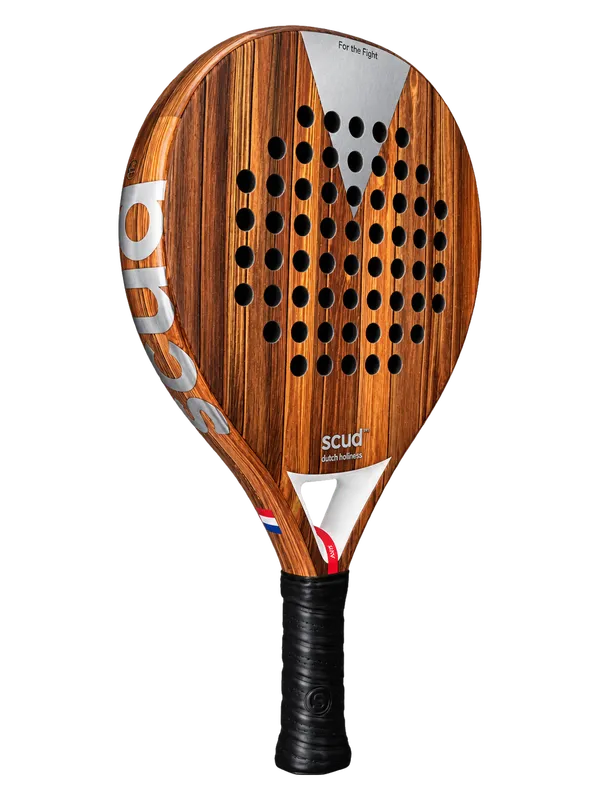
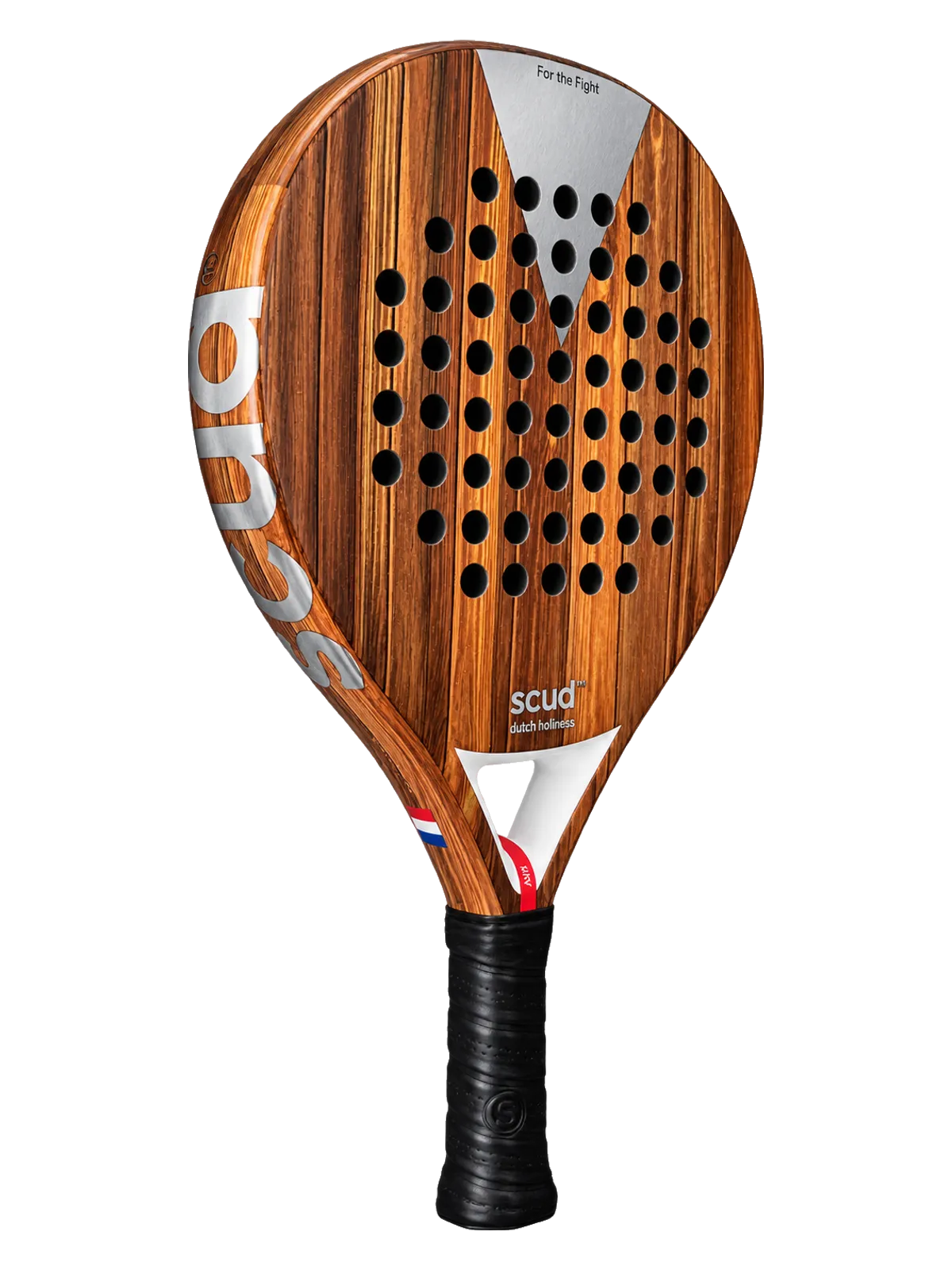
We do not offer a junior racket. However, the lightest and most forgiving racket in our range suits precisely this stage: the SCUD Wood S1 weighs 350 g, has a teardrop shape with medium balance, combines 12K carbon and fibreglass with soft EVA foam, and includes the AVS anti-vibration system that filters shocks before they travel up the arm. It is a racket with which a teenager learns to build the point, and which they will not have to replace as soon as they improve. The other models in the control collection come later, once their game is established.
For a teenager receiving their first adult racket as a present, our guide on giving a padel racket details the 30-day return rules, useful if the weight turns out not to suit. And our free guide to choosing a racket goes through all the criteria, to read together.
In short
- An adult racket is too heavy and too long for a child: it distorts the stroke and tires the arm.
- Weight is the first criterion; the outstretched-arm test quickly tells whether a racket suits.
- The handle is standard: no overgrip while the hand is small.
- Round or teardrop shape, never diamond, for a wide, forgiving sweet spot.
- Strap on the wrist every time they step on court; move to adult when the build gets close, starting light.
Frequently asked questions
From what age can a child play padel?
As soon as they can hold a light racket and follow a ball: padel schools often welcome children from primary-school age. The rule is to start with a racket suited to their build, not their age.
Is there a specific racket for girls or boys?
No. Only weight, balance and forgiveness matter, and they depend on the child’s size and strength.
Can my teenager play with my racket?
If their build is close to yours and your racket is forgiving, to try the game, yes. To play regularly, a light racket with a round or teardrop shape remains preferable to a diamond.
Is the wrist strap really compulsory?
In competition, yes. In recreational play it should be a reflex: it is the simplest protection against a racket flying into a wall or a partner.
Which SCUD racket for a teenager?
The Wood S1: 350 g, teardrop shape, soft EVA foam and the AVS system, the most forgiving in the range. It takes a young player from the move to adult size through to an established game.
A well-equipped young player keeps the joy of the game and a clean technique: when the time for the first adult racket comes, our range is ready.