Testing a padel racket seriously requires neither a full match nor a laboratory: thirty well-organised minutes are enough, provided you know what to hit, in what order, and the traps that distort judgement. Most failed tests fail for a simple reason: you hit three smashes, find the racket “powerful”, and forget to check what really matters, forgiveness on average balls and comfort in the twentieth minute. Here is a protocol we apply ourselves when we compare prototypes.
Before you start: setting up the test
Three conditions make a test usable.
New or nearly new balls. Dead balls bounce less and blur the rebound differences between two rackets. Open a tube for the occasion.
A consistent partner. The test compares rackets, not opponents. Ask a partner to play at a steady pace, feeding you the same balls, rather than playing points.
A reference point. Bring your current racket. Without it you have nothing to compare against, and every new racket feels better than the memory of the old one.
Also check that the racket being tested is in good condition: a demo model with compacted foam will tell you nothing about the new one.
The protocol minute by minute
| Minutes | Sequence | What you observe |
|---|---|---|
| 0 to 5 | Warm-up, baseline rallies at half pace | Grip in hand, perceived weight, first contact |
| 5 to 10 | Volleys at the net, balls fed to the body and to the sides | Manoeuvrability, hand speed, forgiveness |
| 10 to 15 | Bandejas and viboras from the net zone | Slice, depth control |
| 15 to 20 | Smashes, first at 70% then at full power | Rebound, stability, vibrations |
| 20 to 25 | Glass exits and baseline defence | Touch, behaviour on soft balls |
| 25 to 30 | Drop shots, sliced serves, then free rallies | Surface grip, overall feel |
This order is not arbitrary: the demanding shots come when the arm is warm, and the touch shots at the end, when fatigue starts to reveal the racket’s real comfort.
The shots that reveal a racket
The off-centre volley
This is the most useful and most neglected test. Ask your partner to feed you fast balls at the body, on the volley, without giving you time to set up. A forgiving racket returns a decent ball even when contact is three centimetres off centre. A demanding racket makes you pay with a soft ball and a vibration in the forearm.
The 70% smash
The full-power smash flatters every racket. The held-back smash, the one you play to place rather than to kill, reveals whether the racket lets you measure. If you cannot control depth at 70%, you will not control it in a match.
The bandeja
The bandeja demands spin, depth control and stability on a ball taken high. It is the shot where the racket’s balance is felt most: a head-heavy balance helps you drive through the ball, a medium balance helps you place it.
The glass exit
On a ball coming slowly off the glass, the racket must give you time and touch. A very stiff shell on hard foam makes this shot dry and hard to measure; a softer shell follows the ball. We detail this difference in 12K or 18K carbon.
Comparing two models without fooling yourself
The brain is poor at comparing two sensations twenty minutes apart. To compare two rackets, alternate them on the same sequence: five volleys with one, five volleys with the other, then five bandejas with each. Note immediately, on three simple criteria, with a score from 1 to 5: forgiveness, control, comfort.
Always finish by going back to your current racket. If it suddenly feels soft or heavy, you have learned something. If it feels just as good, the racket you tested may not bring what you are looking for.
The biases that distort judgement
- The novelty effect. Every new racket, grain intact and foam fresh, feels better than a two-season-old one. Compare sensations, not condition.
- The smash bias. Three winning smashes do not make a good racket. Padel is played 90% on average balls.
- The price and looks bias. A racket you find beautiful, or know to be expensive, seems to play better. Write down your criteria before you look at the face.
- Fatigue. A racket tested at the end of a session always feels heavier. Test fresh, or test both models in the same state of fatigue.
- The partner who changes pace. If the balls you receive are not comparable, neither are the sensations.
What a test will not tell you
Thirty minutes reveal neither a racket’s lifespan, nor its behaviour in cold weather, nor how your elbow will react after ten sessions. For those questions you have to rely on the construction: the quality of the foam, the presence of an anti-vibration system, the surface finish. That is what a well-written spec sheet describes, and it is why we state for every model the weave, the core, the shape, the weight and the balance.
Applying the protocol to SCUD rackets
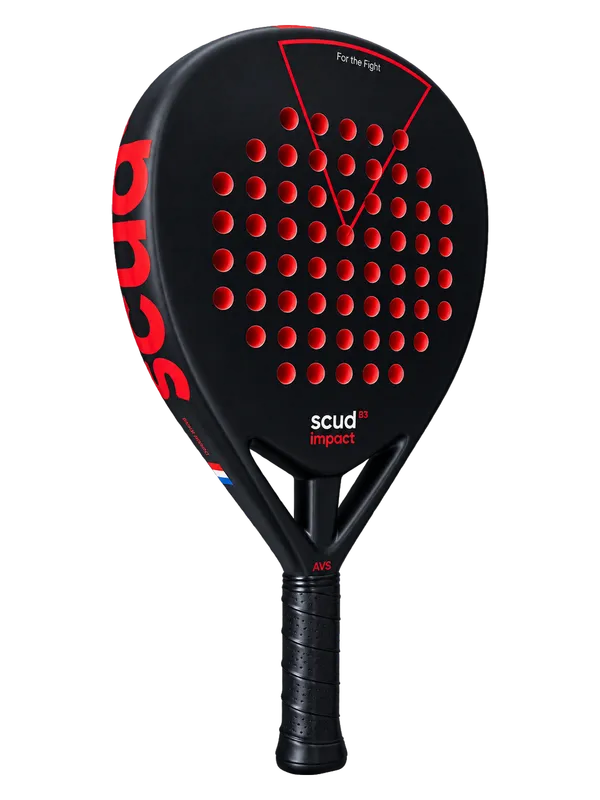
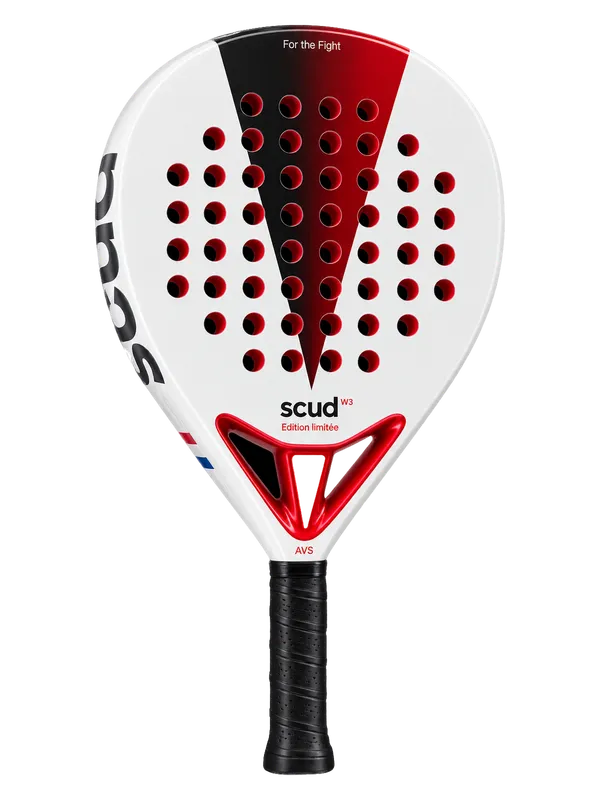
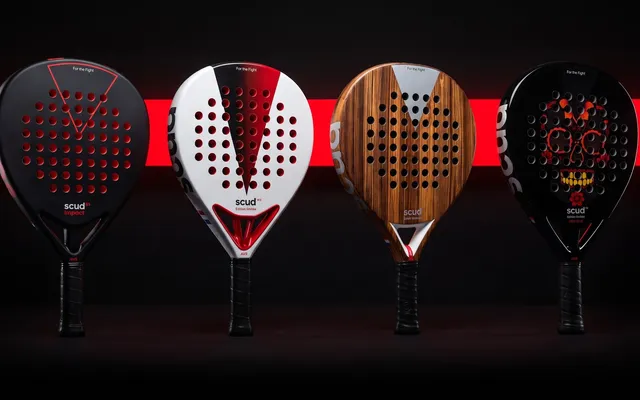
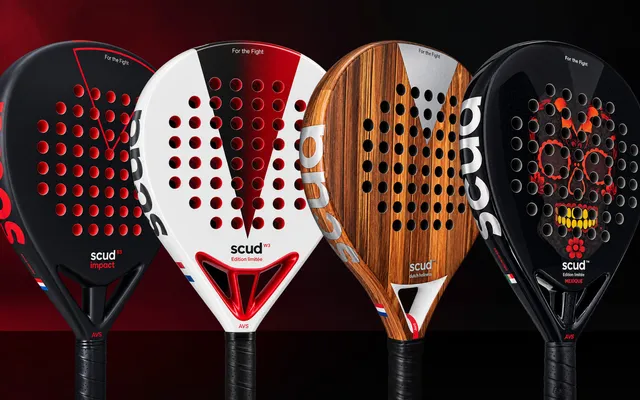
Two of our models lend themselves well to a side-by-side comparison, because they share the diamond shape, the 365 g, the head-heavy balance and the Hard Power EVA foam, and differ only in the shell. The SCUD Black Impact B3, in 18K carbon, gives the driest rebound: it is on the 70% smash and the off-centre volley that you will find out whether your arm can use it. The SCUD White S3, in 12K carbon, shows its worth on the bandeja and the glass exit, where its longer touch makes the difference. The full comparison is on the padel rackets page.
If you cannot try before buying, you have 30 days to change your mind after delivery, provided you return the racket in a condition that allows resale: a simple try-out is accepted, marks from extended play are not. The details are on the shipping and returns page.
In short
- Set up the test: new balls, a consistent partner, your current racket as reference.
- Follow a fixed sequence: rallies, volleys, bandejas, smashes, glass, drop shots.
- The most revealing shots are the off-centre volley, the held-back smash and the glass exit.
- Compare two models by alternating them on the same sequence, and take notes straight away.
- Beware of the novelty effect and the smash bias.
Frequently asked questions
Can you judge a racket in ten minutes?
You can form a first impression, but not a reliable judgement: comfort and forgiveness show themselves when the arm tires, rarely in the first ten minutes.
Should you test with your own balls?
Yes, or at least with identical new balls for every racket compared. A worn ball erases rebound differences.
How do you test a racket without a partner?
A wall or a glass panel lets you test grip, weight and touch, but not forgiveness on fast balls or overhead shots. The test remains partial.
What if two models seem equivalent?
Choose the one that felt most comfortable in the twenty-fifth minute. All else being equal, comfort decides over a season.
Before the test, our free guide to choosing your racket helps you define what you are looking for; afterwards, our models are waiting with their full spec sheets.