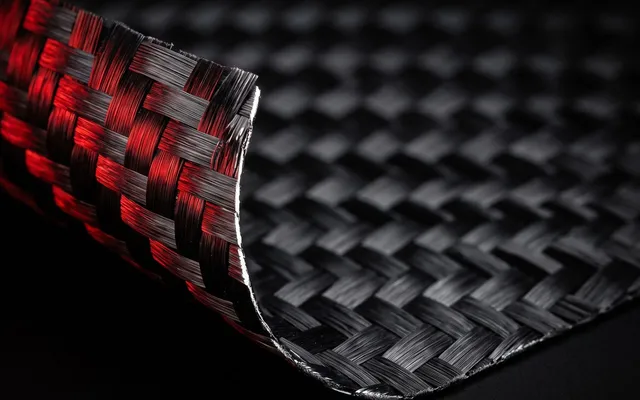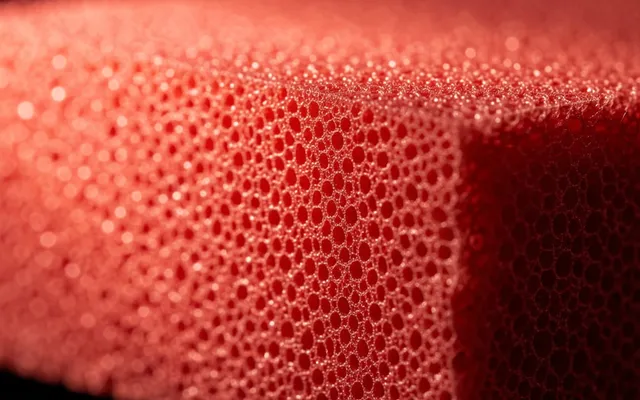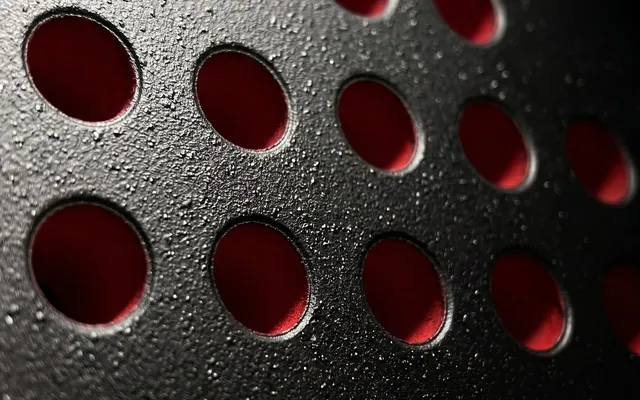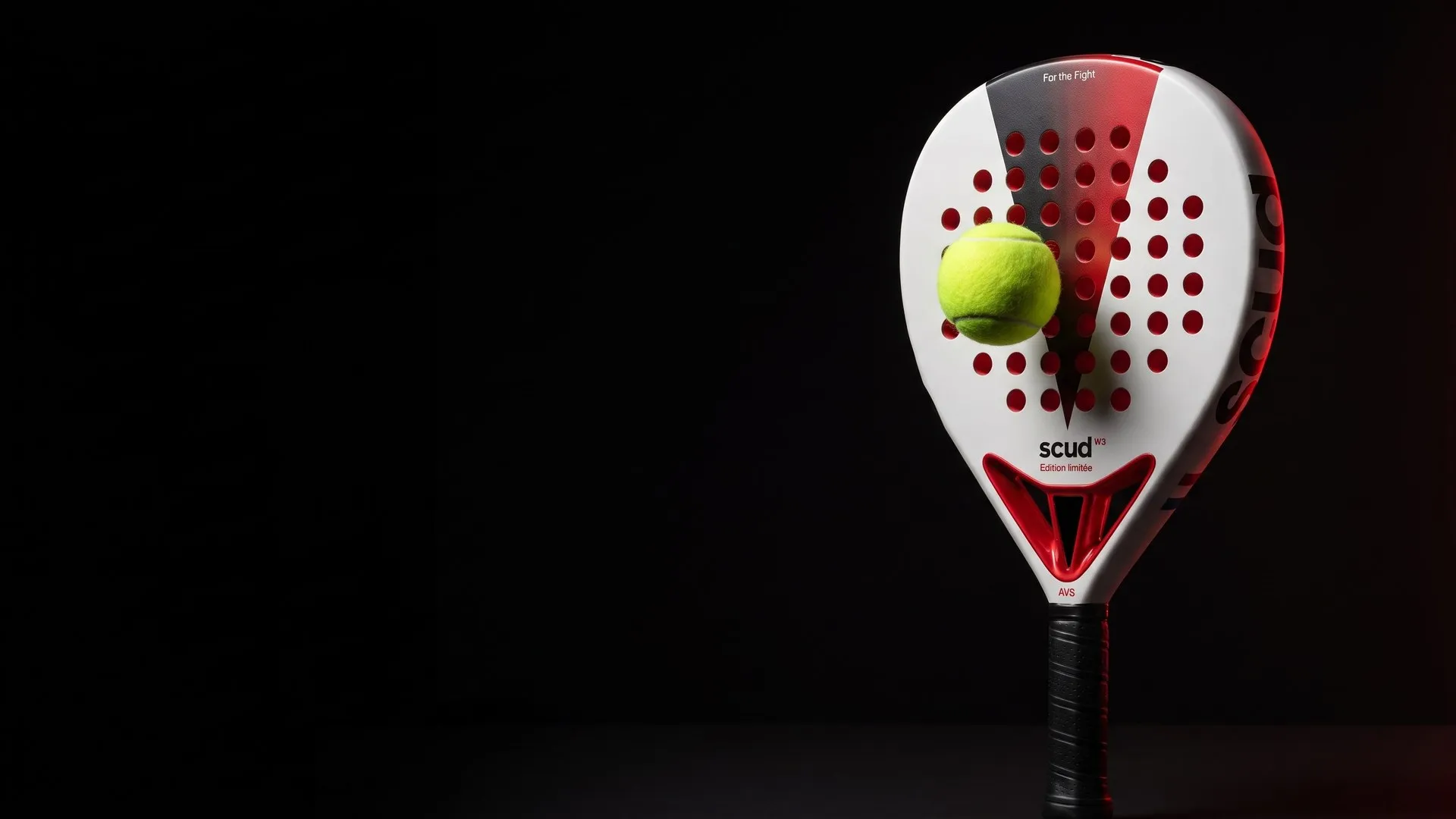
A rough hitting surface increases the friction between the ball’s felt and the face, and therefore the amount of spin you can generate. So far, everyone agrees. What is open to debate is how that roughness is obtained: bonded sand grain, three-dimensional moulded texture or paint loaded with particles. Each method has its own signature at impact, its own wear rate and its own manufacturing cost. This article compares the three, explains what the rules say and helps you work out which surface suits your game.
Why roughness creates spin
At the moment of impact, a padel ball flattens against the face for a few milliseconds. If your racket is moving at an angle, the ball slides along the surface. On a smooth face, that sliding is free and the resulting rotation stays low. On a rough face, the ball’s periphery is braked while its centre keeps moving forward: that differential sets it spinning.
Spin is therefore not just a matter of wrist. It is first a matter of available friction. We described those few milliseconds in detail in our article on hand sandblasting; here, we focus on the different ways of producing that grip.
Three ways to obtain a rough surface
Sandblasting
Abrasive crystals, most often silica, are fixed in the surface varnish. The grain is fine, dense and irregular, which gives a very even grip across the whole face. Sandblasting can be done by machine, with a calibrated grain identical from one piece to the next, or by hand, piece by piece, as we do at SCUD.
Moulded 3D texture
The texture is engraved directly into the mould: when the racket comes out, its face carries a raised pattern (chevrons, diamonds, ridges, honeycomb). Because the texture is part of the shell, it cannot tear off and resists wear very well. In return, the relief is coarser than a grain of sand and the grip is more directional: it depends on how the pattern is oriented relative to the racket’s movement.
Textured paint
A layer of paint or varnish containing particles is applied to the face. It is the quickest and cheapest method, and the one that wears fastest: the particles are held by the paint layer alone, which erodes at every contact with felt and court sand.
Comparing the three surfaces
| Sandblasting | Moulded 3D texture | Textured paint | |
|---|---|---|---|
| Grain fineness | Fine and dense | Coarse, patterned | Variable |
| Grip | Strong and uniform | Medium, directional | Medium to strong at first |
| Durability | Good, softens gradually | Very good | Low |
| Effect on ball exit | Slightly slowed | Little effect | Slightly slowed |
| Manufacturing cost | Medium to high | High (tooling) | Low |
| Appearance | Matt, uniform | Visible pattern | Depends on paint |
No single row in this table settles the question. A player who lives on drop shots and sliced serves will want the finest, grippiest grain possible; a player who hits flat and hard will be happy with a subtler relief that does not slow the ball exit.
What the rules allow
The International Padel Federation rules, available on padelfip.com, state that the hitting surface may be smooth or rough. They set no numerical roughness limit, unlike other racket sports such as pickleball, whose rules define a maximum measured roughness. Padel therefore leaves manufacturers almost complete freedom on this point.
What the rules do regulate are the frame dimensions, the perforations and the safety cord. We detail them in our guide to regulation padel racket dimensions. In short: you can play a sandblasted racket in competition without the slightest concern, provided it respects the size limits and carries its cord.
Roughness and lifespan
Every rough surface wears. The ball’s felt, the court sand and contact with the fence erode the relief session after session. A sandblasted grain softens gradually; a textured paint can become smooth within a few months of intensive play; a moulded relief lasts much longer, because it is part of the shell.
It is important to distinguish this surface wear from the end of the racket’s life. A face that has lost its grip is still a perfectly functional racket: it simply gives less spin. It is foam compaction and frame cracks that mark a true end of life, as we explain in when to change your padel racket.
Three habits extend the grip of any rough surface:
- wipe the face after every session with a slightly damp microfibre cloth, to remove the sand that acts as an abrasive;
- never pick up balls by scraping the floor with the racket face;
- avoid the heat of a car boot, which attacks the varnish before anything else.
SCUD’s choice: grain, applied by hand
All our rackets receive a hand-applied sandblast: the silica crystals are spread by hand over each face, piece by piece, rather than sprayed by a machine set once and for all. We made this choice for the fineness and uniformity of grip it provides, and we accept its consequence: it is slower, it cannot be industrialised, and no two rackets come out exactly alike.
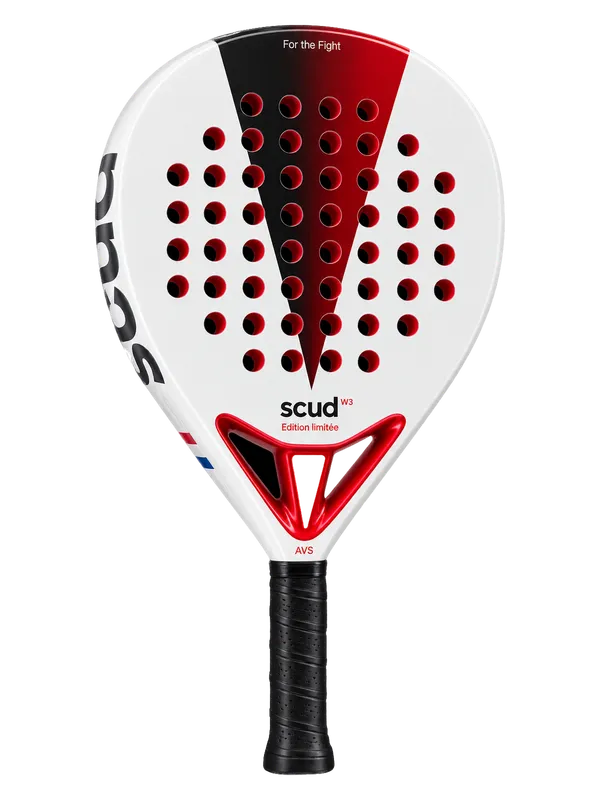
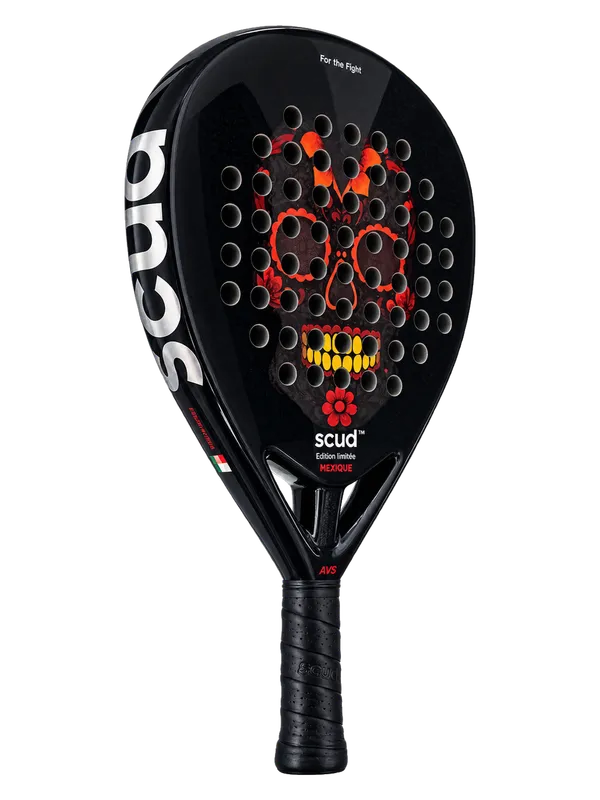
This grain particularly serves models built for control and variation. On the SCUD White S3, 12K carbon and Hard Power EVA foam, it provides the grip needed to place drop shots and glass exits with precision. On the SCUD Mexique M1, 12K carbon and firm EVA, available from January 2027, it brings a fine, even grip across the whole surface in the service of responsiveness. You will find both, and the rest of the range, in our control collection and on the all rackets page.
In short
- Roughness increases friction, and therefore spin: it is what makes the ball bite on a slice.
- Three methods exist: sandblasting (fine grain, strong grip), moulded 3D texture (durable, more directional), textured paint (cheap, wears quickly).
- FIP rules allow both smooth and rough surfaces, with no numerical limit.
- A surface that softens is not a dead racket: the foam and the frame decide when a racket is finished.
- At SCUD, the sandblast is applied by hand on every face.
Frequently asked questions
Does a rough surface cost you power?
Very slightly: the ball is braked at its periphery, which slows the exit a little. On a flat smash the difference is marginal; on a slice, the extra spin more than makes up for it.
Can you make a smooth racket rough?
Some players apply textured sprays or varnishes. We advise against it: the result is uneven, wears off within weeks and can damage the original varnish. Better to choose the right surface when you buy.
Is 3D texture allowed in competition?
Yes. The rules forbid no surface texture, provided the racket respects the maximum dimensions and carries nothing that could cause injury.
How long does a sandblast keep its grip?
It depends on how much you play and how you care for the racket. A regular player feels the grain soften over the months, without the racket losing its hitting qualities.
If you are still unsure which surface suits your game, our free guide to choosing your racket helps you narrow it down before comparing our models.