There are two ways to buy a padel racket. The first is to pick the one that catches your eye, take it out of the box one Saturday morning and hope for the best. The second takes twenty minutes of reading beforehand and saves you two seasons of ill-suited gear, balls flying long and an elbow that aches in the third set. This guide covers the second. It does not champion any particular model: it explains the grammar shared by every padel racket, so that you can then read any spec sheet — including ours.
A very tight rulebook
Before comparing anything, you should know that every approved padel racket lives inside a tiny box. The International Padel Federation rules set a maximum length of 45.5 cm, a maximum width of 26 cm and a maximum thickness of 38 mm. The face must be perforated, and a wrist strap is mandatory in competition.
The direct consequence: two rackets from different brands have, give or take a few millimetres, the same external dimensions. What sets them apart is therefore never the size, but how the material is distributed inside that template. That is exactly what the four parameters below describe.
Face shape
The silhouette of the face determines where the ideal point of impact sits — the famous sweet spot — and how much mass is in the upper part of the racket.
Round shape
The sweet spot is wide and centred, roughly in the middle of the face. It is the most forgiving shape: a ball struck slightly off-centre still comes off well. It needs little arm speed to be effective, protects the joint and forgives timing errors. It is the default choice when you are starting out, when you play once or twice a week, or when you value consistency over power.
Teardrop shape
The most widespread compromise. The sweet spot moves slightly up the face, and so does the mass. You gain acceleration on high shots — bandeja, víbora, smash — without losing all the forgiveness of the round shape. It is the all-round shape par excellence, the one that suits the intermediate player who is starting to come to the net and build points.
Diamond shape
The sweet spot is high and small. All the mass is pushed towards the head, which produces considerable leverage at the moment of the smash. In return, the racket is less forgiving: a poorly centred ball comes off noticeably worse, and the arm takes more punishment. It is a shape for attacking players, with good arm speed and already clean technique.
Weight
A padel racket generally weighs between 340 and 390 g. The range is narrow, but the difference is felt immediately.
A light racket (around 350-360 g) is quicker to handle, protects the wrist and shoulder, and suits players who defend a lot or string together fast exchanges at the net. A heavier racket (above 370 g) drives through the ball better, absorbs opponents’ shots better and delivers power without forcing — provided you have the arm to carry it for two hours.
The useful reflex: start at the bottom of the range if you play little, if you are prone to tendinitis or if you come from a sport without a racket. Move up in weight only when your technique is stable.
Balance
Balance describes where the centre of gravity sits, measured from the bottom of the handle.
- Low balance. The mass is close to the hand. Very manoeuvrable racket, ideal for volleys and reflexes at the net, undemanding on the joint. The racket feels “light” even at equal weight.
- Medium balance. The middle ground between manoeuvrability and power. The neutral setting, which suits the vast majority of players.
- Head-heavy balance. The mass is in the head. Maximum leverage on the smash, but less hand speed and more strain on the arm.
Weight and balance offset each other: a 370 g racket with low balance is often easier to handle than a 360 g racket with head-heavy balance. Never judge one without the other.
The core
Beneath the face sits a foam, almost always EVA, whose density changes everything.
A soft EVA deforms more at impact: the ball stays on the face longer, the touch is comfortable, the ball comes off more slowly. A hard EVA barely deforms: the rebound is crisp, fast, more powerful, but it demands a clean strike and tires the arm more. Medium EVA sits in between and suits most players.
Temperature plays a part too: in cold weather, every foam stiffens. A racket that feels pleasant in July can feel brittle in January.
The frame and the fibres
The carbon weave is stated in “K”, which corresponds to the number of thousands of filaments per tow. The denser the weave, the stiffer the frame and the more direct the rebound. A fibreglass racket will be softer and more forgiving, a 12K carbon racket will offer a good compromise between touch and reactivity, an 18K carbon racket will deliver the crispest and most powerful response. This point deserves an article of its own: we wrote it in 12K or 18K carbon: what difference does it make on court?.
Summary
| Player profile | Shape | Weight | Balance | Core |
|---|---|---|---|---|
| Beginner, one session a week | Round | 350-365 g | Low | Soft to medium |
| All-round intermediate | Teardrop | 360-375 g | Medium | Medium |
| Attacking, good arm speed | Diamond | 370-385 g | Head-heavy | Medium to hard |
| Defender, placement game | Round or teardrop | 355-370 g | Low to medium | Soft to medium |
And in practice, at SCUD?
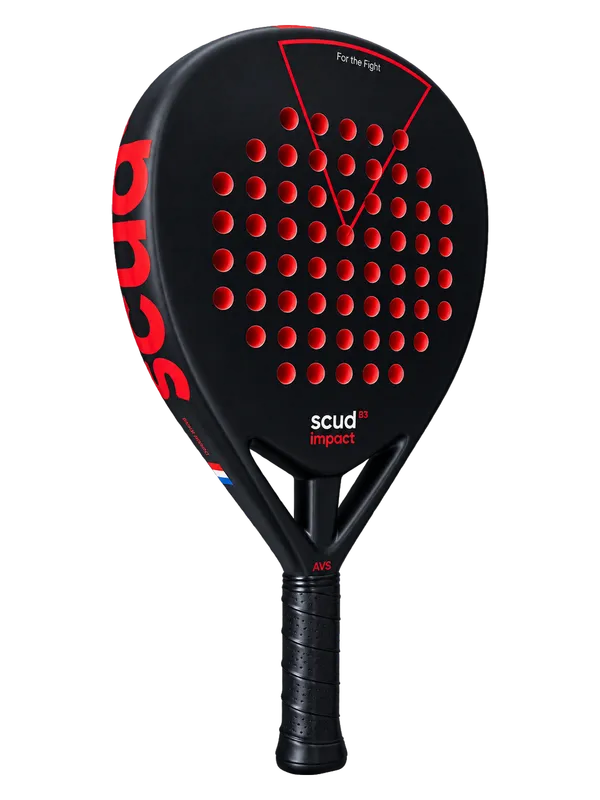
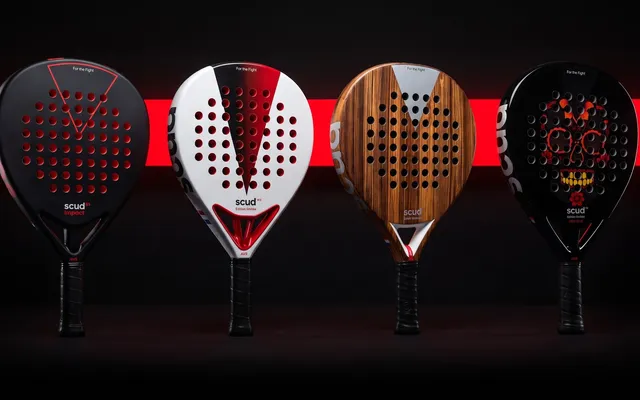
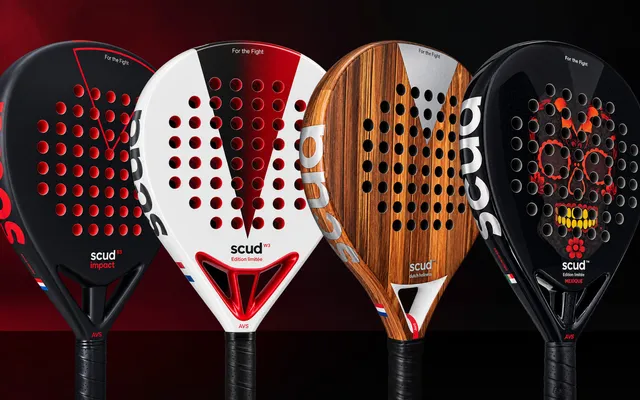
Our models are limited editions finished by hand, but they are not aimed at the same game. The SCUD Black Impact B3 is our most attacking racket: 18K carbon shell, EVA Hard Power foam, diamond shape, 365 g with head-heavy balance, AVS anti-vibration system, designed in France. It is the racket you pick up when you want to hit hard and finish the point.
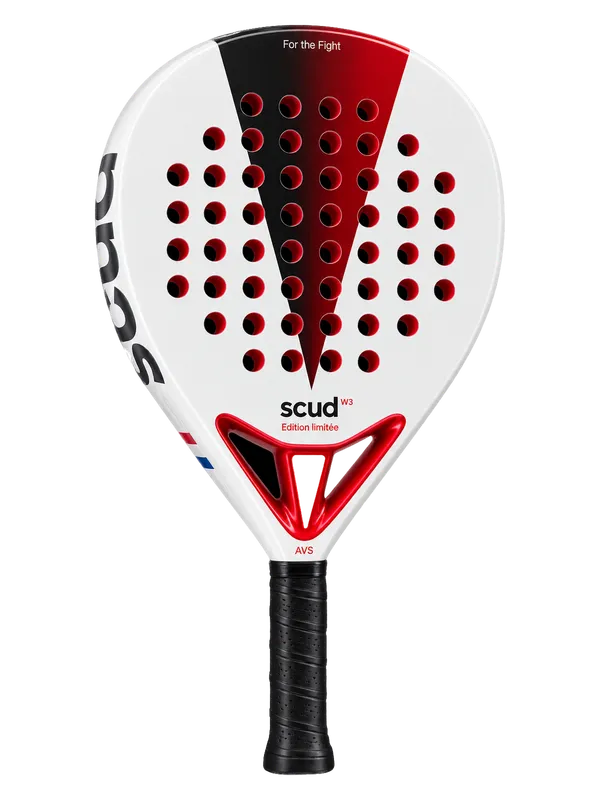
At the other end, the SCUD White S3 is our control reference: more forgiving 12K carbon under the hand, EVA Hard Power foam, hand-applied sanding, designed in Paris. It favours touch, off-the-glass shots and building the point before accelerating.
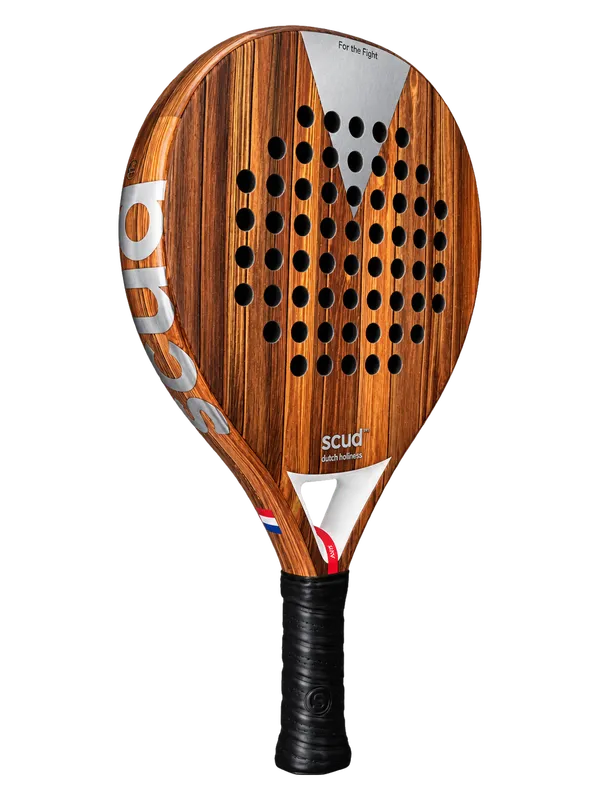
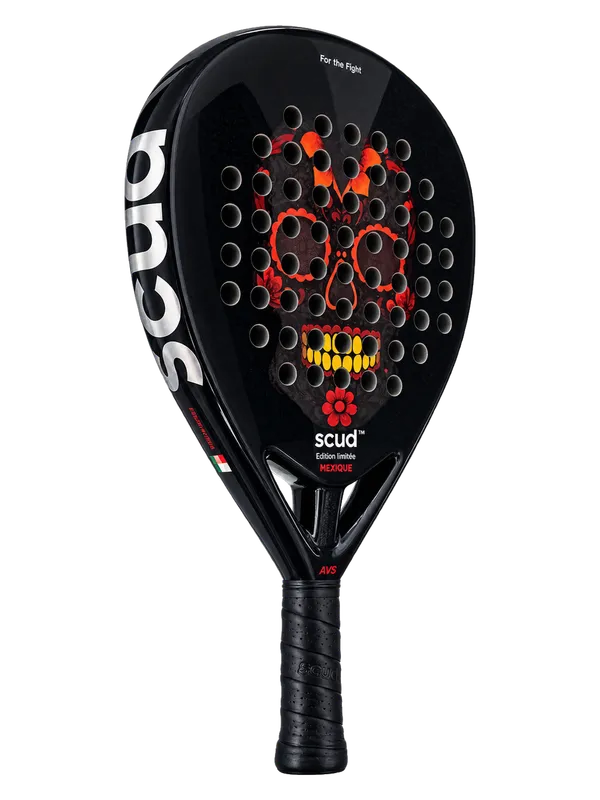
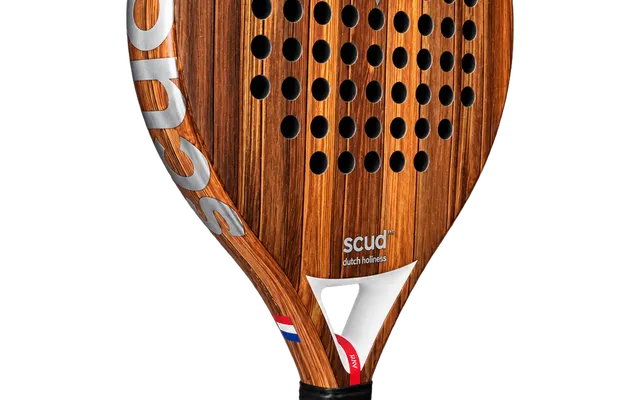
In between, the Mexique M1 (diamond, firm EVA, available in January 2027) and the Wood S1 (teardrop, 350 g, soft EVA: the most forgiving in the range) round out the line-up with their own aesthetic stances and distinct profiles. The simplest thing is still to browse all the rackets and compare the product pages, or to write to us through the contact page if you are torn between two models.
Three mistakes to avoid
Choosing on looks alone. A beautiful racket that does not match your game is still a bad racket. Look at the shape and the core first, then let the design settle it between two equivalent models.
Going too stiff too soon. A very stiff frame combined with a hard EVA sends a large share of the vibrations into the forearm. Until your technique is stable, the pain arrives before the winners.
Neglecting the overgrip and the protector. Two consumables costing a few euros change the grip in your hand and the lifespan of the frame. We have a dedicated guide: padel racket care.
A well-chosen racket does not win a match on its own. It simply removes one variable from the equation: gear that works against you.