An experienced player no longer wants a racket that forgives, but one that gives back exactly what it is given: a fast, stable response on heavy balls, precision that holds at high speed, a sweet spot found without thinking. That points towards stiffer frames, firmer foams and often a diamond shape, though not always: in competition, the side you play on counts as much as your level. Here is what really changes, and how to settle the power-versus-control question once you are past the beginner stage.
What changes once technique is stable
For a beginner, the racket compensates: it widens the sweet spot, softens the impact, corrects off-centre hits a little. For an advanced player, the stroke is repeated cleanly thousands of times a season, and that compensation becomes a brake. A frame that is too soft “eats” part of the arm speed, a foam that is too soft slows the ball off the face, a head that is too light lacks stability when the opponent’s ball comes in heavy.
The advanced player is therefore after three things. Response: the energy of the stroke should go back into the ball, not disappear into frame deformation. Stability: on a counter-smash or a blocked volley, the face must not twist. Precision at speed: as the game gets faster the margin for error shrinks, and you want a racket whose behaviour does not vary from one hit to the next.
Those three qualities come at a cost: a smaller sweet spot, sharper vibration on mishits, an arm that works harder. It is a trade worth making, provided you have the technique and the physical preparation to honour it. If you are still unsure on that point, our article power or control: which one for your game? helps you make the diagnosis honestly.
Power or control: both exist in competition
It is a common misconception that high-level padel is played only with power rackets. In doubles, roles are shared. On court, the left-side player (for two right-handers) most often takes responsibility for finishing the point: smashes, viboras, balls hit out through the side. The right-side player builds, defends, resets with the lob and opens up angles. Two jobs, two rackets.
The attacking competitor gets the most out of a diamond shape, a head-heavy balance and a stiff frame. The competitor who builds points often prefers to keep some feel and tolerance, to place the short ball, come cleanly off the glass and avoid the error that hands over the point. Some very aggressive right-side players use a diamond; some left-side players prefer a teardrop. The side is a reference point, not a rule.
The diamond shape and high balance
A diamond shape moves mass and sweet spot towards the top of the face. At equal arm speed, the head reaches the ball faster: that is geometry, and it is why most smash-oriented rackets are cut this way. The flip side is a smaller sweet spot and a racket that is slower in the hand during fast exchanges at the net.
An advanced player is not at the mercy of that smaller sweet spot: they know where the ideal impact point is and find it by reflex. That is the fundamental difference from the beginner, for whom the same racket is a lottery. We go through the three shapes in round, teardrop or diamond shape.
18K or 12K carbon, firm foam
The carbon weave sets the stiffness of the face. At equal construction, an 18K deforms less than a 12K: the ball leaves drier, more directly, faster. It is the tool for the player who wants every smash to go through. A 12K keeps a little flex, hence feel and tolerance, without going soft: it is often the choice of the competitor who alternates building and accelerating. The full comparison is in 12K or 18K carbon: what difference on court?.
As for the core, a firm or hard EVA foam returns energy quickly. It demands a committed stroke and stiffens in cold weather, two constraints the advanced player accepts because it delivers a ball speed softer foams do not.
Weight, wrist cord and a second racket
A competitor generally plays between 365 and 385 g. Heavier, the racket drives through the ball better and holds up better against the opponent’s impacts; lighter, it gains hand speed. The right weight is the one you can carry without a drop in quality in the third set, not the one on the most impressive spec sheet.
Two practical points. The International Padel Federation rules require a safety cord at the wrist: in a tournament, it is not negotiable. And once a racket suits you, it is wise to own two identical ones: a crack mid-tournament leaves no time to adapt to another model. Our limited editions are not remade identically once sold out, which is a reason to plan ahead.
Table: competitor profile and settings
| Profile | Shape | Balance | Carbon | Foam | Weight |
|---|---|---|---|---|---|
| Left side, finisher | Diamond | High | 18K | Hard / firm | 365-385 g |
| Left side, all-round | Diamond or teardrop | High to medium | 12K | Firm | 365-375 g |
| Right side, builder | Forgiving diamond or teardrop | Medium to high | 12K | Hard Power or medium | 360-375 g |
| Right side, defender | Teardrop | Medium | 12K (+ fibreglass) | Medium to soft | 350-365 g |
What we offer competitive players
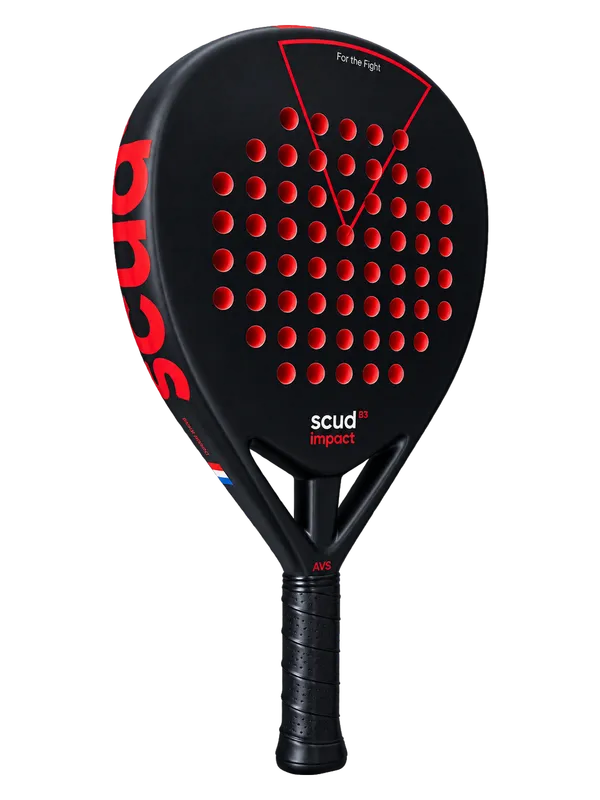
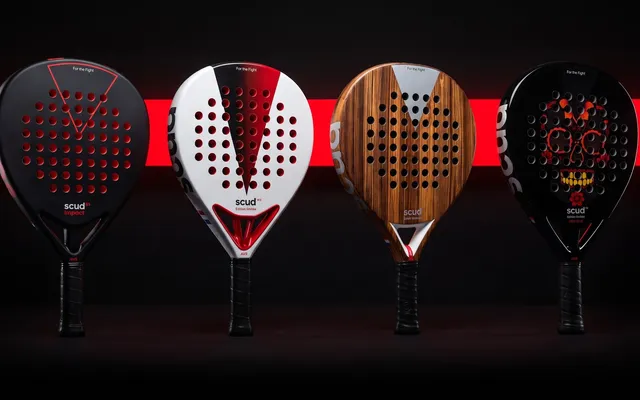
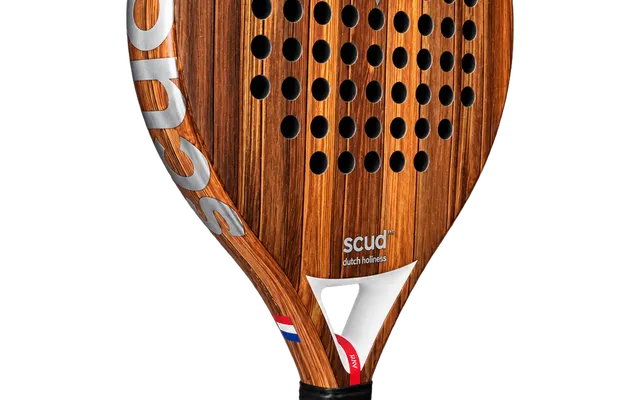
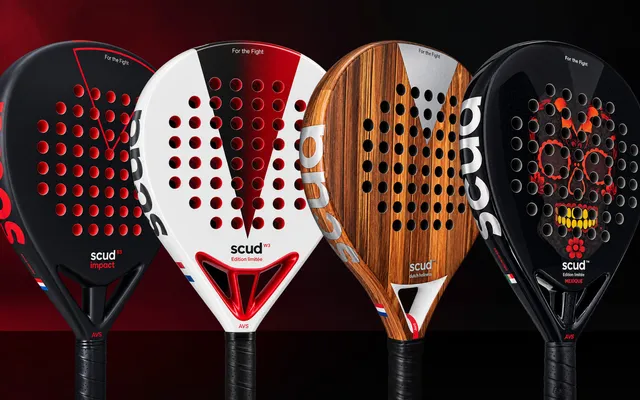
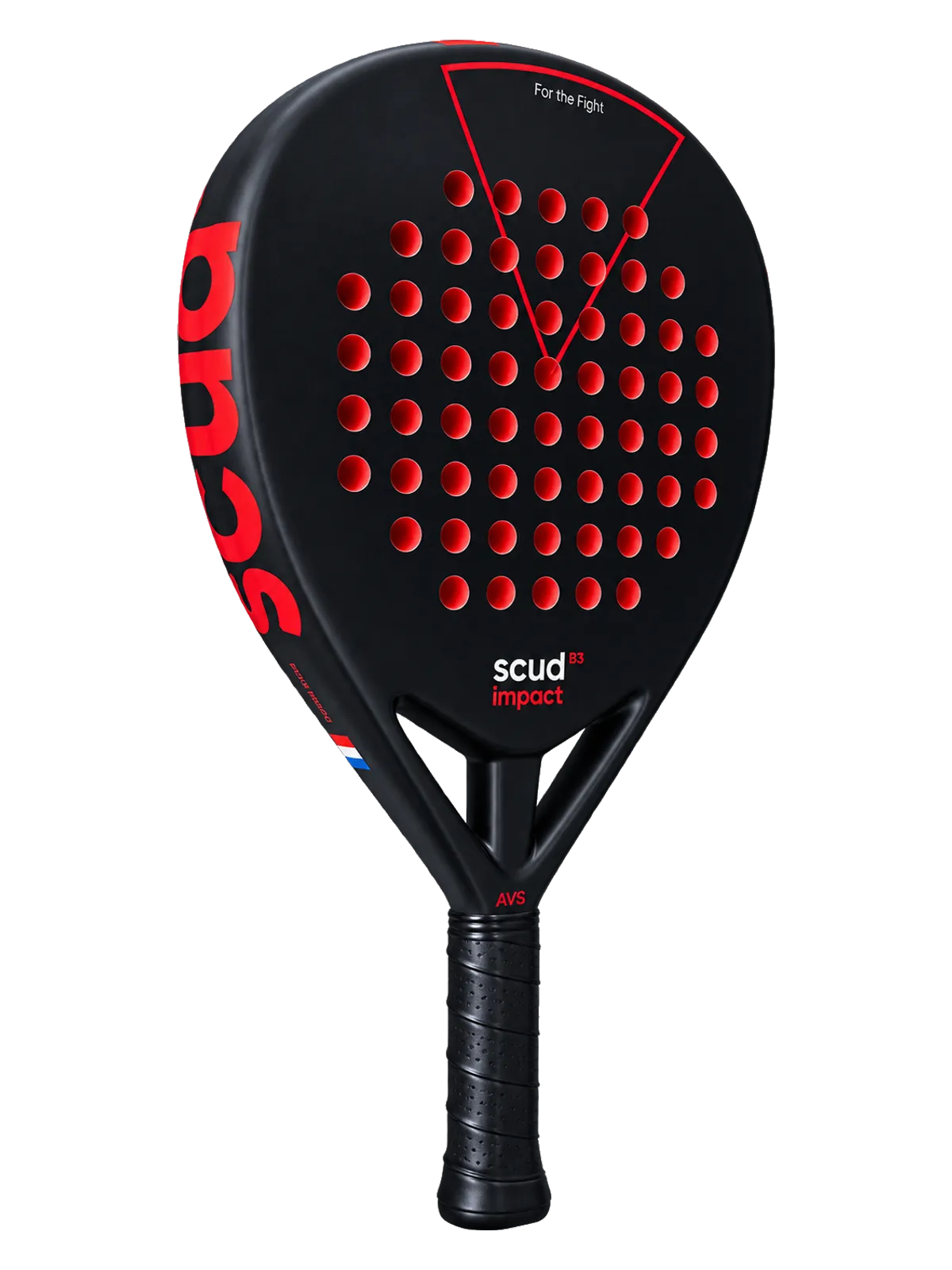
The SCUD Black Impact B3 is our racket for the attacking left-side player: 18K carbon, EVA Hard Power foam, diamond shape, 365 g, high balance, with the AVS anti-vibration system to make the stiffness of the weave liveable. It asks for good arm speed and a clean strike; in return it gives the most direct ball response in the range.
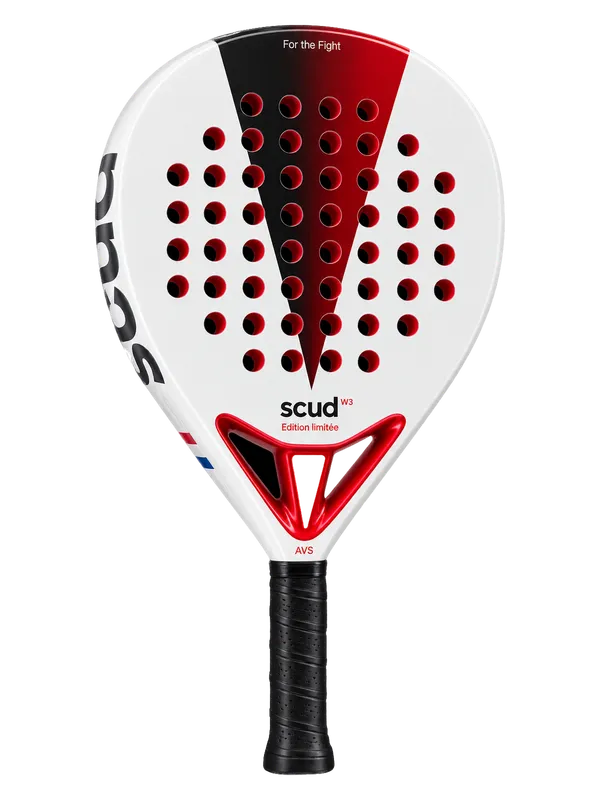
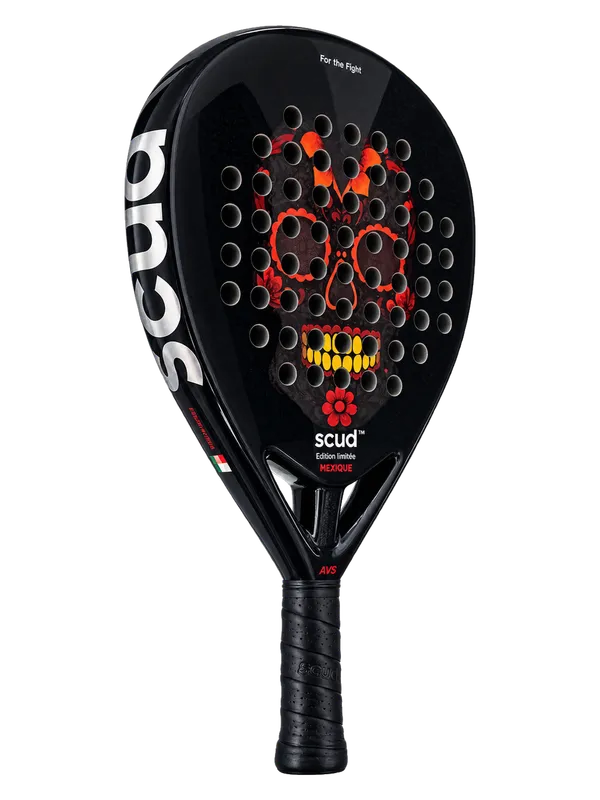
The SCUD White S3 shares its EVA Hard Power foam, diamond shape and 365 g, but in 12K carbon: it is the racket for the competitor who builds before accelerating, with more feel coming off the glass and more tolerance on off-centre hits. The SCUD Mexique M1, available in January 2027, pairs 12K carbon with a firm EVA in the same diamond shape: a frank response, less dry than 18K.
All three carry the hand-applied sanded finish that gives the bite spin needs, and a honeycomb silicone handle that lets you hold the racket without tensing up. You will find them in the power collection and on the control page.
In short
- The advanced player wants response, stability and consistency, and accepts a smaller sweet spot and a harder-working arm in return.
- Power and control both exist in competition: the left side finishes, the right side builds, and each has its racket.
- Diamond shape and high balance for the smash, 18K carbon for the most direct ball response, 12K to keep some feel.
- Weight from 365 to 385 g depending on the arm, a compulsory wrist cord in tournaments, and two identical rackets once you have found the model.
- At SCUD: Black Impact B3 to finish, White S3 to build, Mexique M1 in between from January 2027.
Frequently asked questions
Must an advanced player use a diamond shape?
No. The diamond serves the smash and the attacking volley; a competitor who wins through placement and defence may prefer a teardrop, especially on the right side.
Is 18K carbon only for competition?
It is for players able to load a stiff frame with a stable stroke. It is not a question of ranking but of arm speed and consistency of technique.
Which weight for a tournament with several matches in one day?
The one you can hold without losing precision at the end of the day. Many competitors stay around 365 g for that reason rather than moving up towards 380 g.
Is the wrist cord really compulsory?
Yes, the international rules require it on the wrist during play. Check its condition before every tournament: a frayed cord costs a few euros to replace.
Do I need two identical rackets?
It is strongly advised as soon as you play tournaments: a frame that cracks mid-match leaves no time to get used to another model.
To compare the specs in detail, browse all our padel rackets or download our free guide to choosing your racket.