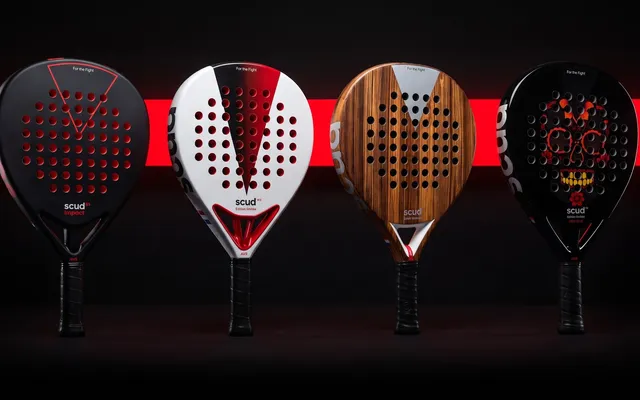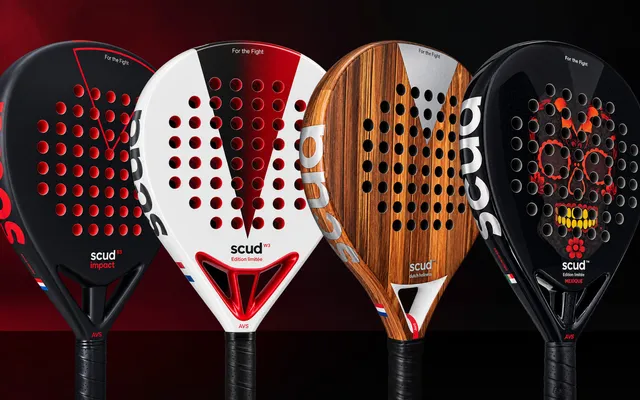
A tennis racket is strung, a padel racket is solid and perforated, a pickleball paddle is solid and smooth. Behind that visible difference are three objects that share neither dimensions, nor materials, nor role in the game, and that are not interchangeable, even for fun. If you are coming to padel from tennis, or hesitating between padel and pickleball, this comparison gives you the reference points to understand what you are holding and why the stroke changes so much from one sport to the next.
Three different constructions
The tennis racket is a hollow frame, most often in carbon composite, strung with polyester, nylon or natural gut. It is the strings that hit the ball: they deform, hold it for a fraction of a second, then propel it. String tension, adjustable, is part of the player’s choice.
The padel racket has no strings. It is a solid sandwich: two composite faces (carbon, fibreglass or a mix), an EVA foam core, a frame surrounding the whole, and a face perforated with cylindrical holes. The foam plays the role strings play in tennis, with one essential difference: it cannot be adjusted, it is chosen at purchase, between soft and hard. We describe this construction in how a padel racket is made.
The pickleball paddle is also solid, but without holes. Its core is most often a polymer honeycomb structure, sandwiched between two carbon or fibreglass faces. It is shorter, lighter, and its surface roughness is limited by the rules.
Dimensions and weight: the table
| Padel racket | Tennis racket | Pickleball paddle | |
|---|---|---|---|
| Maximum length | 45.5 cm | 73.66 cm (29 in) | 43.18 cm (17 in) |
| Maximum width | 26 cm | 31.75 cm (12.5 in) | Length + width ≤ 60.96 cm (24 in) |
| Maximum thickness | 38 mm | No limit for the frame | No limit |
| Hitting surface | Solid, perforated | Strung | Solid, no holes |
| Core | EVA foam | None (strings) | Polymer honeycomb |
| Roughness | Free | Not applicable | Limited and measured |
| Typical weight | 340 to 390 g | 260 to 340 g strung | 200 to 250 g |
| Safety cord | Compulsory | No | No |
The padel limits come from the International Padel Federation rules, the tennis limits from the ITF rules, the pickleball limits from the USA Pickleball rulebook. We detail the padel template in our guide to regulation dimensions.
Three balls, three behaviours
The ball explains a large part of the differences between rackets.
The padel ball looks like a tennis ball, felt included, with a very similar diameter and weight (between 6.35 and 6.77 cm and between 56 and 59.4 g under FIP rules), but a lower internal pressure: it bounces a little less and flies more slowly. That is what makes play possible on a 20 m by 10 m court surrounded by glass.
The tennis ball is more pressurised and livelier, to cover a court 23.77 m long. The tensioned strings and the long handle of the racket serve precisely to generate the speed and spin that format demands.
The pickleball ball is hard plastic, perforated with 26 to 40 holes, and weighs around 22 to 26 g. It bounces little and takes almost no spin: hence a light, short paddle with a smooth surface, where placement matters more than rotation.
What it changes in the stroke
In tennis, the strings and the handle length give significant leverage: you take the ball far from the body, with a wide swing, and topspin is generated by string friction.
In padel, the racket is short, unstrung, and the ball often arrives after bouncing off the glass. The stroke is more compact, the grip closer to the face, and spin comes from direct friction between felt and hitting surface, hence the importance of sandblasting and roughness, which we explain in our article on hand sandblasting. The foam absorbs part of the energy: you do not “hit” a padel ball the way you hit a tennis ball, you push it and place it.
In pickleball, the very light paddle and the spinless ball favour short volleys and “dinks”, soft balls dropped at the net. The wrist does little, placement does everything.
Can you play with another sport’s racket?
No, and not only for regulatory reasons.
- A tennis racket on a padel court exceeds the permitted length, has no safety cord, and its strings send a depressurised ball far too fast for an enclosed space.
- A pickleball paddle in padel has no holes, is too light to drive through a padel ball and lacks the roughness needed for slices.
- A padel racket in pickleball is too heavy, perforated, and its rough surface breaches the sport’s roughness limits.
Each object is designed for its ball and its court. The only useful transfer from one sport to another is reflexes: reading trajectories, footwork, volley instinct.
Moving from tennis to padel: which racket to choose
The tennis player discovering padel arrives with high arm speed and the habit of hitting hard. It is both an asset and a trap: a stiff padel racket, dense carbon on hard foam, will turn that speed into balls flying out the back of the court and vibrations in the elbow, while you learn to play with the glass.
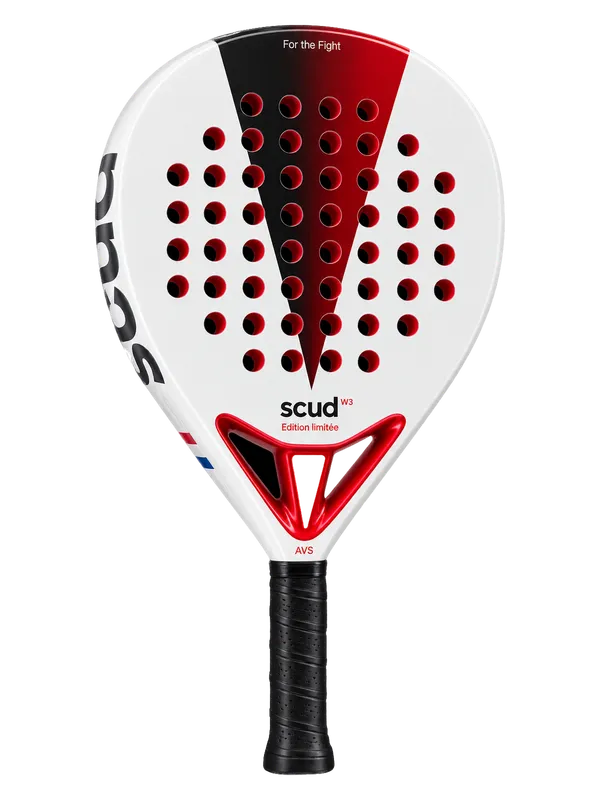
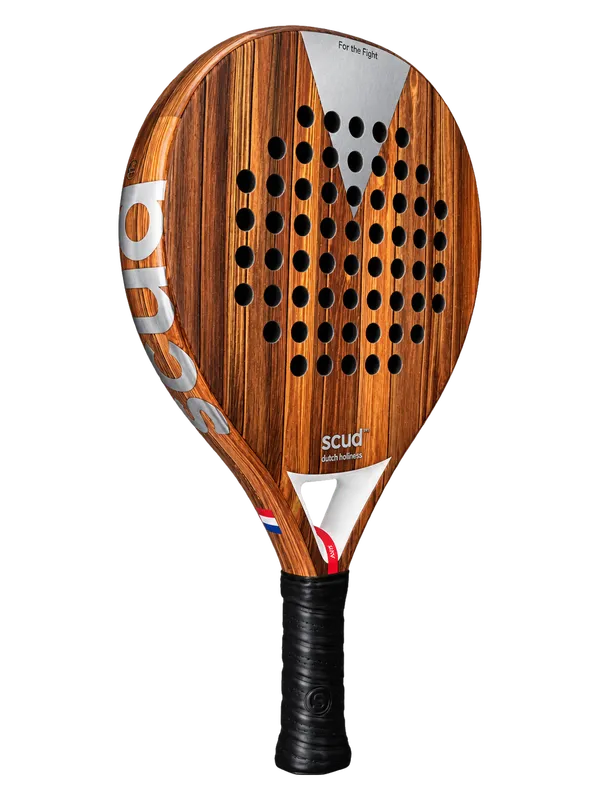
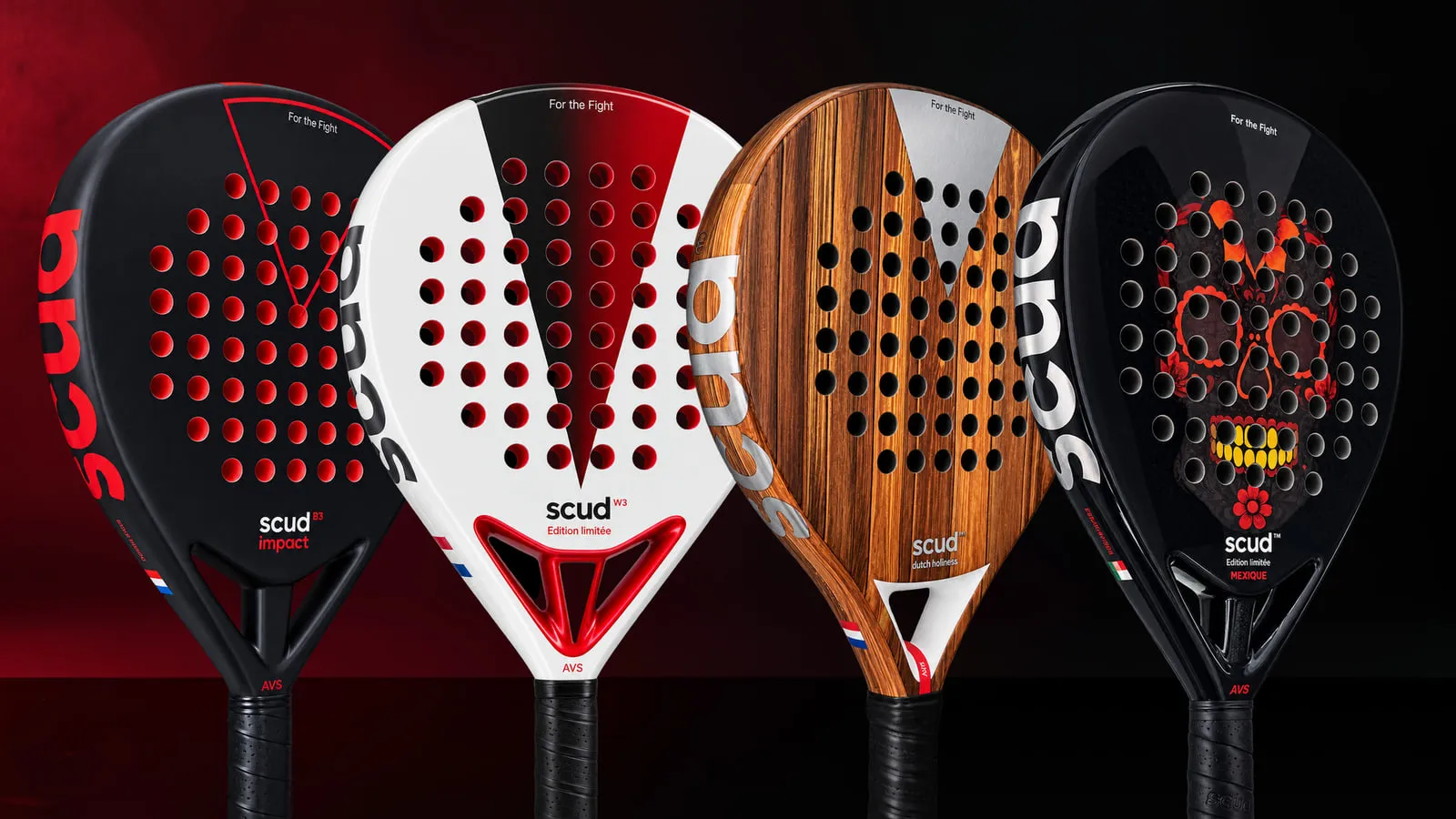
Our advice is to start with a forgiving racket with a long touch, and move up in stiffness once the glass game is mastered. In our range, the SCUD Wood S1, 12K carbon and fibreglass on soft EVA foam, teardrop shape and 350 g, is the most manoeuvrable and most forgiving: the best entry point for a tennis player who has to relearn how to measure. The SCUD White S3, 12K carbon and Hard Power EVA in a diamond shape, is the next step, once arm speed can be put in the service of control. The control collection gathers these two models; the guide power or control helps you place your profile.
In short
- Tennis: strung frame, up to 73.66 cm, pressurised ball, spin from the strings.
- Padel: solid perforated face, 45.5 cm maximum, EVA foam, compulsory cord, spin from surface roughness.
- Pickleball: solid paddle without holes, 43.18 cm maximum, honeycomb, plastic ball, limited roughness.
- The three objects are not interchangeable, by rule and by design.
- A tennis player switching to padel does well to start with a forgiving racket.
Frequently asked questions
Is a padel ball a tennis ball?
Almost: same size and same felt, but a lower internal pressure, which makes it less lively. You do not play competitive padel with tennis balls.
Why does a padel racket have holes?
The rules require it: the face must be perforated. The holes lighten the racket, reduce air resistance and contribute to the grip on the ball.
Is pickleball closer to padel or to tennis?
In equipment, closer to padel: a solid paddle, no strings. In play, it stands apart: a 6.1 m by 13.4 m court without glass, a plastic ball, short exchanges at the net.
Does a tennis player progress quickly in padel?
Generally yes, thanks to ball reading and the volley. The difficulty concentrates on the glass game and on measuring: that is where a forgiving racket saves time.
To find the padel racket that matches your sporting background, our free guide to choosing your racket goes through shape, weight and core step by step, before letting you compare our models.