A regulation padel racket measures at most 45.5 cm in length, 26 cm in width and 38 mm in thickness, has a perforated face and a safety cord attached to the handle. These limits are set by the rules of the International Padel Federation (FIP), adopted by national federations, including the French Tennis Federation for France. Here is the detail of what the rules require, what they leave open, and what an umpire is entitled to check before a match.
The template: length, width, thickness
The rules describe the racket in two parts, head and handle, and set maximums for each. The total length, head and handle included, cannot exceed 45.5 cm.
| Element | Regulation maximum |
|---|---|
| Total length | 45.5 cm |
| Head length | 30 cm |
| Head width | 26 cm |
| Head thickness | 38 mm |
| Handle length | 20 cm |
| Handle width | 5 cm |
| Handle thickness | 5 cm |
These are maximums, not required dimensions. A manufacturer can perfectly well design a shorter or thinner racket. In practice, almost every racket on the market comes close to the maximum template, because every extra millimetre of face widens the useful hitting zone. That is why two rackets from different brands have, to within a few millimetres, the same outline: what sets them apart happens inside, as we explain in how to choose your padel racket.
The holes in the face
The hitting surface must be perforated. The rules allow an unlimited number of cylindrical holes, each between 9 and 13 mm in diameter, in the central zone of the face. In a 4 cm peripheral band measured from the outer edge, holes may have a different diameter or shape, provided they do not alter the essence of the game.
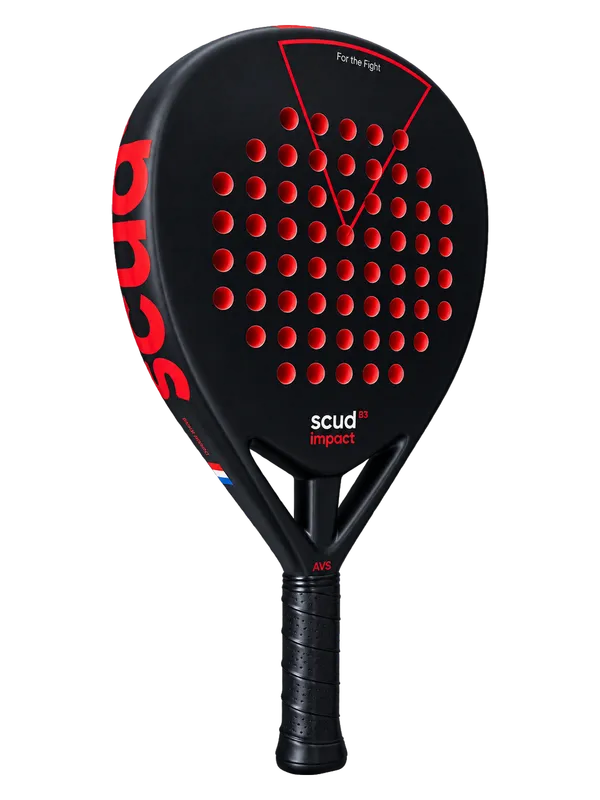
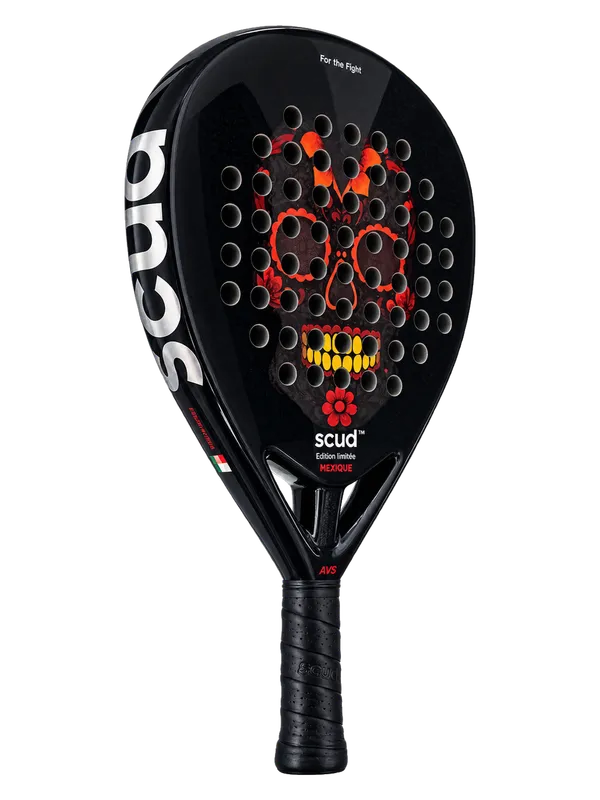
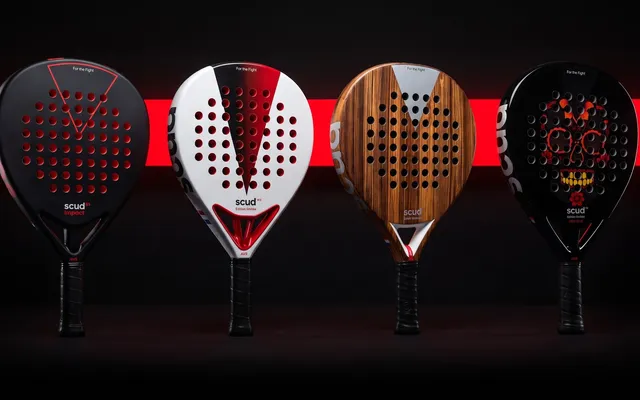
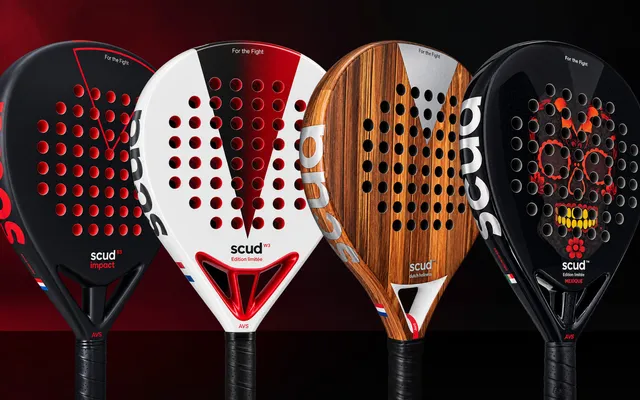
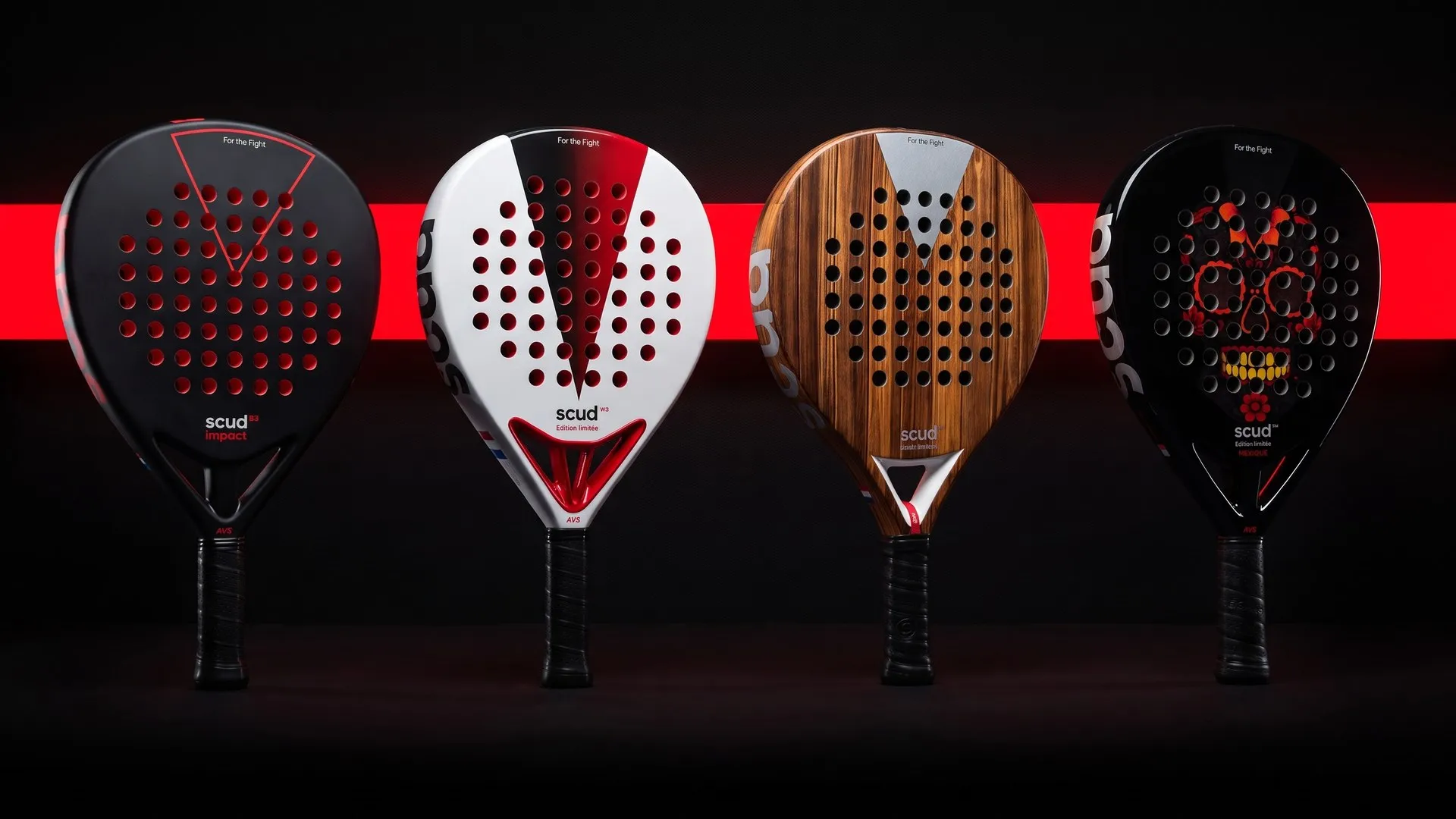
This freedom explains the variety of patterns you see on faces: aligned holes, holes concentrated in the centre, decorative shapes along the edges. On our rackets, the perforations draw the model’s visual identity, from the red triangle of the Black Impact B3 to the Día de los Muertos skull of the Mexique M1, while staying within the rules.
The surface: smooth or rough
The rules state that the hitting surface may be smooth or rough. No numerical roughness limit is set. Sandblasting, moulded relief or textured paint are therefore all allowed in competition. We compare these three methods in our article on surface roughness.
The safety cord
This is the point most often forgotten, and the only one that concerns other players’ safety. The racket must carry a non-elastic cord, or wrist strap, fixed to the handle, with a maximum length of 35 cm. During a match, the player must wear it around the wrist: a racket that slips out of the hand at the end of a smash becomes a projectile in an enclosed space of twenty metres by ten. We devote a full guide to this rule: the padel racket safety cord.
What the rules do not set
Three parameters that make all the difference between two rackets are not regulated at all.
- Weight. No limit, minimum or maximum. Rackets on the market generally weigh between 340 and 390 g, but that is custom, not a rule.
- Materials. Carbon, fibreglass, EVA foam, wood: everything is allowed, provided the racket carries nothing likely to injure a player.
- Face shape. Round, teardrop or diamond, the outline is free within the template.
The rules do, however, forbid any added device that would alter the racket’s properties or present a danger: no protruding elements, no moving parts.
What gets checked in competition
As far as we know, there is no official list of approved rackets model by model, as exists in some other sports. The manufacturer designs its racket within the rules, and the umpire or referee may check, before or during a match, that a racket complies.
In practice, checks focus on what can be seen and measured quickly: outer dimensions, the presence of the cord and whether it is actually worn, the absence of added elements or dangerous damage (split frame, piece of shell coming loose). A player who loses their cord during a match, or whose racket is visibly damaged, may be asked to replace it.
For competitions held in France, the rules of the game published by the French Tennis Federation, modelled on the FIP’s, apply. The international reference text is available on padelfip.com, and the French rules on fft.fr.
What about SCUD rackets?
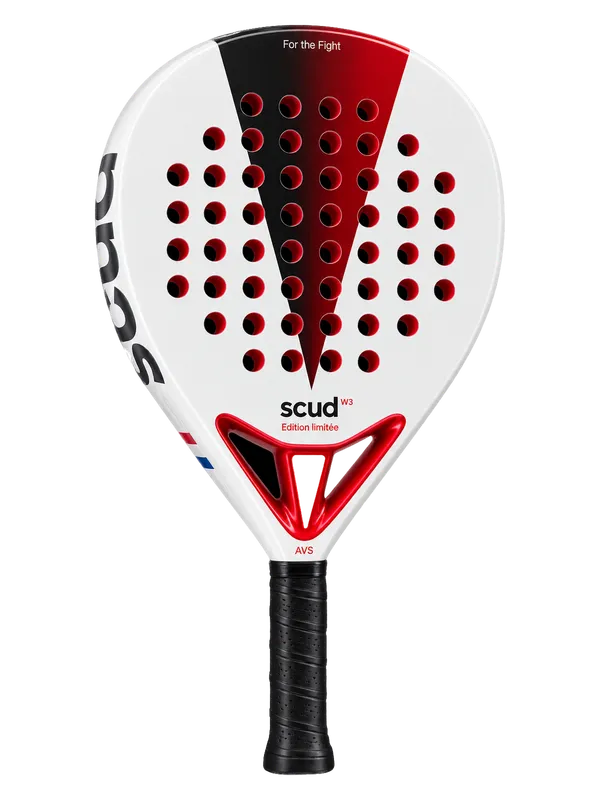
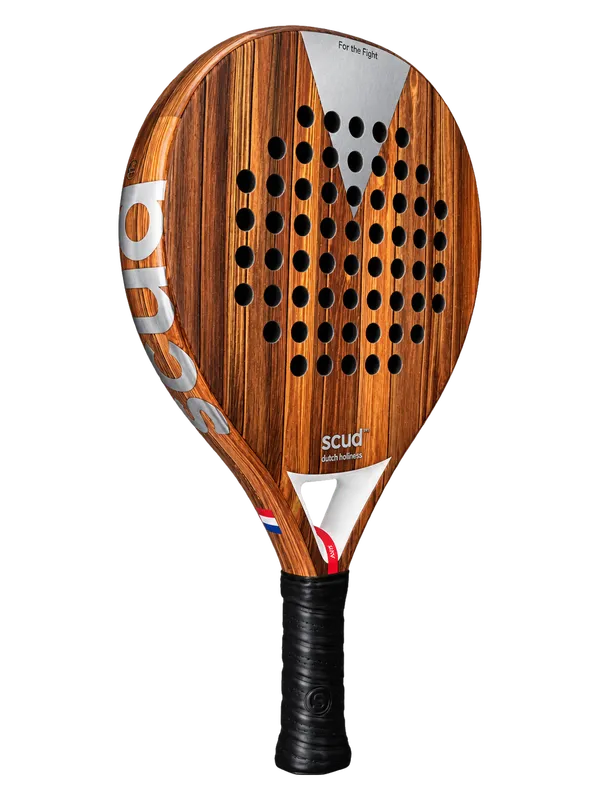
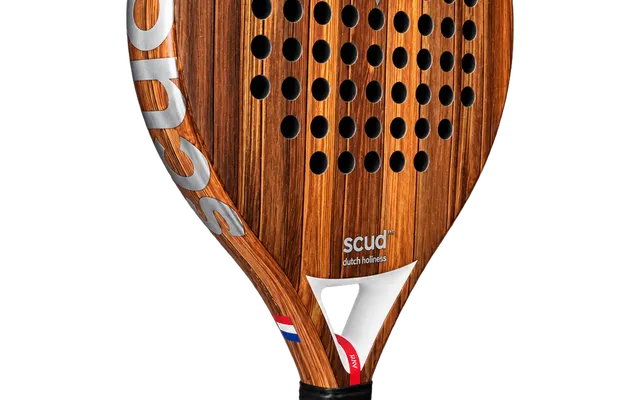
Our whole range is designed within this template and intended for competition as much as recreational play. The SCUD Black Impact B3, 18K carbon, diamond shape and 365 g, like the SCUD White S3, 12K carbon and the same outline, use the full width of the face to place the impact point high, where smashes are won. The Wood S1, teardrop shape and 350 g, recentres that impact point within the same template. Every racket ships with its wrist strap, and all the spec sheets are gathered on the padel rackets page.
In short
- FIP maximums: 45.5 cm long, 26 cm wide, 38 mm thick; handle no longer than 20 cm.
- Perforated face required: holes of 9 to 13 mm in the central zone, free shapes on the 4 cm edge band.
- Smooth or rough surface, your choice; no roughness limit.
- Non-elastic cord of 35 cm maximum, compulsory and worn on the wrist during a match.
- Weight, materials and face shape are not regulated.
Frequently asked questions
Is a racket bought in a shop automatically regulation?
In the vast majority of cases, yes: manufacturers design their models within the rules. What to watch is rather the condition of the racket and the presence of the cord.
Can you play a tournament with a racket without holes?
No. The hitting surface must be perforated. The very first solid wooden faces, at the origin of padel, would no longer comply today.
Is racket weight limited?
No. The rules set no weight limit. The 340 to 390 g range you find on the market results from manufacturers’ choices, not from a regulatory constraint.
What happens if my cord breaks during a match?
You must replace it or switch rackets before play resumes. It is a safety rule, and the umpire is entitled to enforce it.
To choose, within this shared template, the racket that fits your game, our free guide to choosing your racket reviews shape, weight, core and carbon before pointing you to our models.