Padel rackets get compared on carbon, core, shape and weight. The hitting surface, meanwhile, almost always slips through the cracks — even though it is the only part of the racket that actually touches the ball. A few tenths of a millimetre of roughness decide how much spin you can impart, how the ball bites when you slice, and even how long your racket will stay pleasant to play with. Here is what happens at that precise spot.
What happens during the four milliseconds of contact
A padel ball stays in contact with the face for only a few milliseconds. In that brief window, two movements overlap: the ball compresses perpendicular to the surface, and it slides along it if the racket is moving at an angle.
It is that sliding that produces spin. If the surface is perfectly smooth, the ball slides freely: the energy of your swing is lost to useless friction and the rotation you get is weak. If the surface grips, the ball is braked at its edge while it keeps moving through its centre. That differential sets it spinning.
In other words, spin does not come from the wrist alone. It comes from the friction available between the felt of the ball and the face. A racket that does not grip turns a beautiful slice into a flat ball.
Rough or smooth: two philosophies
Manufacturers come down on different sides.
A smooth surface is faster. The ball slides, comes off quicker, and the racket gets less dirty. It suits a direct, hard-hitting game where spin is not the priority. It has another advantage, often left unsaid: it wears more slowly, because there is no texture to erode.
A rough surface slows the ball off the face slightly but multiplies the grip. It makes possible the heavily sliced strokes, the drop shots that die after the bounce, the sliced serves that dart towards the side glass. It does age, though: the texture smooths out over the hours of play.
There is no objectively superior camp. There is a brand choice, which has to be consistent with the rest of the racket.
Industrial sanding and hand-applied sanding
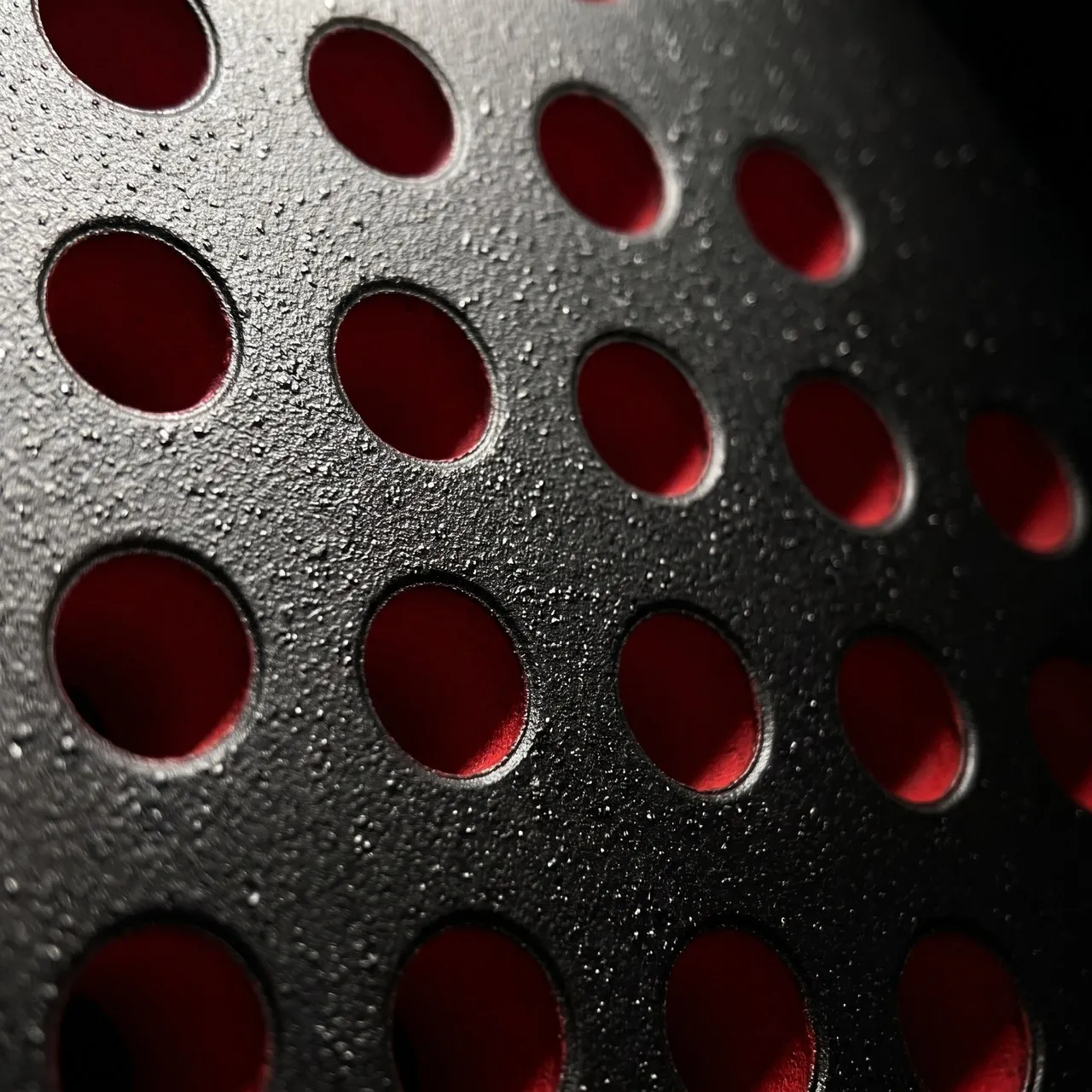
Roughness can be obtained in several ways: by blasting an abrasive grain onto the surface, by treating it after curing, or by applying a paint loaded with particles.
On an industrial line, the operation is automated and calibrated to be identical from one piece to the next. It is efficient and perfectly legitimate for large runs.
At SCUD, this step is done by hand, piece by piece. In practical terms, that means a person works each face, adjusts the pressure and goes back over it where needed. The result differs on two counts.
The first is relative uniformity. Hand sanding is never mathematically uniform: there are very slight variations across the surface, exactly as on an object finished by hand rather than moulded. No racket is the perfect twin of the next.
The second is what this step implies upstream. Sanding by hand means small series. It simply would not be sustainable on tens of thousands of units a month. That is consistent with our model: limited editions, with no identical re-runs.
What you feel on the court
In play, the grip is noticeable on four strokes in particular.
The drop shot. It is the most revealing stroke. A well-sliced ball on a grippy surface bounces short and dies. On a smooth surface, it bounces higher and offers the opponent a second chance.
The serve. A sliced serve takes a curved trajectory that pushes the receiver towards the side glass. How much curve you get depends directly on the friction available.
The bandeja. The slice keeps the ball low after the bounce and gives you time to get back to the net. Without grip, the bandeja floats and gets attacked.
The off-the-glass shot. A surface that bites lets you return with a rotation that stabilises the ball, instead of watching it balloon up.
How the sanding ages — and how to slow it down
The texture of a sanded face erodes. That is normal: it rubs against felt, court sand, sometimes the fence. After several months of regular play, the surface becomes noticeably softer and the spin gradually decreases. Most players do not notice, because the degradation is slow and they adapt to it without thinking.
Three simple habits push back the deadline:
- Wipe the face after every session with a slightly damp microfibre cloth. Sand dust left embedded acts as an abrasive in the next match.
- Never leave the racket in a car. Heat attacks the surface varnish before it attacks anything else.
- Avoid scraping the floor to pick up balls with the face. It is the gesture that wears the surface fastest — and the easiest to fix.
We cover the rest of the maintenance in a dedicated guide: padel racket care.
Where hand-applied sanding shows in the range
Every SCUD racket receives this hand sanding, but it does not read the same way on every model.
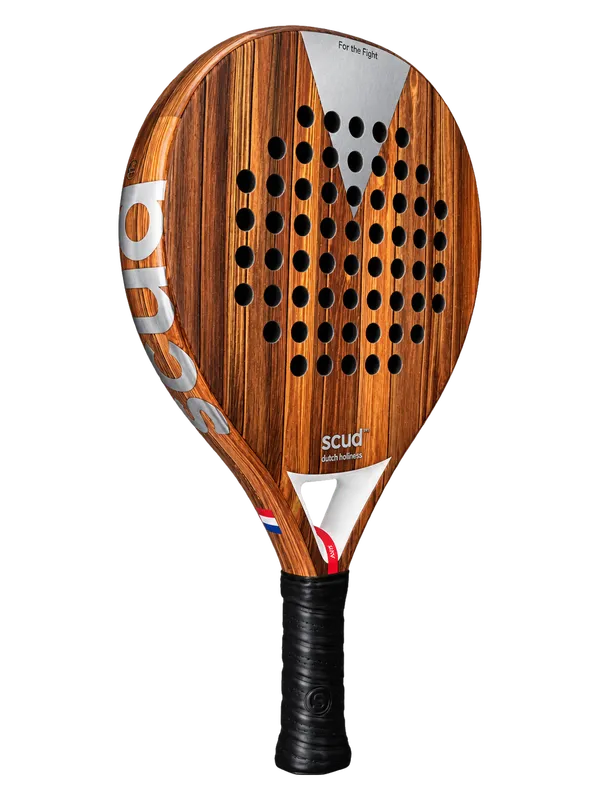
On the SCUD Wood S1, the wood finish makes the craftsmanship immediately visible: the texture and the tint vary slightly from one racket to the next, which is precisely the intention. Its 12K carbon and fibreglass shell, over a soft EVA foam, favours comfort and control, and its AVS anti-vibration system absorbs the repeated impacts over the length of a match.
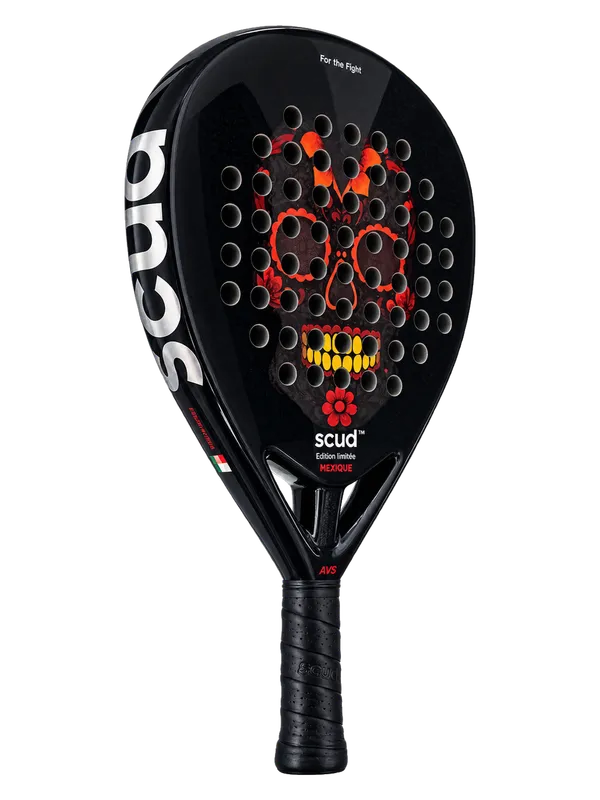
On the SCUD Mexique M1, the sanding comes on top of a highly detailed Día de los Muertos artwork. 12K carbon, firm EVA foam and AVS system: a reactive racket with a firm touch, where the grip of the face directly serves placement and variation of spin. It will be available in January 2027.
You will find the material details of each model, and which model carries what, on the all our rackets page.
A detail that is anything but
The hitting surface is the part of the racket we talk about least and touch most. It will never replace a good stroke — but it decides how much of that stroke actually reaches the ball. That is why we treat it by hand, one piece after another, rather than considering it a mere finishing layer.