Contents — 14 parts
- The fight at a glance
- Round 1: player numbers, tennis way ahead
- Round 2: speed, padel without rival
- Round 3: the square metre, the argument that worries tennis
- Round 4: money and spectacle, two different worlds
- Round 5: Spain, the country where padel has pulled ahead
- Round 6: France, a record that owes a lot to padel
- Round 7: the Swedish crash test
- The verdict: 4-3 to tennis
- And in the United States? The rival is called pickleball
- What the key players say
- Padel and tennis myths
- In short
- Frequently asked questions
In Paris, the City replaced two tennis courts with four padel courts. Same footprint, but up to three times more potential revenue per hour. Novak Djokovic, for his part, has issued a warning: if nobody reacts, “they’re going to convert all the clubs”. So, will padel kill tennis? To find out, we staged the fight: seven rounds, using only figures published by federations, ministries and market studies.
The short answer: no. Padel is taking square metres from tennis, not its players. Wherever they are counted (France, the United Kingdom, the United States, the world), tennis players have never been so numerous, at the very moment padel is booming. The long answer takes seven rounds, and it holds a few surprises.
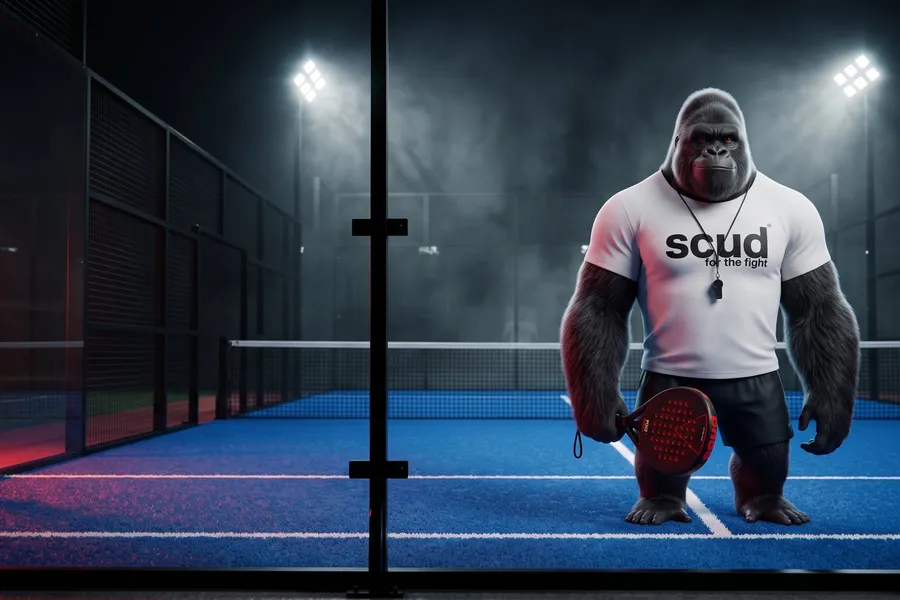
We filmed this fight too: a seven-minute video, refereed by Coach SCUD, with the same figures and the same sources as this article.
The chapters: players (0:31), speed (1:10), the square metre (1:58), money (2:51), Spain (3:37), France (4:22), the Swedish crash test (5:17) and the verdict (6:09).
The fight at a glance
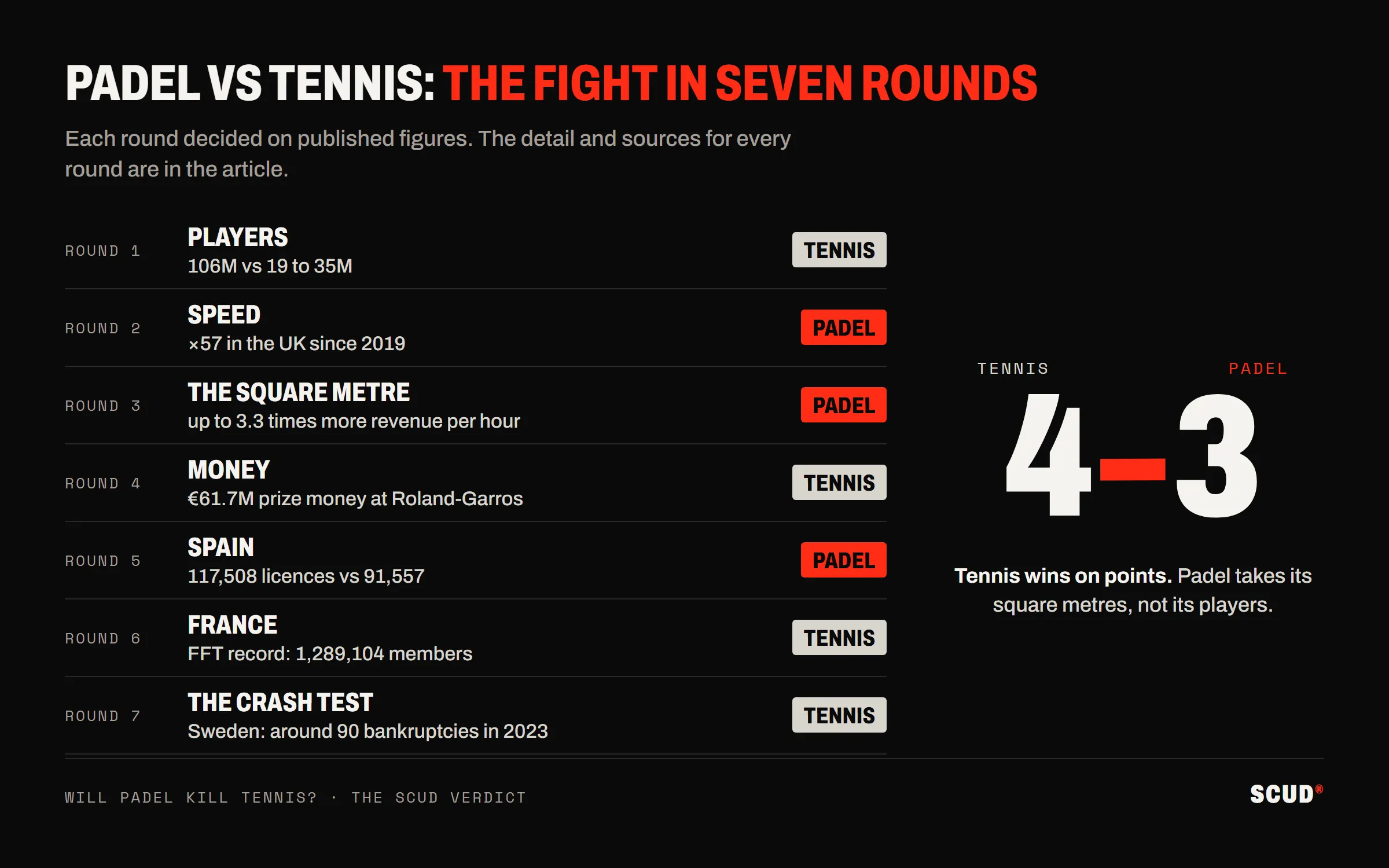
| Round | The decisive figure | Winner |
|---|---|---|
| 1. Players | 106 million for tennis, 19 to 35 million for padel | Tennis |
| 2. Speed | British padel multiplied by 57 since 2019 | Padel |
| 3. The square metre | Up to 3.3 times more revenue per hour on the same surface | Padel |
| 4. Money | €61.7M prize money at Roland-Garros, around €475,000 for a P1 | Tennis |
| 5. Spain | 117,508 padel licences against 91,557 for tennis | Padel |
| 6. France | FFT record: 1,289,104 members | Tennis |
| 7. The crash test | Sweden: around 90 padel bankruptcies in 2023 | Tennis |
Round 1: player numbers, tennis way ahead
Let’s start with the basics: how many people play each of the two sports? According to the 2024 Global Tennis Report from the International Tennis Federation (ITF), tennis has around 106 million players worldwide, up from 84.4 million in 2019, and 698,034 courts.
For padel, the answer depends on who is counting. The International Padel Federation (FIP) claims more than 35 million players and 77,300 courts in its 2025 report, and even 38 million in June 2026. The 2026 Playtomic report, produced with PwC and deliberately cautious, counts 19.4 million and 58,334 courts. The gap comes down to how an “active player” is defined; remember the range, and be wary of anyone who only quotes the highest figure.
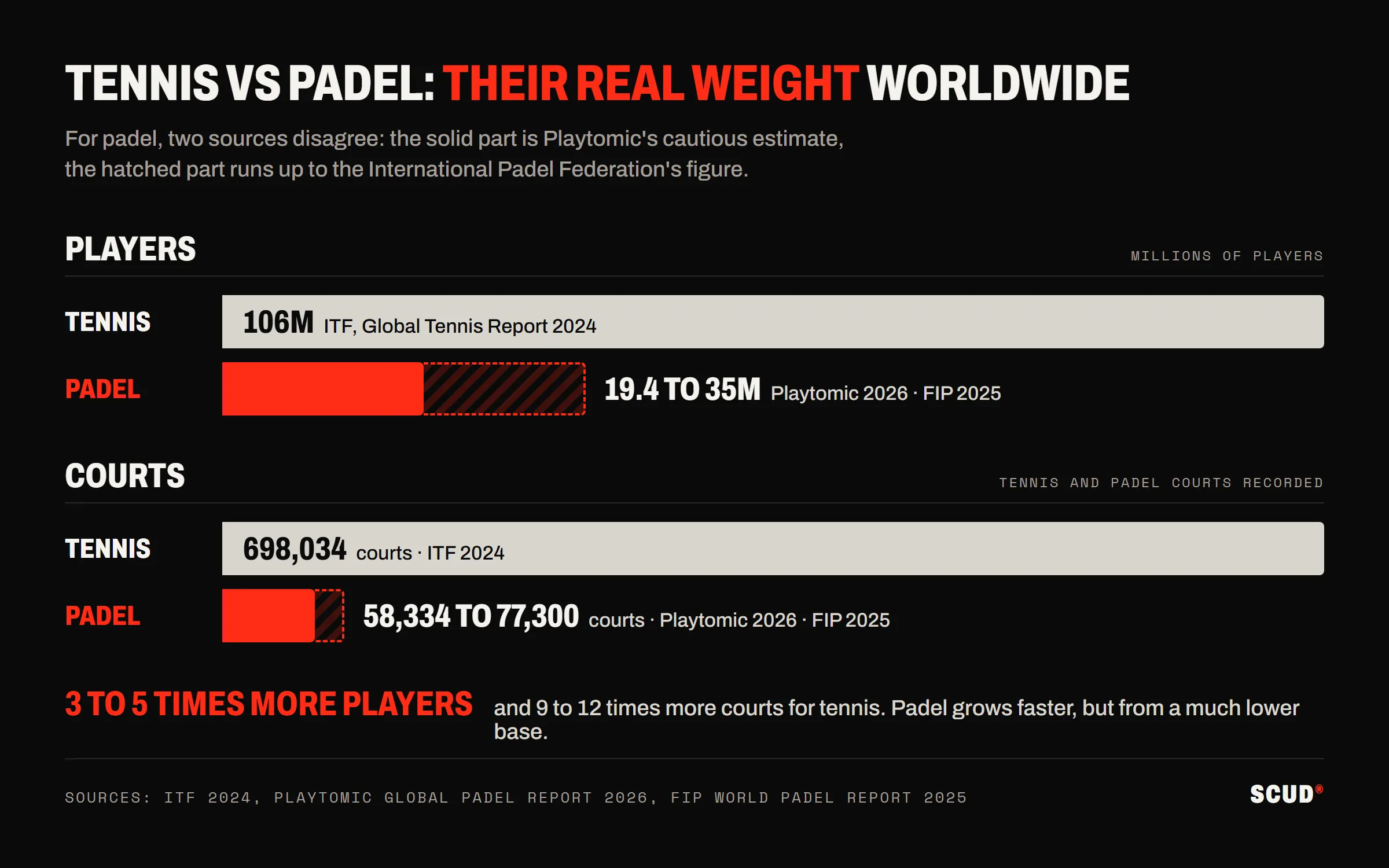
Even taking the highest estimate, tennis has three times as many players as padel, and nine to twelve times as many courts. First round, no debate: point to tennis.
Round 2: speed, padel without rival
Tennis is bigger; padel is moving much faster. In the United Kingdom, according to the Lawn Tennis Association (LTA), it had 15,000 players in 2019, 129,000 at the end of 2023, 400,000 at the end of 2024 and 860,000 at the end of 2025: multiplied by 57 in six years. The LTA even announced one million players in May 2026. The number of British padel courts rose from 69 in 2020 to 1,553.
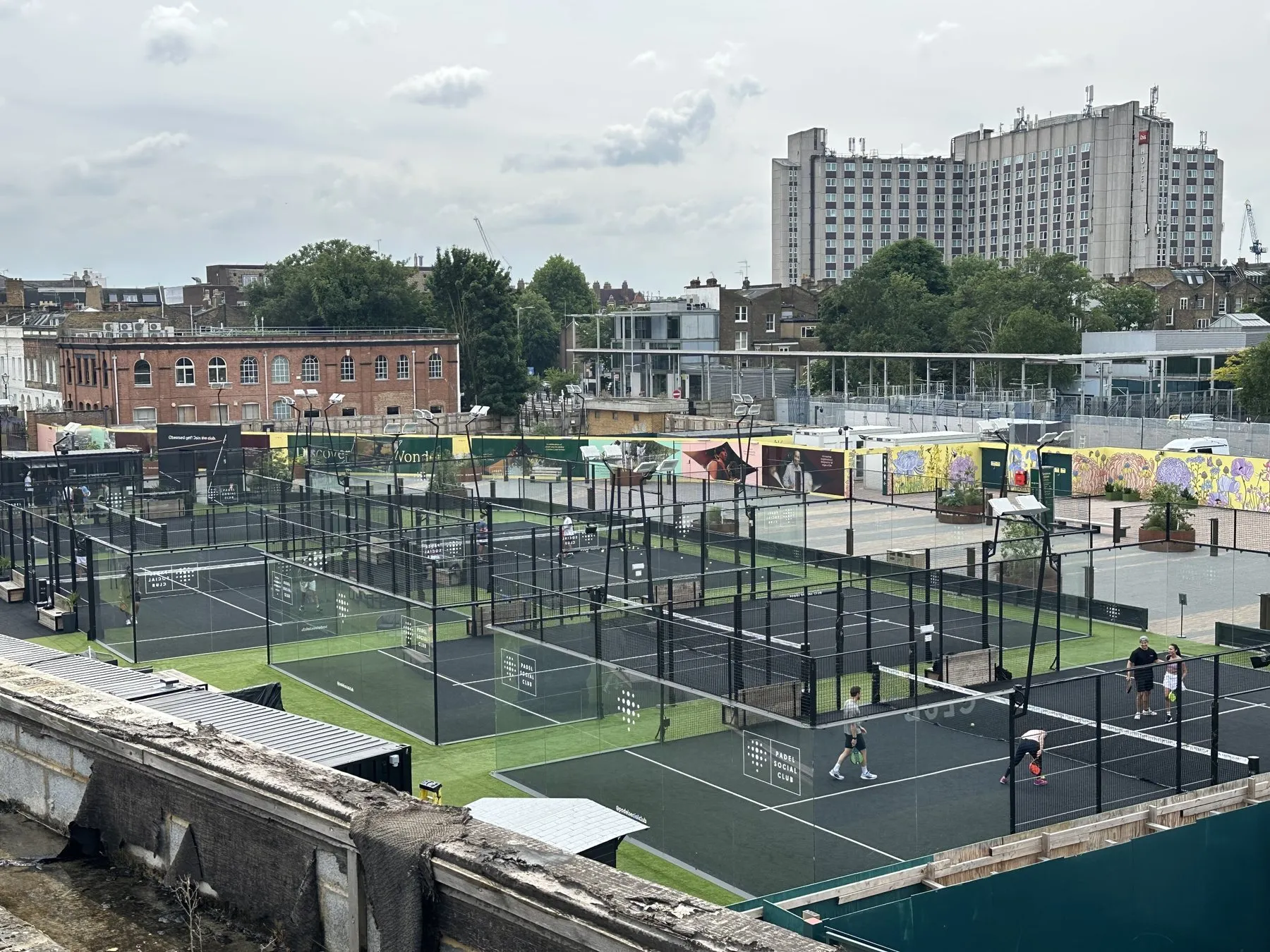
In France, the FFT (French Tennis Federation) recorded around 4,000 courts at the end of 2025, up 118% in three years, and 1,027 clubs offering padel, compared with 10 in 2014. Official tournaments rose from 274 in 2018 to 33,310 in 2025. According to Playtomic, France built more padel courts than any other country in the world in 2025. At the end of August 2026, it had 4,520: we detail this growth in our article on padel in France in figures.
And padel keeps hold of those who try it: again according to Playtomic, 92% of players come back after their first game. You play as a four, you get rallies going in the first hour, you laugh a lot. Tennis is growing too, but not at this pace: point to padel.
Round 3: the square metre, the argument that worries tennis
This is the round that hurts tennis. At the Ladoumègue sports centre, in Paris’s 19th arrondissement, the City replaced “two old, run-down tennis courts” with four padel courts, for €221,000. A padel court there costs €20 an hour to hire; an outdoor municipal tennis court, €12 at the full rate.
Do the maths: on the same footprint, the City could take at most €24 an hour from tennis; it can now take €80. That is 3.3 times more potential hourly revenue, before taking occupancy into account, and it goes from 4 players an hour in singles to 16. In Monaco, Guillaume Couillard, captain of the Davis Cup team, puts it bluntly in Monaco Tribune: padel is “a real cash machine” for clubs.
Djokovic, at Wimbledon in 2024, claimed that “with one tennis court, you can build three padel courts”. On paper, the ratio of surface areas comes close; in every documented French example (Paris, Caen, Bagnols-sur-Cèze), it is two padel courts per tennis court. We have devoted a whole article to this economy: why clubs are turning their tennis courts into padel courts. Still, for the same surface, padel brings in more: point to padel.
Round 4: money and spectacle, two different worlds
Here, tennis brings out the heavy artillery. Prize money at Roland-Garros 2026 reaches €61.7 million. A P1 tournament on the Premier Padel tour, such as Valencia in 2026, pays out around €475,000, men’s and women’s draws combined. It would therefore take around 130 P1 tournaments to match a single Roland-Garros.
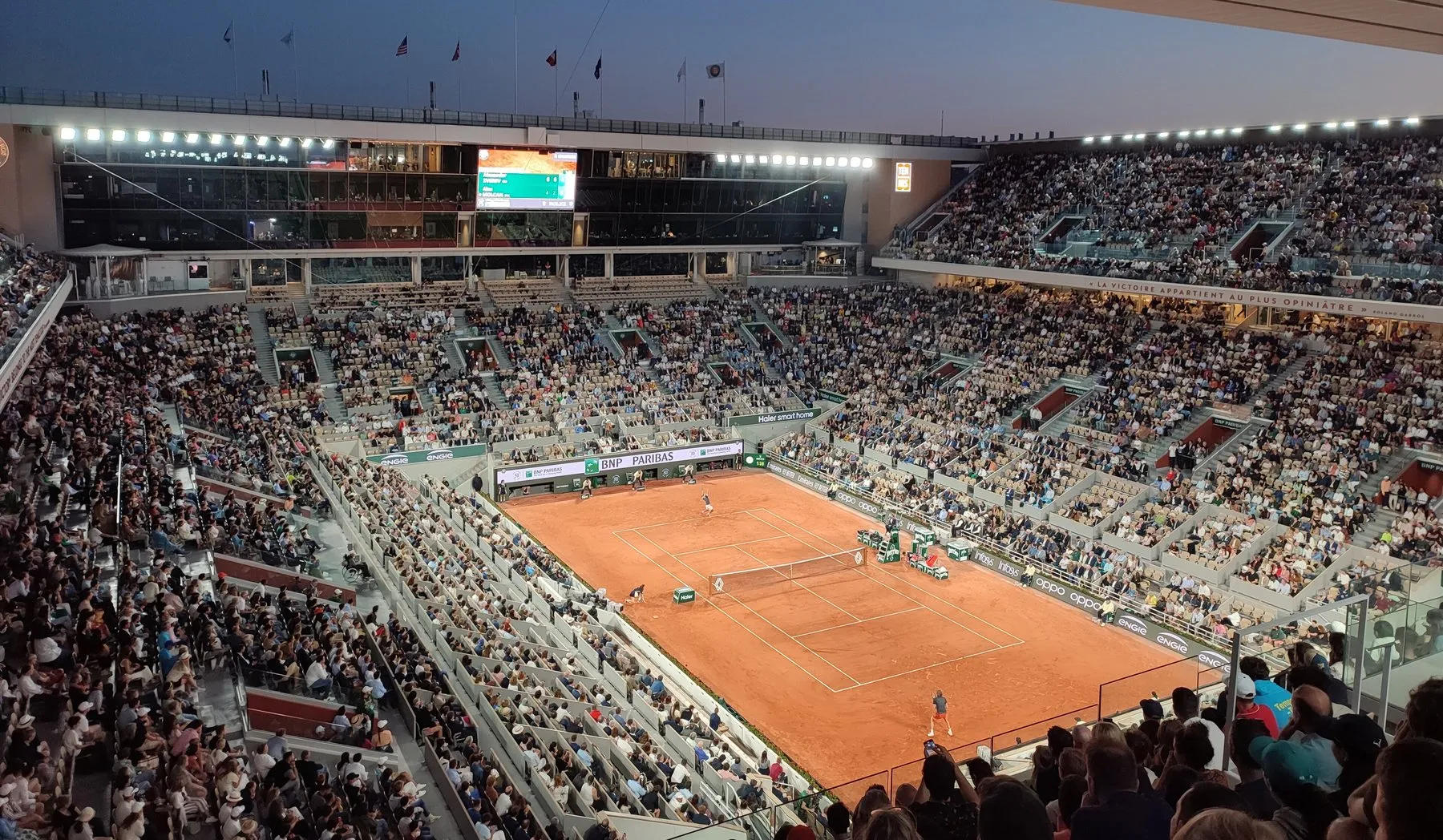
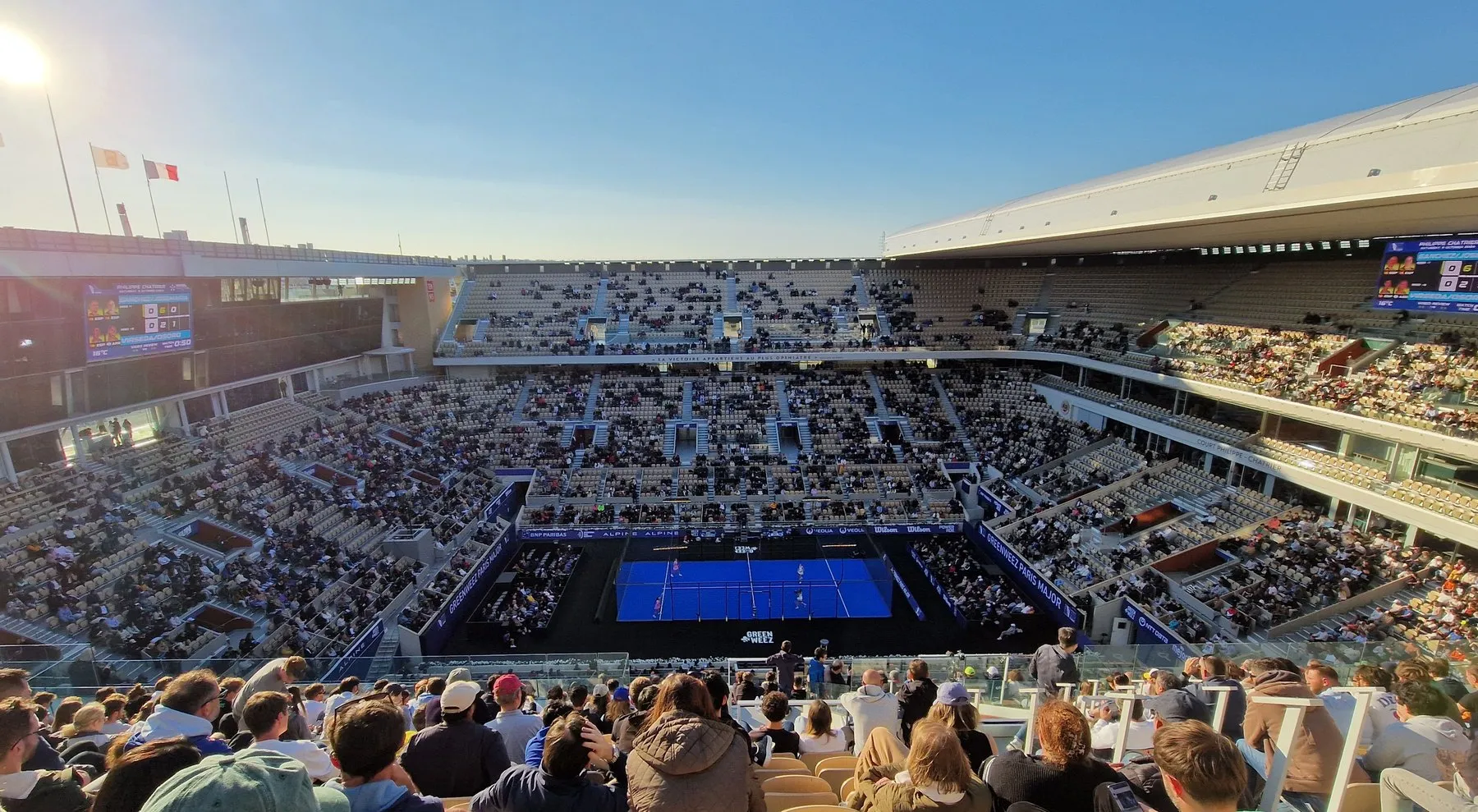
Padel has nonetheless filled the Chatrier: the Premier Padel Paris Major drew 81,000 spectators in 2026, a record for the tour, with a full Chatrier for the finals. We covered it in our 2026 Paris Major review. That is huge for padel; it is a fraction of what Roland-Garros welcomes in two weeks. When it comes to money, there is no contest: point to tennis.
Round 5: Spain, the country where padel has pulled ahead
If there is one country where padel has “killed” tennis, it is Spain. According to the ministry’s sports statistics yearbook, published in May 2026, Spain had 117,508 padel licences in 2025 (+7.7% in a year) against 91,557 tennis licences. At the end of 2021, the country already had around 14,000 padel courts for 13,385 tennis courts, according to a Deloitte study for Playtomic.
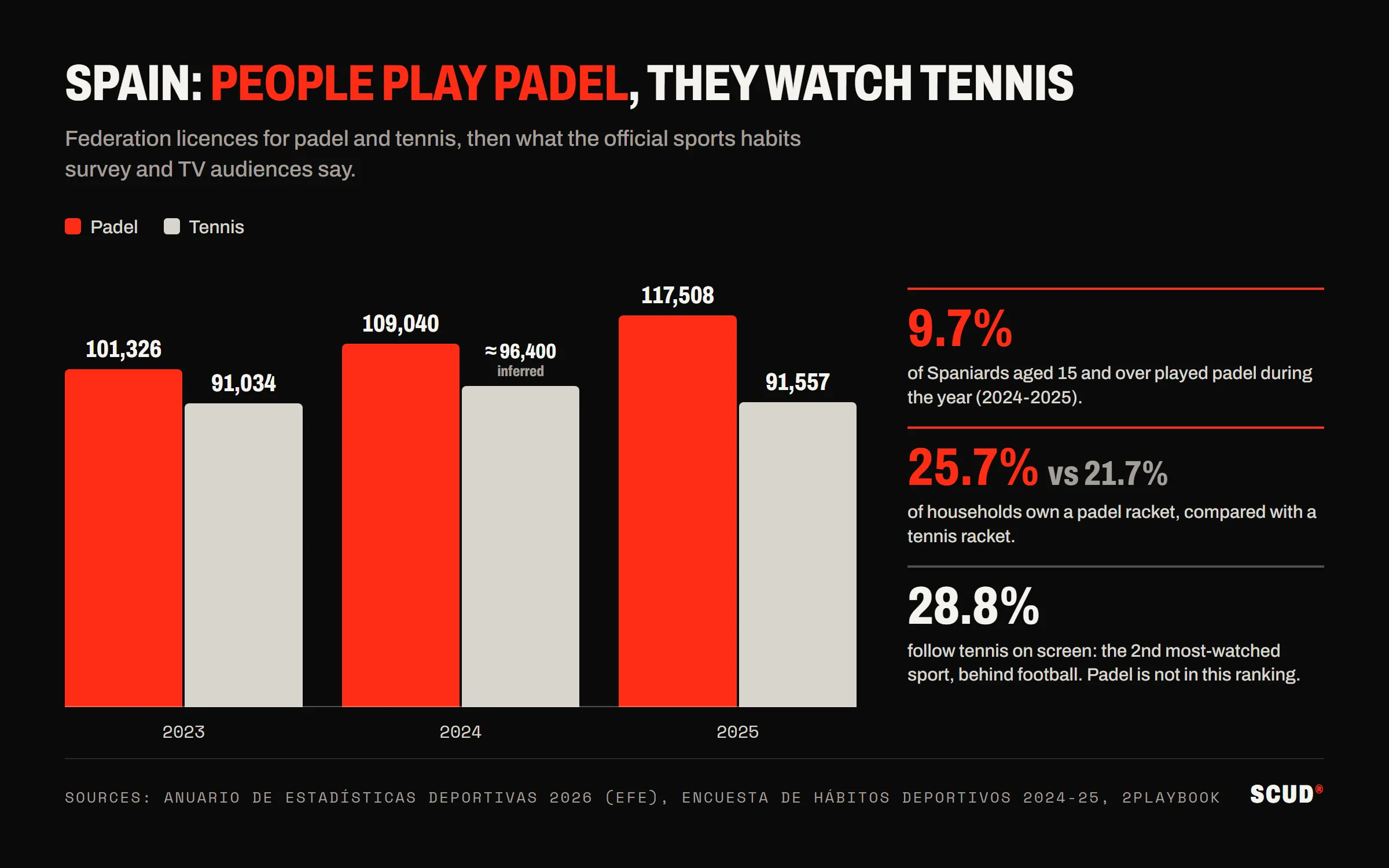
The official 2024-2025 sports habits survey confirms the scale of the phenomenon: 9.7% of Spaniards aged 15 and over played padel during the year, and 25.7% of households own a padel racket, compared with 21.7% owning a tennis racket.
But the same survey shows the other side. On screen, tennis is the country’s second most-followed sport (28.8% of the population), behind football; padel does not appear in that ranking. And it was in the middle of the padel boom that Spain turned Carlos Alcaraz into a world number 1, in 2022. Spanish club tennis has declined since the 1990s; it has not disappeared. On court, however, padel is ahead: point to padel.
Round 6: France, a record that owes a lot to padel
In France, there is a twist. On 31 August 2026, the French Tennis Federation had 1,289,104 members, up 4.9% in a year: its all-time record, above the previous peak of 2012 (1.12 million). Yet French tennis was coming out of a long decline, down to a low of 947,000 licences in 2020-2021, at the time of Covid.
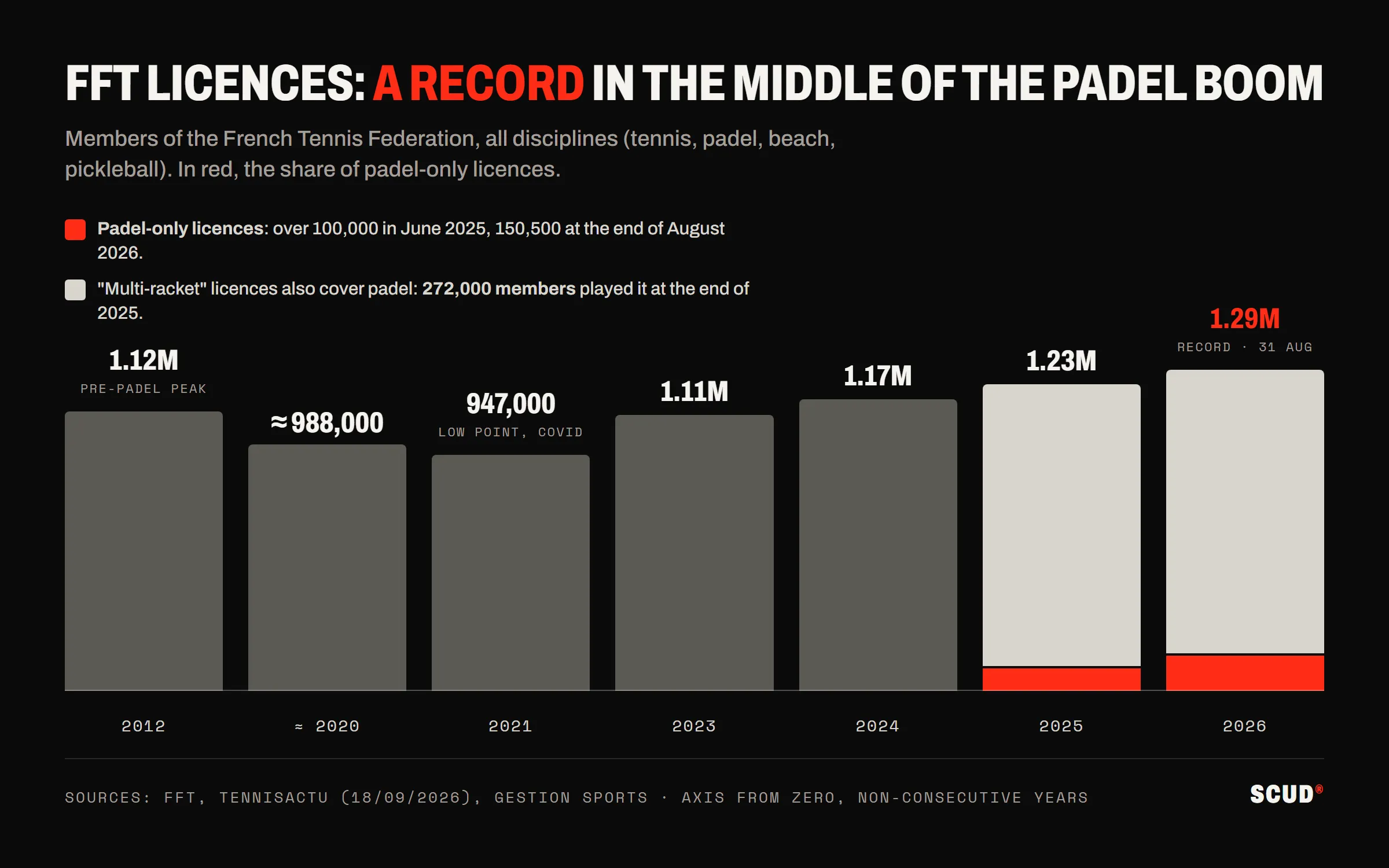
Except that the FFT also runs padel. Padel-only licences passed 100,000 in June 2025 (+42.7% in a year) and reached 150,500 at the end of August 2026. Above all, 272,000 members were playing padel at the end of 2025, padel and multi-racket licences combined, up 130% since 2022. By our calculations, padel-only licences alone explain around a quarter to a third of the rise since 2021; part of the rest comes from multi-racket members who also play padel, but the FFT does not publish a “tennis only” figure.
The FFT president, Gilles Moretton, said as much himself on RCI in May 2026: “Tennis is progressing, padel is exploding, and every discipline is benefiting from this multi-activity momentum.” And it is the tennis federation, carried by Roland-Garros revenue, that funds covered courts in community clubs through its Boost Padel programme. In France, padel is not eating tennis: it is growing up in its house. French tennis has never had so many members: point to tennis.
Round 7: the Swedish crash test
Last round, and the most instructive. Between 2019 and 2022, Sweden went from around 300 padel courts to more than 4,200, in three years, often in converted former warehouses. In Uppsala, the number of courts rose from 14 to nearly 100 in a year. Then came the crash: according to Creditsafe, quoted by Bloomberg, nearly 90 padel-related businesses went bankrupt in 2023. By the end of 2024, more than a hundred venues had closed; some halls became warehouses again, others supermarkets.
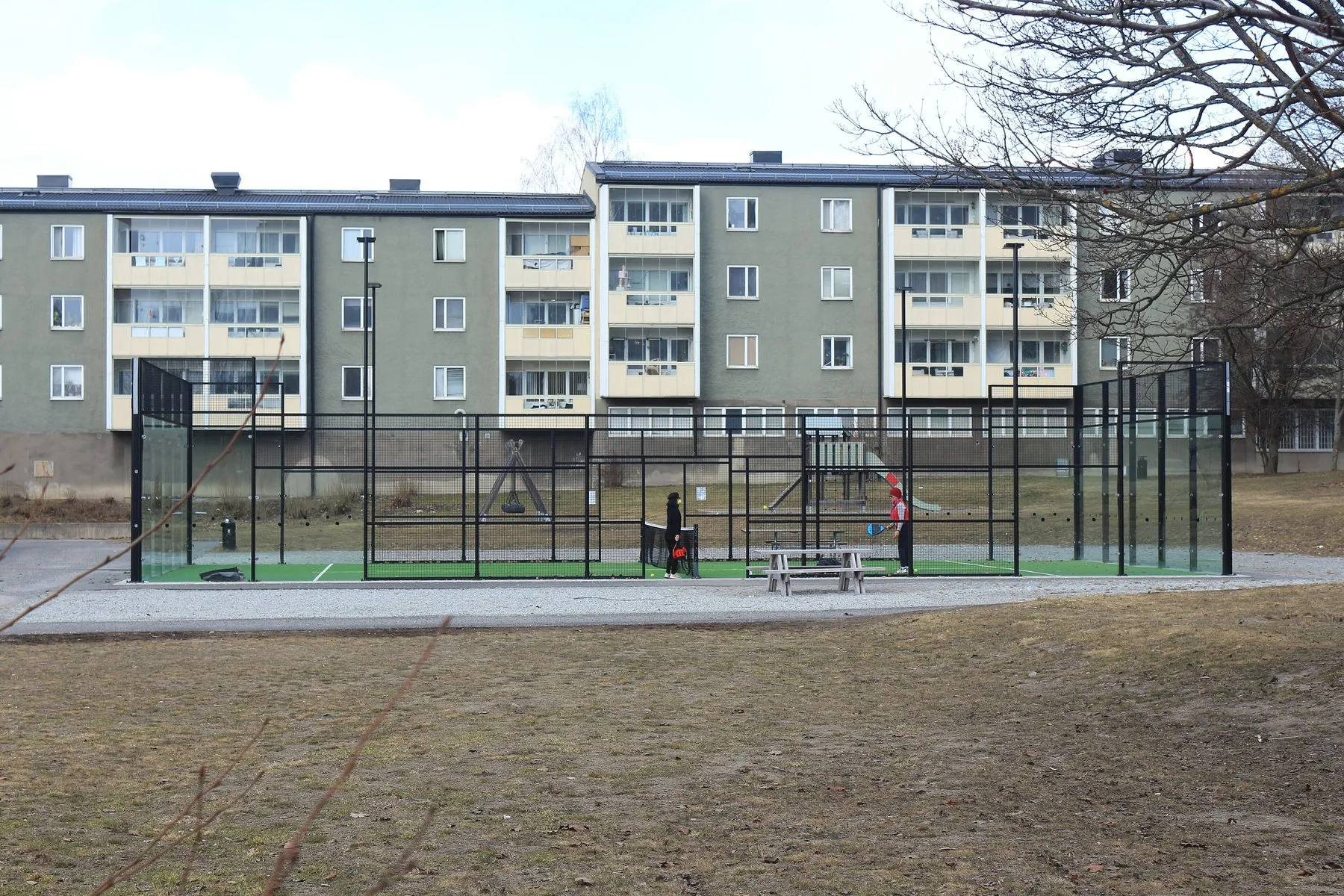
The causes put forward: debt-financed expansion, a supply of square metres far exceeding demand, and soaring electricity prices in the south of the country in winter 2022. Demand, though, did not disappear: the FIP counted more than 600,000 Swedish players in early 2024. And tennis? Tennis Stockholm’s membership rose from 37,061 in 2016 to 41,909 in 2022: no visible drop at the height of the bubble.
The same story had already played out in Argentina in the 1990s: courts on every street corner, then clubs closing and turning into car parks or five-a-side football pitches. We tell it in our history of padel. Padel did not kill tennis; it hurt itself, and it got back up. Point to tennis.
The verdict: 4-3 to tennis
Final score: four rounds to three for tennis. A win on points, not a knockout. Padel is not killing tennis: it is taking its courts, not its players. The strongest proof is that both sports are breaking records at the same time.
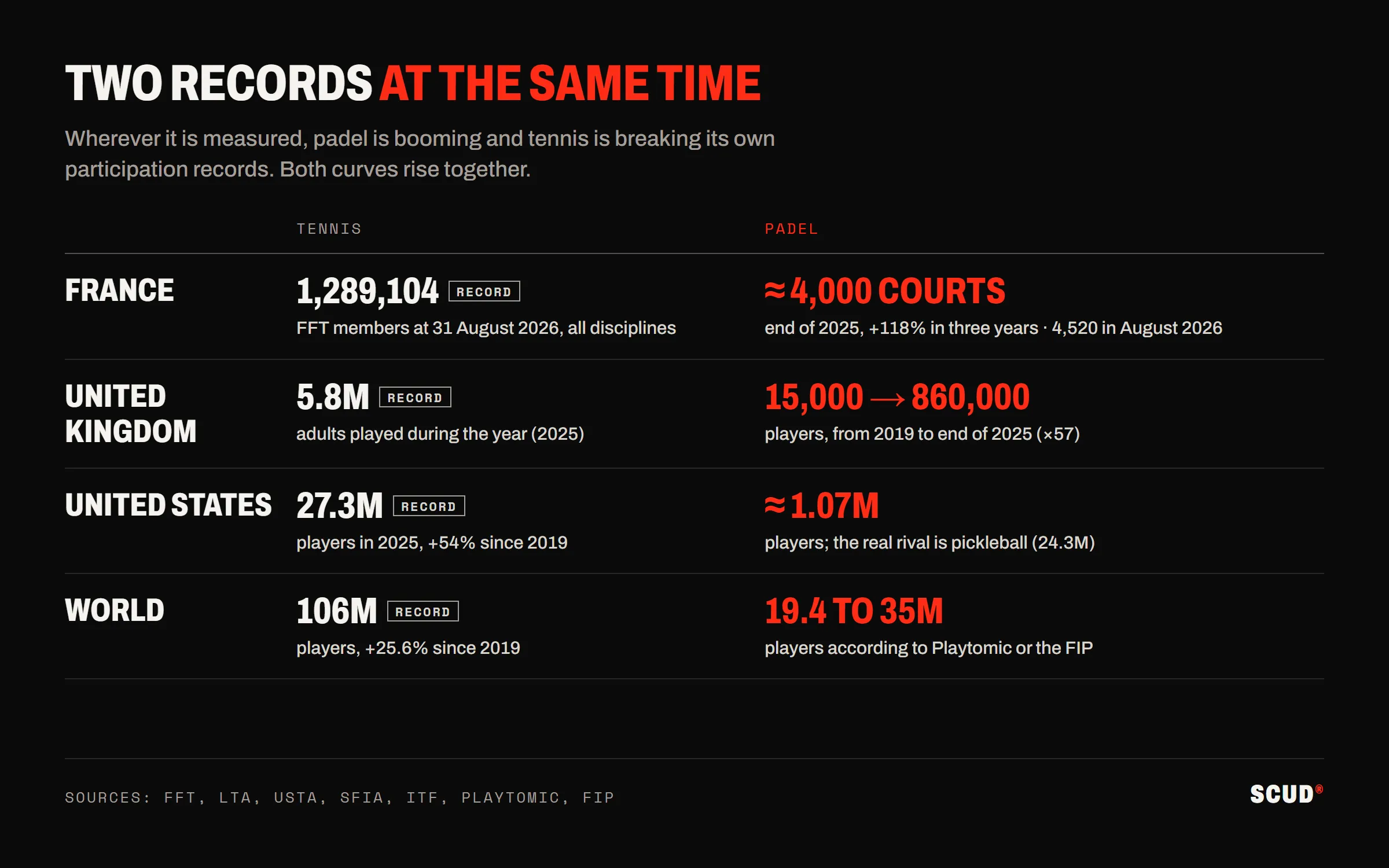
The threat is real, but it is local and economic: a club short of revenue may sacrifice an under-used court for two padel courts running at full capacity. The tennis player then loses a slot close to home; tennis itself does not lose players at national level. Padel’s real danger is not tennis: it is growing too fast, as in Sweden. And the real danger for tennis would be to shut the door on it.

And in the United States? The rival is called pickleball
In the United States, tennis’s competitor is not padel. According to the SFIA, pickleball had 24.3 million players in 2025 (+22.8% in a year), against around 1.07 million for padel, including 238,000 regulars. Djokovic was in fact targeting both sports at once: “padel and pickleball in the United States”.

And yet American tennis is also breaking its record: 27.3 million players in 2025 according to the USTA, up for the sixth year in a row and 54% higher than in 2019. Racket sports are not sharing a fixed cake: they are making it bigger together. To compare the three pieces of kit, read our article pickleball, padel, tennis: the rackets compared.
What the key players say
Public positions line up fairly clearly according to who is speaking.
- Novak Djokovic (Wimbledon, July 2024, quoted by L’Avenir): “If we don’t do anything about padel and pickleball in the United States, they’re going to convert all the clubs.” His concern is about facilities, not participation.
- Gilles Moretton, president of the FFT: “Tennis is progressing, padel is exploding.” The federation sees padel as an opportunity, and a source of licences.
- Andrew Castle, former British number 1: “I don’t see how padel could be seen as a threat to tennis.” Worth knowing: he co-owns Game4Padel with Andy Murray.
- Guillaume Couillard, Monaco’s Davis Cup captain: padel is “a real cash machine”, and tennis-only clubs are “suffering a lot”.
Many former tennis players have made the switch, by the way. Juan Carlos Ferrero, 2003 Roland-Garros champion, played a World Padel Tour event in 2015; Arnaud Clément and Arnaud Di Pasquale became French over-45 padel champions in 2024. If you are coming from tennis too, our comparison padel or tennis: which to choose tells you what really changes on court.
Padel and tennis myths
| What you hear | What the figures say |
|---|---|
| “Padel is emptying tennis clubs.” | The FFT, the LTA and the USTA all report record tennis participation in 2025-2026. |
| “In Spain, padel killed tennis.” | There are more padel licences, but still 91,557 tennis licences, and tennis is the second most-watched sport. |
| “One tennis court makes three padel courts.” | Documented conversions in France give two padel courts per tennis court. The “three” comes from the ratio of surface areas. |
| “Padel has 35 million players.” | That is the FIP’s figure. Playtomic, more cautious, counts 19.4 million. |
| “Padel is a highly female sport.” | The FIP claims 40% women among amateurs worldwide; in France, only 12.7% of ranked players are women. |
| “In the United States, padel threatens tennis.” | It is pickleball (24.3 million players), not padel (around 1.07 million). |
In short
- Tennis remains much bigger: around 106 million players worldwide, against 19 to 35 million for padel, and ten times as many courts.
- Padel is growing much faster: ×57 in the UK since 2019, around 4,000 courts in France at the end of 2025.
- For the same surface, a padel court brings in more than a tennis court: up to 3.3 times more potential hourly revenue in Paris.
- Tennis is breaking participation records in France, the UK, the US and worldwide during the padel boom.
- Padel’s real risk is a property bubble, as in Sweden or Argentina; the real rival of American tennis is pickleball.
Frequently asked questions
Will padel replace tennis?
No, nothing in the figures suggests it. Tennis has around 106 million players worldwide and is breaking participation records in France, the UK and the US, at the very moment padel is booming. Padel sometimes replaces courts, not players.
Why are tennis clubs building padel courts?
Because a padel court brings in more per square metre: in Paris, two tennis courts hired at €12 an hour made way for four padel courts hired at €20 an hour, up to 3.3 times more potential hourly revenue. Padel also attracts adults who did not play tennis.
Has padel killed tennis in Spain?
No. Padel has overtaken tennis there in licences (117,508 against 91,557 in 2025) and in courts, but tennis remains the country’s second most-watched sport, and Spain turned Carlos Alcaraz into a world number 1 in the middle of the padel boom.
How many padel and tennis players are there in France?
The FFT had 1,289,104 members on 31 August 2026, all disciplines combined, a record. 272,000 members were playing padel at the end of 2025, and the FFT estimates the number of padel players, licensed or not, at 850,000.
Is padel a fad that will collapse?
Padel itself is unlikely to disappear, but local bubbles do exist: in Sweden, around 90 businesses in the sector went bankrupt in 2023 after courts were built too quickly. What collapses then is the property model, not the sport.
To dig deeper into the history and figures of the sport, browse our Padel culture page.
Sources
- FFT : plus de 1 200 000 licenciés (tennis, padel, beach, pickleball, fauteuil)
- 2025, une saison record pour le padel en France
- La barre des 100 000 licenciés padel atteinte
- La FFT a encore gagné des licenciés cette année : les chiffres
- Le tennis progresse, le padel explose en Guadeloupe : le constat de Gilles Moretton
- ITF Global Tennis Report: participation hits 106 million in five years
- FIP World Padel Report 2025
- Global Padel Report
- 860,000 players: LTA unveils latest figures on growth of padel in Britain
- LTA annual report and accounts show growth of tennis and padel in 2025
- Tennis participation in the U.S. rises to a new high of 27.3 million in 2025
- SFIA report confirms over 24 million Americans playing pickleball
- Padel surpasses one million players in the United States
- Vive le padel au CS Ladoumègue
- Le padel, une discipline incontournable pour relancer les clubs de tennis
- Novak Djokovic a peur pour l'avenir du tennis
- El pádel es el deporte que más creció en fichas en 2025
- Encuesta de Hábitos Deportivos en España 2024-2025 : nota resumen
- Sweden holds warning for potential crash of the $4 billion padel craze
- How Sweden's padel mania ended in bankruptcies
- Tennis Stockholm : verksamhetsberättelse 2022
- Roland-Garros rappelle la spécificité de son modèle face à la protestation des joueurs sur le prize money
- From Paris 81,000 to Buenos Aires record: padel's show is smashing attendance records
- Crecimiento de récord para el pádel : el número de clubes aumenta un 181 % en cinco años
- Classement FFT padel : combien de joueuses et de joueurs classés
- Andrew Castle: padel is no threat to tennis