Contents — 12 parts
- What the rules say about the glass
- When should you let the ball go to the glass?
- Reading the ball’s path
- Where to put your feet: side-on, glass behind you
- Back glass, side glass, double wall
- The contra-wall, or contrapared
- Which shot should you play off the glass?
- The most common mistakes
- Drills to learn the glass
- Which racket for playing off the glass?
- In short
- Frequently asked questions
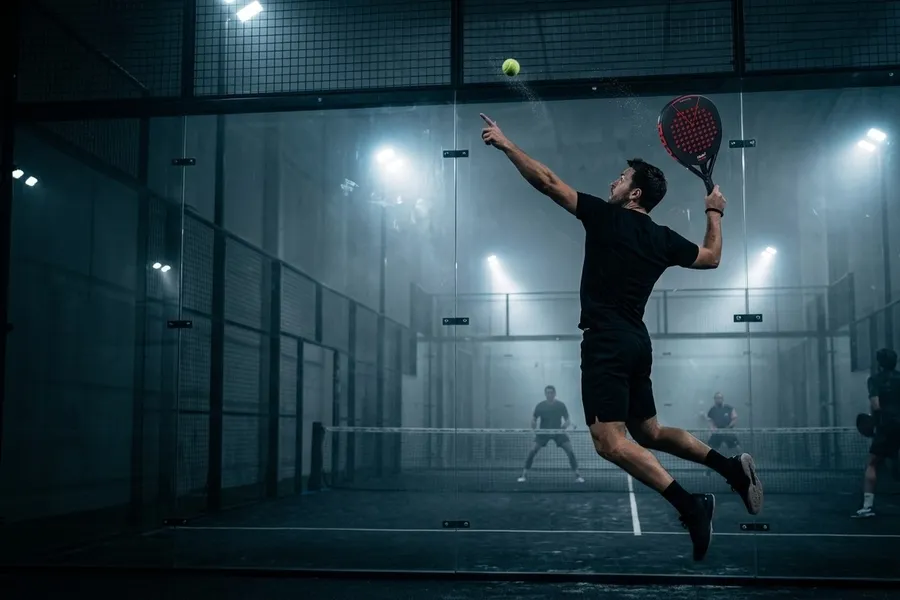
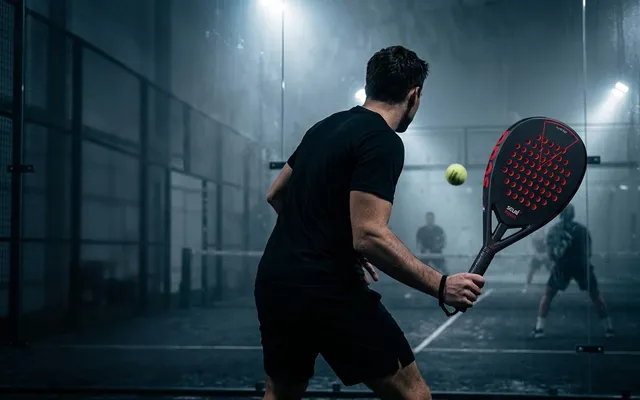
Playing off the glass in padel means letting the ball bounce on the ground, then off the glass on your side, and hitting it as it comes back out, before it lands a second time. The movement comes down to one positioning rule: don’t back up towards the glass; let the ball come back, stand side-on next to its path and move forward with it so you hit it in front of you. The glass is not attacking you: it gives you the ball back, slower, and buys you the time you didn’t have.
This guide covers everything to do with defending off the glass: what the rules allow, how to read the ball’s path, where to put your feet, how to play off the back glass, the side glass and a double wall, when to try the contra-wall, which shot to play coming off the glass, the most common mistakes and drills to practise.
What the rules say about the glass
The basic rules are set out in our article on padel rules for beginners. Here are the ones that govern play off the glass, according to the rules of the International Padel Federation (FIP).
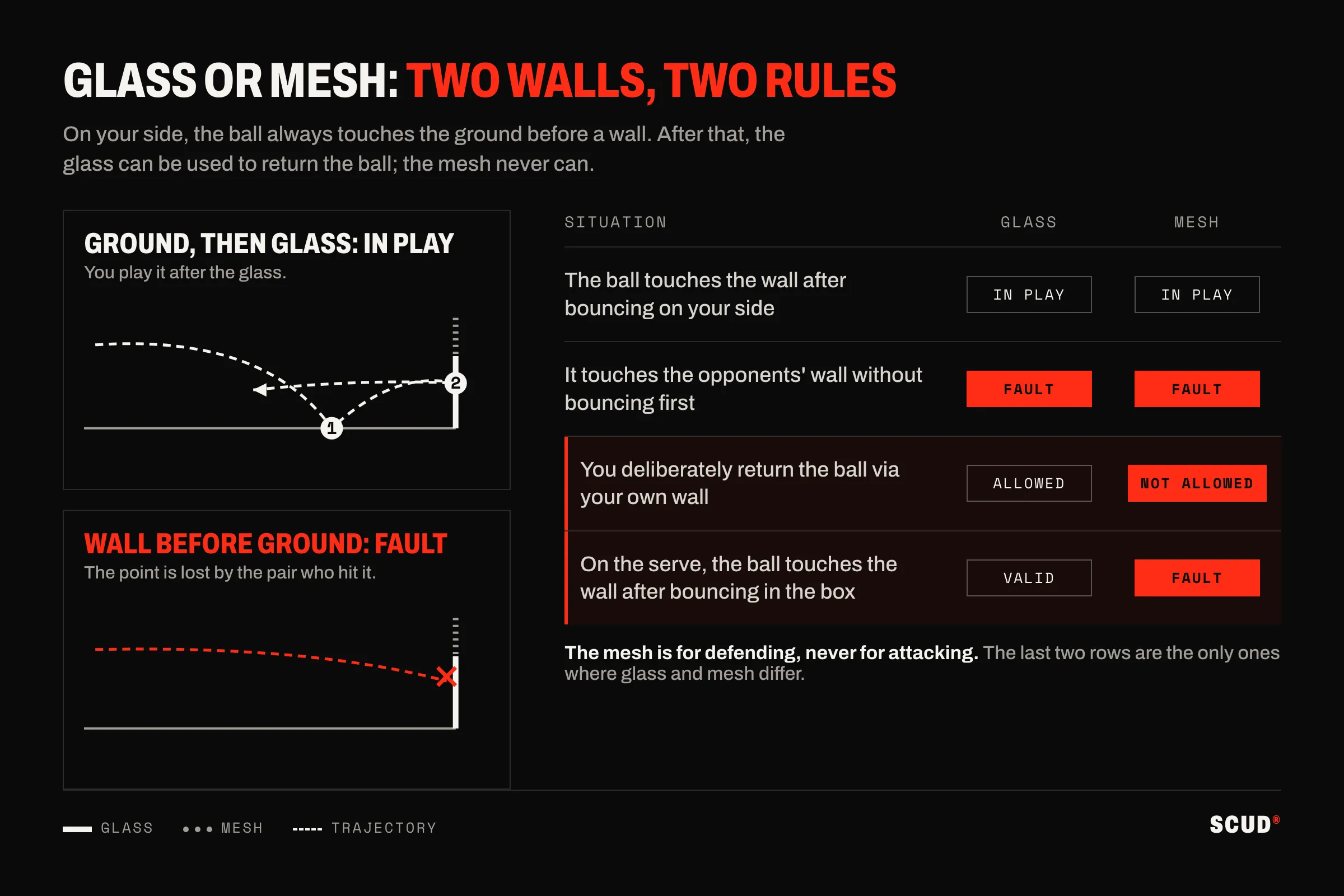
- Ground first, glass second. Once it has bounced on your side, the ball stays in play whatever part of the court it touches — back glass, side glass, mesh — and must be returned before its second bounce (rule 12).
- Several walls, no problem. Back then side, side then back: the ball remains playable as long as it has not touched the ground a second time.
- You may use your own glass. A ball hit against a glass wall on your side, which then bounces in the opponents’ half, is a valid return (rule 14). That is the contra-wall.
- Never your mesh. If your shot touches the mesh or the ground on your side, you lose the point (rule 13).
- Never the opponents’ glass directly. A ball that touches the opponents’ glass or mesh without bouncing on the ground is a fault, even after clipping the net (rule 13).
- The corner is good. A ball that bounces exactly in the corner formed by the floor and the glass is good (rule 14).
| Situation | Verdict |
|---|---|
| The ball bounces on your side, hits the back glass, you hit it | In play |
| It touches the back glass then the side glass before you hit it | In play |
| It bounces in the corner between floor and glass | Good |
| You hit it against your own glass and it bounces on the other side | Valid |
| You hit it and it touches your mesh | Point lost |
| Your shot hits the opponents’ glass without bouncing | Point lost |
| After bouncing on your side, the ball gets stuck on top of your glass | Point to the opponents |
A few dimensions help you read the game. According to the same rules, the back of the court is closed by three metres of glass topped with one metre of mesh. On the sides, the glass runs for four metres from the back (or in two two-metre steps on courts with stands), then the mesh takes over up to the net. The service line is 6.95 m from the net, so just over three metres from the back glass: that is the depth of your defensive zone.
When should you let the ball go to the glass?
The first decision comes before the stroke: play the ball before the glass, or let it go there. The FFT’s (French Tennis Federation) practical padel guide gives the starting rule: “In the majority of cases, any ball that bounces behind the service line should be played after it comes off the glass.”
Belgian player Laura Bernard, interviewed by DH Les Sports+ in March 2024, makes it her first piece of advice for beginners: “When you start padel, the main difficulty is the glass. I recommend everyone lets the ball bounce off the glass before playing it. That way you pick up the right reflexes faster. You need to take one or two steps forward instead of backing up.”
There are exceptions. A short ball, or a very slow ball loaded with slice, can die before reaching the glass or come out too low: that one is played before. Padel Addict makes the point in an April 2025 article on playing off the glass: some balls must be hit directly, without waiting for them to come off the wall. The practical test: if the ball bounces in front of the service line, play it; if it bounces behind and is heading for the back, let it come. The same decision arises from the very first shot of the rally, as we explain in our guide to the return of serve.
Even against a smash, the reflex is counter-intuitive. The FFT guide is explicit: “If you think the opponent is going to smash hard, unlike in tennis, you need to move towards the net to pick up the ball after it comes off the glass.” A powerful smash bounces hard off the glass and comes back a long way: backing up against the wall condemns you to hitting the ball pressed against the glass, with no room to swing.
Reading the ball’s path
The glass sends the ball back according to three things: the pace, the height and the spin of the incoming ball.
- A fast, flat ball comes back quickly and a long way off the glass. Give yourself distance, at least two big steps.
- A high, slow ball (a lob dropping near the back) hits the glass high up and comes down gently: you have time, and sometimes the chance to attack.
- A sliced ball bounces low and comes off the glass with no height, sometimes skidding. It forces you to bend your knees.
- A topspin ball kicks up after the bounce and comes off higher and faster than expected.
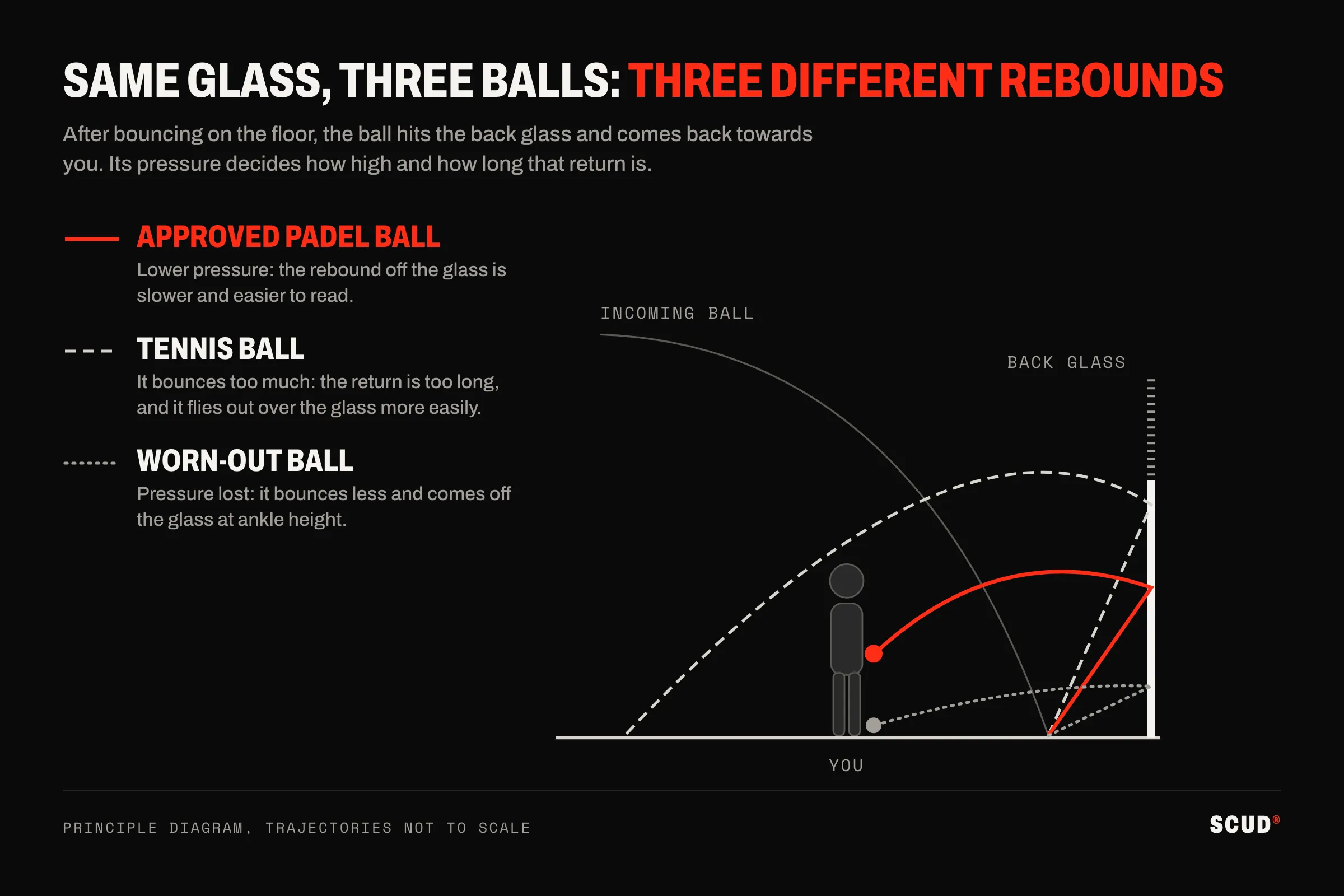
The condition of the ball matters too. An approved ball bounces between 135 and 145 cm when dropped from 2.54 m, and that range sets how high it comes off the glass; a ball that has lost its pressure comes out at ankle height. We covered this in our guide to padel balls: playing with tired balls skews how you learn the glass.
Where to put your feet: side-on, glass behind you
The ready position in defence is taken one to one and a half metres in front of the back glass, knees bent, racket in front of you. When the ball heads for the glass, the temptation is to back up with it and face it. That is the starting mistake: you end up pinned against the wall, with the ball coming out into your body.
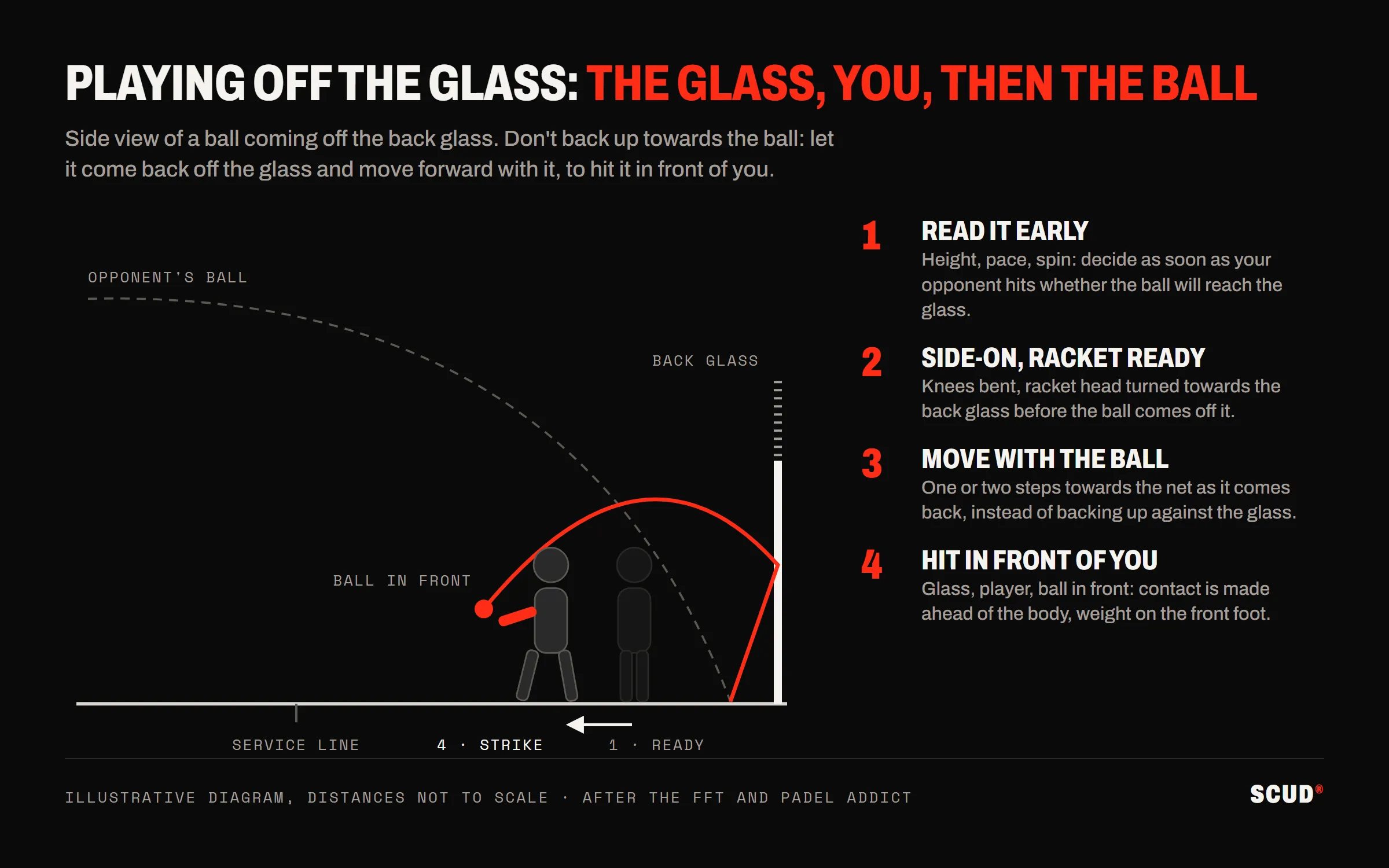
The right sequence has four steps:
- Read it early. As soon as the opponent hits, decide whether the ball will go to the glass.
- Turn side-on. Turn your shoulders, with the shoulder opposite your hitting arm towards the net, and prepare the racket early. On a high ball coming off the back glass, Padel Addict recommends waiting with the arm cocked, the racket head turned towards the back glass.
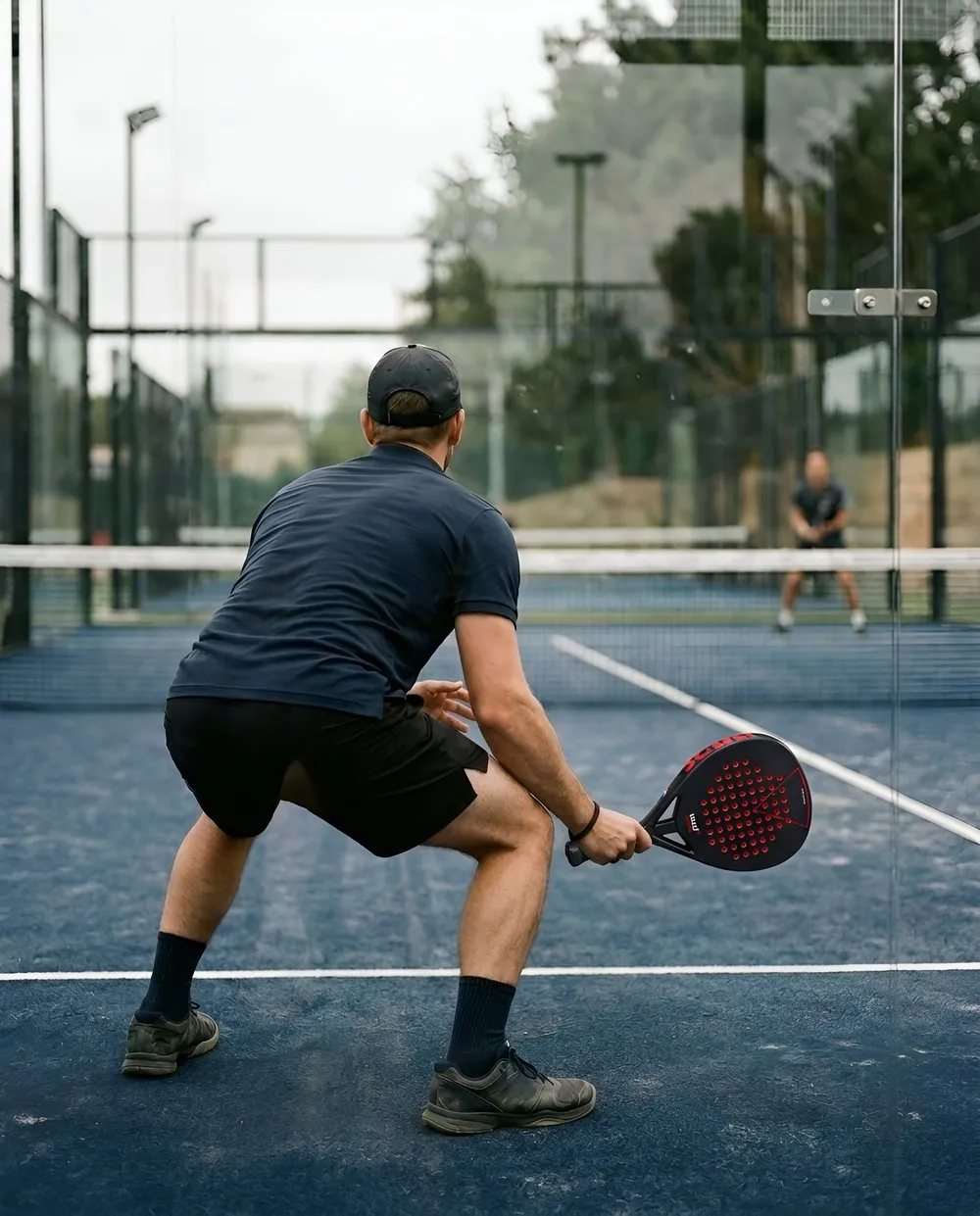
- Let the ball pass, then move forward with it. It comes back off the glass along your body; you go with it, taking one or two steps towards the net.
- Hit in front of you. Coach Miguel Sciorilli sums up the order to follow in Padel Addict: “pared – jugador – pelota por delante”, the glass, then the player, then the ball in front. Your weight finishes on your front foot.
Should you turn round to face the glass? No, in the vast majority of cases. Watching the glass forces you to pivot again to hit, and makes you lose sight of the opponents. Stay side-on, head turned towards the ball: it is the same position as for an ordinary forehand or backhand, just shifted in time.
Back glass, side glass, double wall
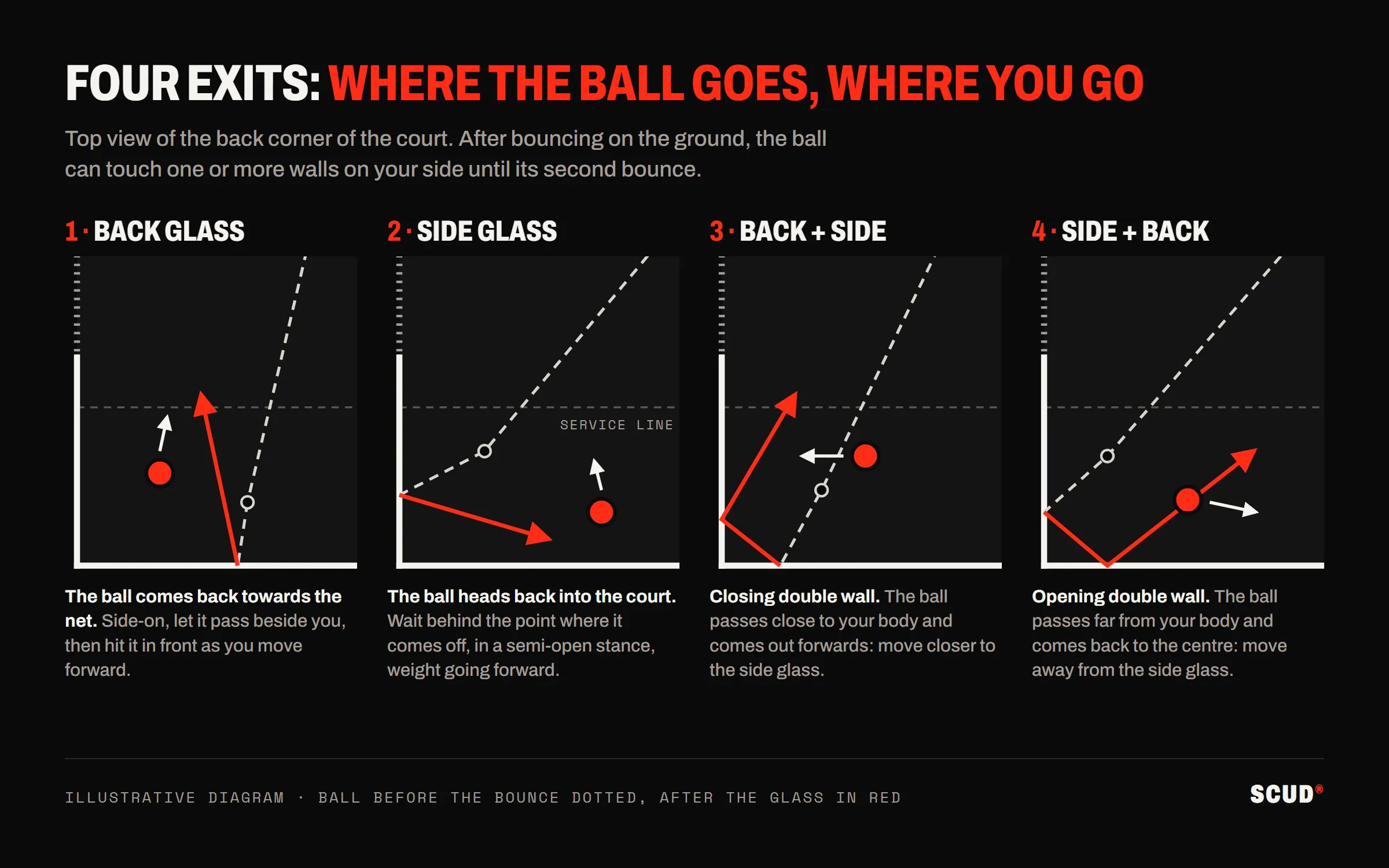
Each wall sends the ball back in a different direction. The diagram below sums up the four cases, seen from above.
The back glass
This is the reference shot off the glass. The ball bounces, hits the glass and comes back towards the net, roughly along the line it came in on. Stand beside that path, an arm and a racket’s length away, and hit the ball as it drops, between knee and hip. If it comes out high, above the waist, Padel Addict advises taking the chance to play an aggressive shot.
The side glass
A cross-court ball that hits the side glass heads back into the court, often towards the back. Wait for it behind the point where it comes off, in a semi-open stance — more closed than for a ball off the back glass, Padel Addict specifies — and hit from back to front, low to high, with your weight finishing on your front foot. The classic mistake is to hug the side glass: the ball then comes straight into your body.
The double wall: the one that closes, the one that opens
A double wall is a ball that touches two walls before you hit it. In a Padel Addict article, Miguel Sciorilli distinguishes two cases, and this is the key to all double-wall defence:
- The closing ball passes close to your body: it touches the back glass first, then the side glass, and comes out forwards. Move closer to the side glass.
- The opening ball passes far from your body: it touches the side glass first, then the back glass, and comes back towards the centre. Move away from the side glass.
In both cases the ball goes via the back glass, and the order stays the same: glass, player, ball in front. On a very wide cross-court ball, Padel Addict points out that the opening double wall often lets you return the ball more naturally and less hurriedly than playing it just after the side glass: you only need to turn and follow its path.
The contra-wall, or contrapared
The contra-wall means hitting the ball against your own back glass so that it travels back over the net. The rules allow it, provided the ball then bounces in the opponents’ half. It is an emergency shot: the ball has got past you, it will die in the last metre, and you have no other option.
Padel Addict, in a January 2025 article, describes it as an “último recurso”, a last resort, and highlights its main risk: being hit on the body or face by the ball coming back off the glass, especially if you strike the lower or middle part of the glass. The version recommended for beginner and intermediate players is the lobbed contra-wall: continental grip, open racket face, hitting towards the top of the glass so that the ball travels back high and long.
Don’t confuse it with the bajada de pared. In Spain, the bajada means the opposite of an emergency shot: an attack, usually a smash or a firm drive, played on a high ball dropping after hitting the back glass. In a sample of more than 8,500 shots from eight men’s World Padel Tour matches, analyst Francisco García Peñalver (Padelmetrics, February 2024) found that the bajada accounts for less than 3% of shots, that it is played on the forehand 91.2% of the time, and that it ends in a winner 7.94% of the time, but in an unforced error in 8.47% of forehand bajadas. A rewarding shot, then, but a risky one.
Which shot should you play off the glass?
Getting the ball off the glass is only half the job: the shot that follows decides whether you stay on the defensive or take back the initiative.
| Shot | When to play it | Aim |
|---|---|---|
| Lob | The ball comes off at a comfortable height, the opponents are at the net | Push them back, retake the net |
| Chiquita | The opponents are at the net but far from the ball, you have touch | Force them to volley upwards |
| Bajada (attack) | The ball comes off high, above the waist | Beat the opponent for pace |
| Contra-wall | The ball has got past you | Save the point |
The lob remains the safest and most useful shot: the ball is coming towards you, you have time to get the racket under it. The FFT guide puts it bluntly: “To take the net, using the lob is fundamental.” Our guide to the lob in padel breaks down the stroke, and our article on padel shots goes back over the chiquita.
The most common mistakes
- Backing up against the glass. You deprive yourself of the room you need to hit. Keep your distance and move forward with the ball.
- Facing the glass. You waste time pivoting and can no longer see the opponents.
- Hitting too early. The ball coming off the glass is still rising: wait for it to drop.
- Hitting the ball behind you. Contact must be made in front of your body, otherwise the ball flies up or into the glass.
- Playing the contra-wall by reflex. It is a last resort, not a building shot.
- Staying at the back after a good return off the glass. If your lob goes over the opponents, move up with your partner: that is what our guide to positioning in padel is all about.
Drills to learn the glass
A few simple drills, to do with a partner or coach who feeds balls by hand or with a racket.
- Reading without hitting. Your partner sends balls towards the back glass; you get into position without hitting, and say out loud where the ball will come out. Padel Addict, following Miguel Sciorilli, suggests the same progression for the double wall: first watch, then move, and only then hit.
- Hand-fed ball, back glass. Stand two metres from the glass; your partner throws the ball so that it bounces then hits the glass. Hit a forehand, then a backhand, making yourself take one step forward before contact.
- Lob after the glass. Same drill, with a target at the back of the opponents’ half: the lob must bounce behind the service line.
- Side glass. Cross-court balls to the side glass, returned from a semi-open stance.
- Double wall: closing or opening? Your partner mixes balls that close and balls that open. You call “closing” or “opening” before you move.
- The point that starts in defence. Opponents at the net, you at the back: every point starts with a ball sent to your glass, and you must retake the net.
Do these drills with balls in good condition, and after a warm-up: playing off the glass demands repeated knee bends and pivots, as we explain in our guide to warming up for padel.
Which racket for playing off the glass?
The return off the glass is the shot where the contact point is least predictable: the ball comes back on a path that varies with its pace, its spin and the wall. A forgiving racket, with a large sweet spot and soft foam, is kinder to off-centre hits; a manoeuvrable racket gets there in time on fast balls. A power racket, head-heavy, is more demanding in this area. Our power or control comparison helps you decide.
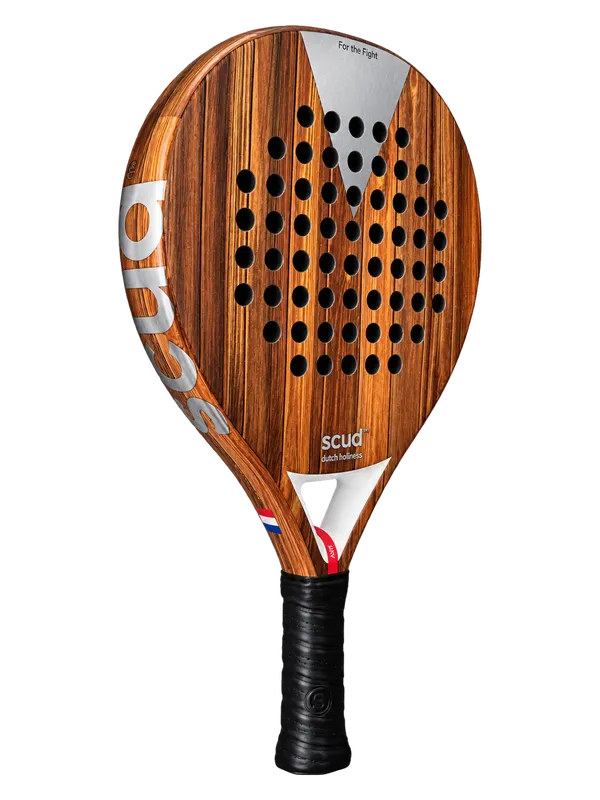
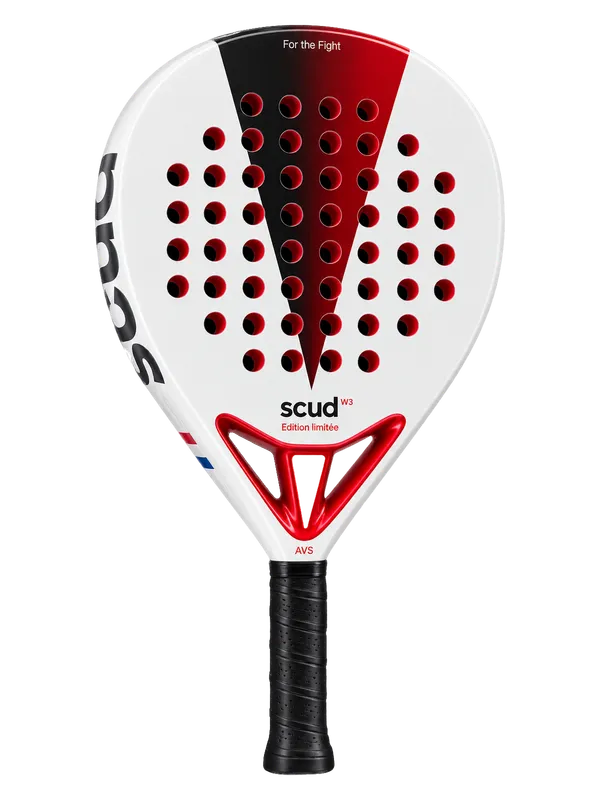
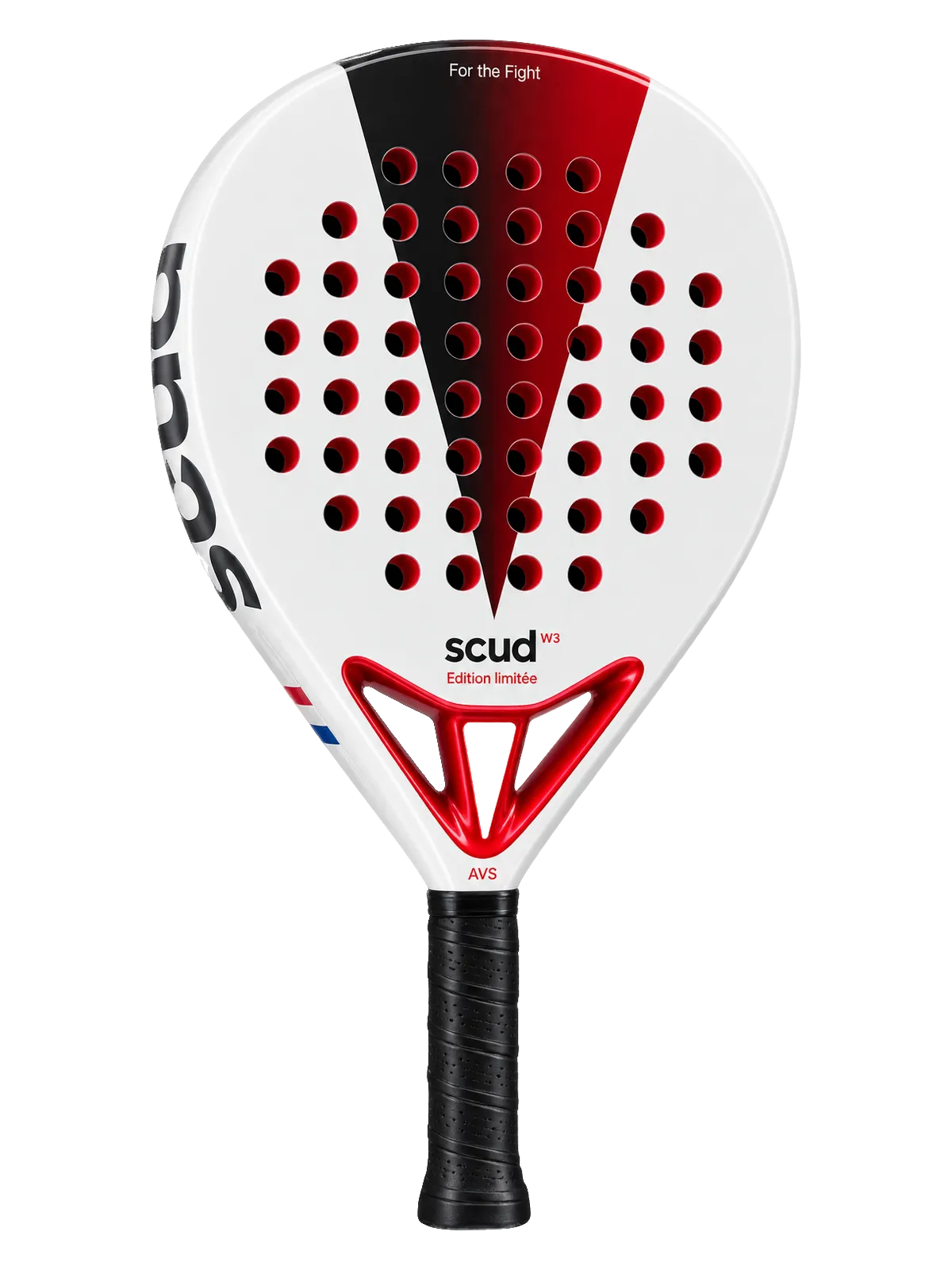
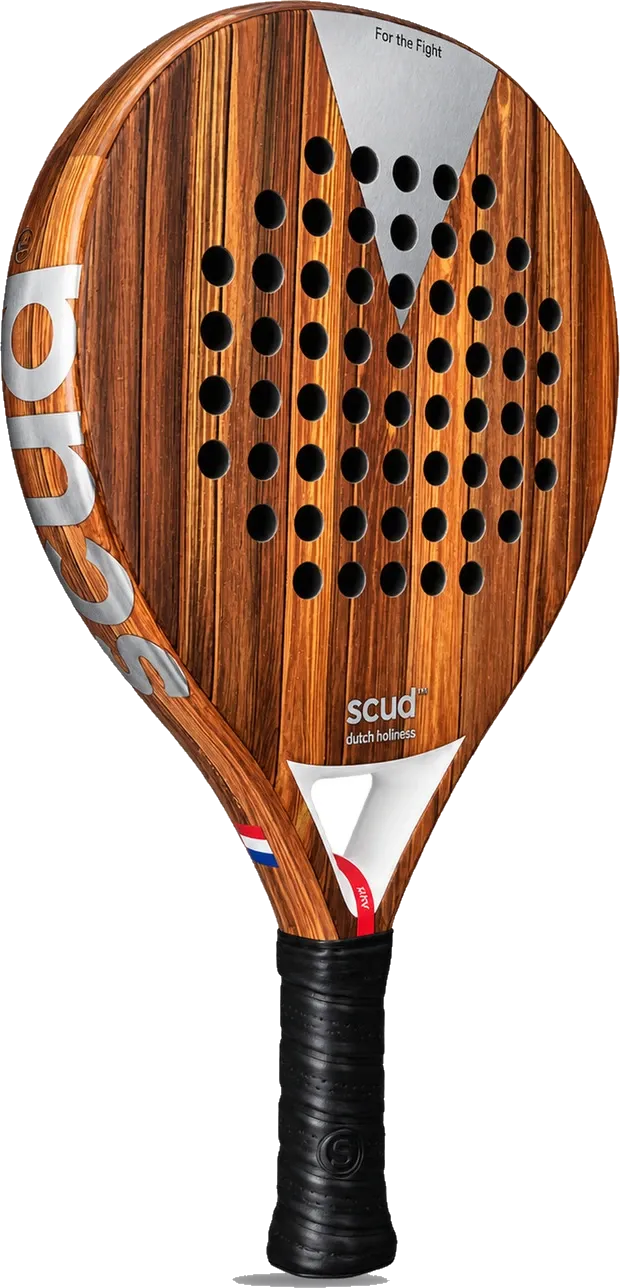
In our range, the SCUD Wood W1 is the best suited to learning the glass: teardrop shape, 350 g, medium balance and soft EVA foam. The SCUD White S3, our 12K carbon control reference, suits more experienced players who want to stay in command of their returns off the glass.
In short
- On your half, the ball must bounce on the ground before touching a glass wall; it then remains playable, even after several walls, until the second bounce.
- Any ball that bounces behind the service line is, in most cases, played after the glass.
- Don’t back up against the glass: turn side-on, let the ball come back and move forward with it to hit it in front of you.
- Double wall: the closing ball means moving closer to the side glass, the opening ball means moving away from it.
- The contra-wall is a last resort; the lob remains the safest shot off the glass for retaking the net.
Frequently asked questions
Are you allowed to play the ball after the glass in padel?
Yes. After bouncing on the ground on your side, the ball may touch one or more glass walls, and you may hit it as long as it has not bounced a second time. It is in fact the most characteristic shot in padel.
Can you return the ball off your own glass?
Yes, that is the contra-wall. The shot is valid if the ball then bounces in the opponents’ half. It is lost if, after your shot, the ball touches your mesh or your ground. Keep it for balls that have got past you.
What happens if the ball hits the opponents’ glass directly?
The point is lost by the pair who hit it. On the opponents’ side, the ball must always bounce on the ground before touching a glass wall or the mesh, even if it first clipped the net.
Should you turn to face the glass when playing off it?
No. Stay side-on, glass behind you, and let the ball come back along your body. You hit it in front of you as you move forward, without having to pivot a second time, and you keep the opponents in view.
What is a double wall in padel?
It is a ball that touches two glass walls on your side, the back and the side, before you hit it. If it passes close to you, it touches the back then the side and comes out forwards: move closer to the side glass. If it passes far from you, it touches the side then the back and comes back towards the centre: move away from it.
Is a ball that bounces in the corner of the glass good?
Yes. The FIP rules treat a ball that bounces in the corner formed by the floor and the glass as good. It often comes out low and unpredictable, which makes it hard to defend.
Playing off the glass is one of the fundamentals of padel: find the other steps in our complete guide to learning padel.
Sources
- Rules of Padel
- Guide pratique du padel
- Déplacements, mouvements de raquette, service, construction du point : les dix commandements pour les débutants au padel
- Claves para defender la doble pared, por Miguel Sciorilli
- Jugar con paredes en el pádel: ¿Cuándo debemos hacerlo?
- La contrapared en el pádel: cuándo realizarla y cómo ejecutarla
- La bajada de pared: ¿me ayuda o me perjudica?