Contents — 12 parts
- The video at a glance
- Three face finishes: smooth, rough, sanded
- The core, “the soul of the racket”
- Classic EVA: soft, medium, hard
- Black EVA and HR: the newer EVAs
- Firm EVA: the passage where SCUD appears
- Polyethylene and Power Foam: the comfort family
- Two foams in one racket
- The eight cores at a glance
- What we take from it when choosing
- In short
- Frequently asked questions
Short answer: the core of a padel racket is almost always EVA or polyethylene. EVA runs from soft, white and comfortable, to hard, the most powerful on fast balls; in between sit medium, Black EVA, high-rebound HR and firm EVA, the foam in the SCUD Mexique M1. Polyethylene and Power Foam favour lightness and comfort, at the cost of a shorter lifespan.
On 3 October 2026, the Portuguese channel SunTzu Padel published the second part of its guide “Como comprar a minha raquete de sonho?”, how to buy your dream racket. Seventeen minutes on two things you can barely see in a shop: the finish of the face and the foam of the core. At 9:05, the SCUD Mexique M1 product page appears on screen, and the author names “the French brand Scud” as an example of firm EVA. We watched the video minute by minute: here is what it teaches, what it says about our rackets, and what we would add.
The video at a glance
SunTzu Padel is a Portuguese channel named after Sun Tzu’s The Art of War: its shorts twist the strategist’s maxims, its long videos cover gear and game. The author says it up front: he is neither an engineer nor a manufacturer, but a racket collector who cross-checks sources rather than repeating what gets said at the club. The first part of the guide went through the fibres of the shell, from carbon to basalt. The second, in Portuguese with captions that YouTube can translate into English, goes beneath the surface. It runs in ten steps:
| Time | What it covers |
|---|---|
| 0:00 | Three face finishes: smooth, 3D rough, sanded |
| 3:29 | The core, “the soul of the racket” |
| 4:05 | Classic EVA: soft, medium, hard |
| 7:03 | Black EVA |
| 7:50 | HR, high-rebound EVA |
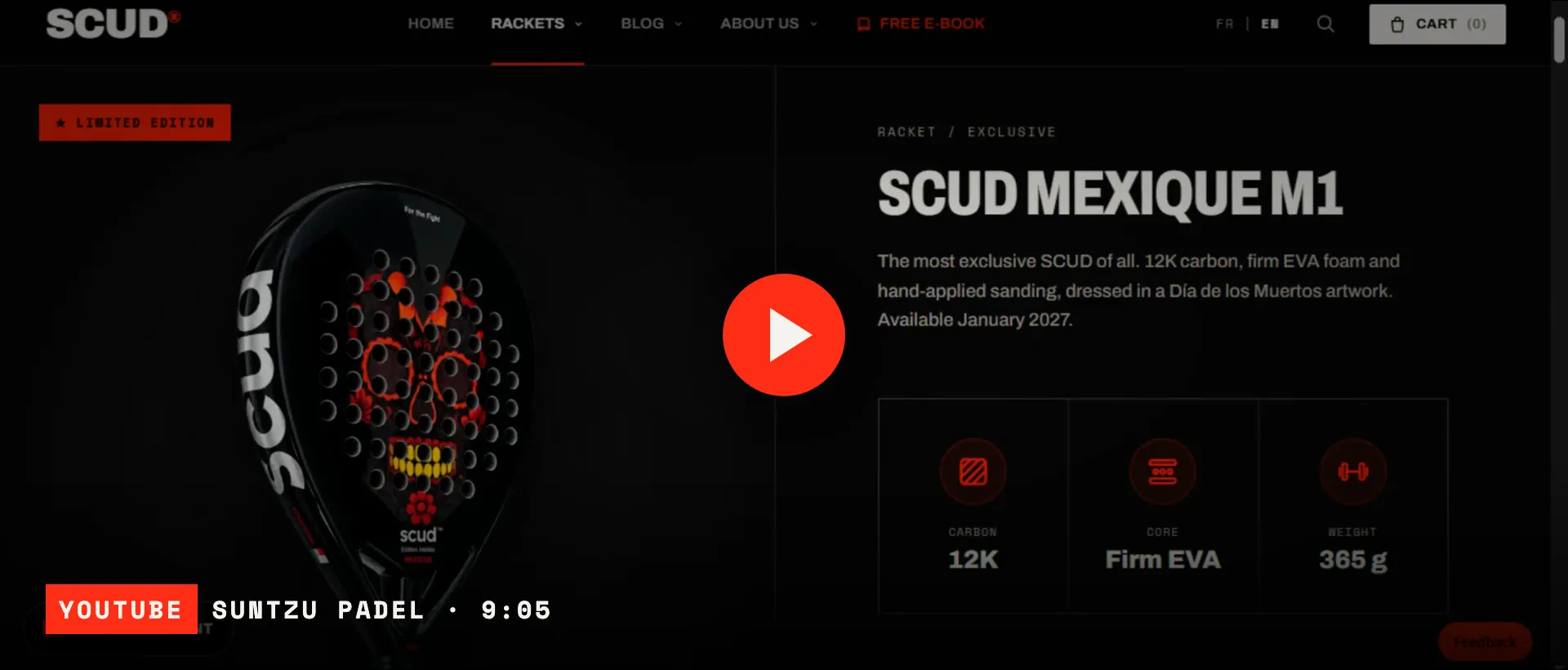
| 8:41 | Firm EVA, with the SCUD Mexique M1 on screen from 9:05 to 9:55 |
| 9:42 | Polyethylene |
| 11:09 | Power Foam |
| 12:48 | Two densities stacked in one core |
| 14:42 | A different density on each face |
Three face finishes: smooth, rough, sanded
The video starts with the skin of the racket before going under the surface.
A smooth face is glossy, finished in epoxy resin with no texture. The ball slides off it straight away: little grip, so little spin from the racket itself, and spin has to come from the arm and wrist. In return, nothing wears: the face stays the same for a very long time.
A 3D rough face carries a relief that holds the ball longer. It gives more rotation and more control, but the relief wears down match after match.
A sanded face (arenosa in Portuguese, or sandpaper) is coated with a silica-loaded paint. Maximum grip and maximum spin, with the fastest wear as the trade-off.
The author adds two nuances. Some brands build the roughness into the structure of the face rather than the paint, so it barely fades. And a worn texture can be restored, but that takes outside work.
| Finish | Spin | Grip | Durability |
|---|---|---|---|
| Smooth | Low | Low | Very good |
| 3D rough | High | High | Medium |
| Sanded | Maximum | Maximum | Shortest |
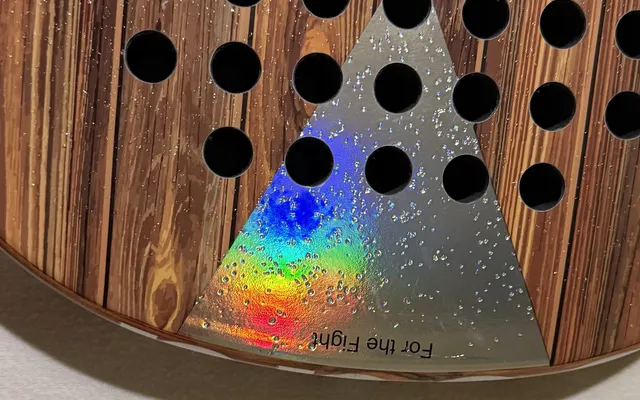
This is exactly the logic we set out in rough padel racket surfaces: sanding or 3D relief. Every SCUD racket belongs to the third family: silica crystals applied by hand, face by face. To make that grain last, see hand-applied sanding.
The core, “the soul of the racket”
Carbon, fibreglass, basalt, graphene, aramid: the materials of the shell and frame matter, the author reminds us, but the core sets the tone. This perforated block of foam fills almost the whole thickness of the face, up to 38 mm under the rules of the International Padel Federation.
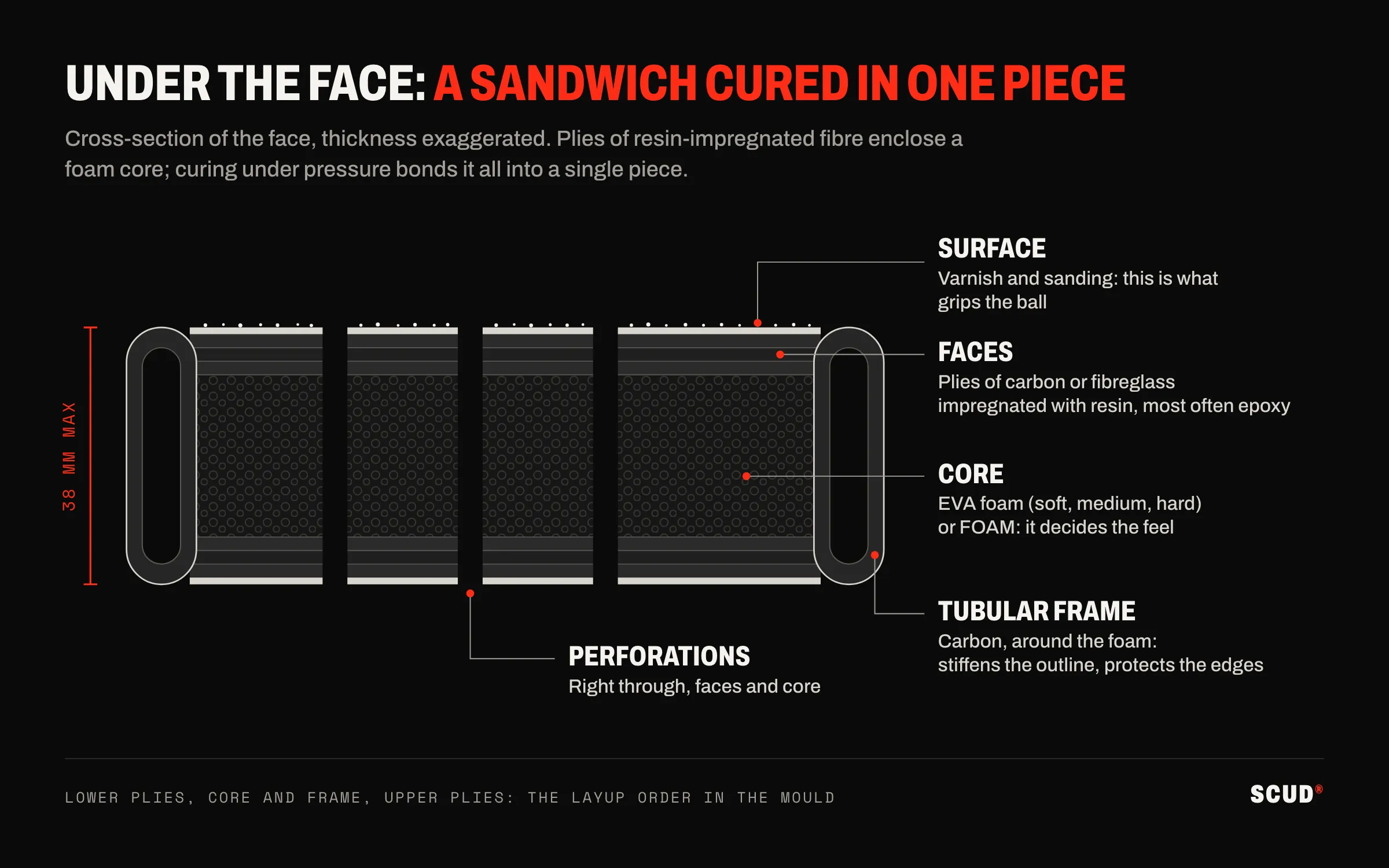
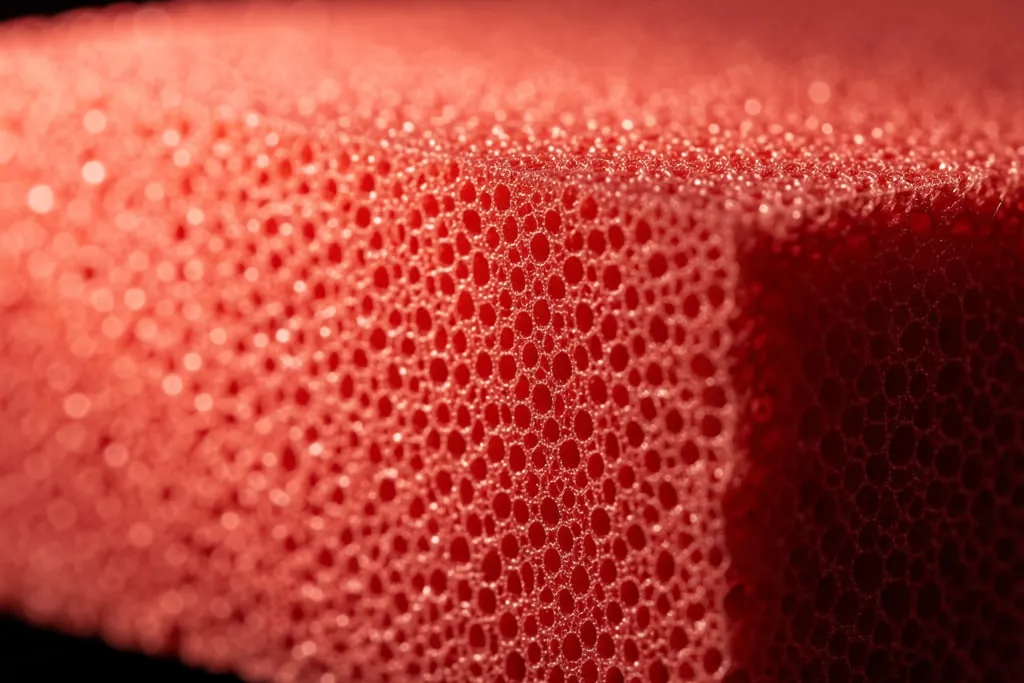
Two families share the market. Ethylene-vinyl acetate, EVA, dominates by far and comes in many variants. Polyethylene forms the second, rarer family, built around comfort.
Classic EVA: soft, medium, hard
Soft EVA is a white, porous, very comfortable foam. You can spot it through the holes of the face: a clean white inside means soft EVA. It soaks up vibration well, which is precisely why it is not the most powerful.
Medium EVA looks light grey through the holes. Medium density: not exceptional for comfort or for power, but a sound balance between the two, which is why so many rackets use it.
Hard EVA is the hardest. You find it in the competition versions of the major brands, the ones that want the ball sent back as fast as possible instead of being absorbed by the face.
The most useful part of the video comes down to one distinction: ball exit is not power. Soft or medium EVA gives “easy power”: it reacts well to slow balls and sends them back without effort. Hard EVA reacts better to fast balls: it returns the pace of a ball that arrives hard, provided you have the stroke to meet it. The first forgives, the second rewards.
One word of caution from us: the colour you see through the holes is a clue, not a rule. It also depends on the foam supplier, and the spec sheet remains the only reliable reference. Our guide soft vs hard EVA or FOAM compares the three densities point by point, cold weather included.
Black EVA and HR: the newer EVAs
Black EVA, a black foam, is more recent than the three above. For the author it strikes “a spectacular balance” between comfort, power and control: firm without being as hard as a hard EVA, and without dropping back to medium or soft. He insists it is not better than the others; it suits players who want a firm foam without the dryness of a hard one.
HR EVA, for High Rebound, is a very elastic orange rubber with a high rebound and a distinctive way of returning energy. Nox has long used it in its well-known HR3, and other makers are now introducing it with their own tuning.
Firm EVA: the passage where SCUD appears
At 8:41, the author reaches the last EVA variant on his list, which he defines a few seconds later:
“An EVA made with special compression and expansion of the core, found at Wilson and at the French brand Scud.”
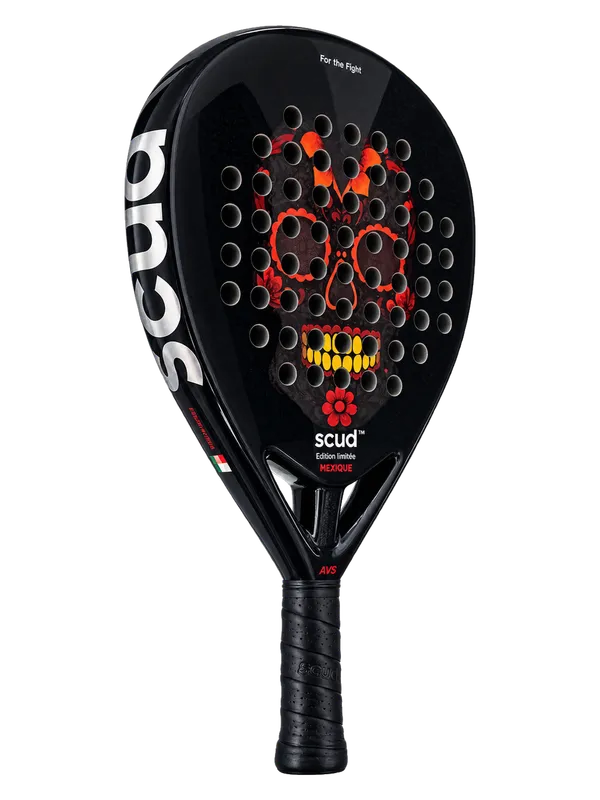
He gives the benefit straight away: this EVA is said to be less sensitive to atmospheric conditions. At sea level or at 500 m of altitude, in damp or dry weather, the core keeps a very consistent response. Throughout those fifty seconds, the SCUD Mexique M1 page stays on screen: 12K carbon, Firm EVA, 365 g.
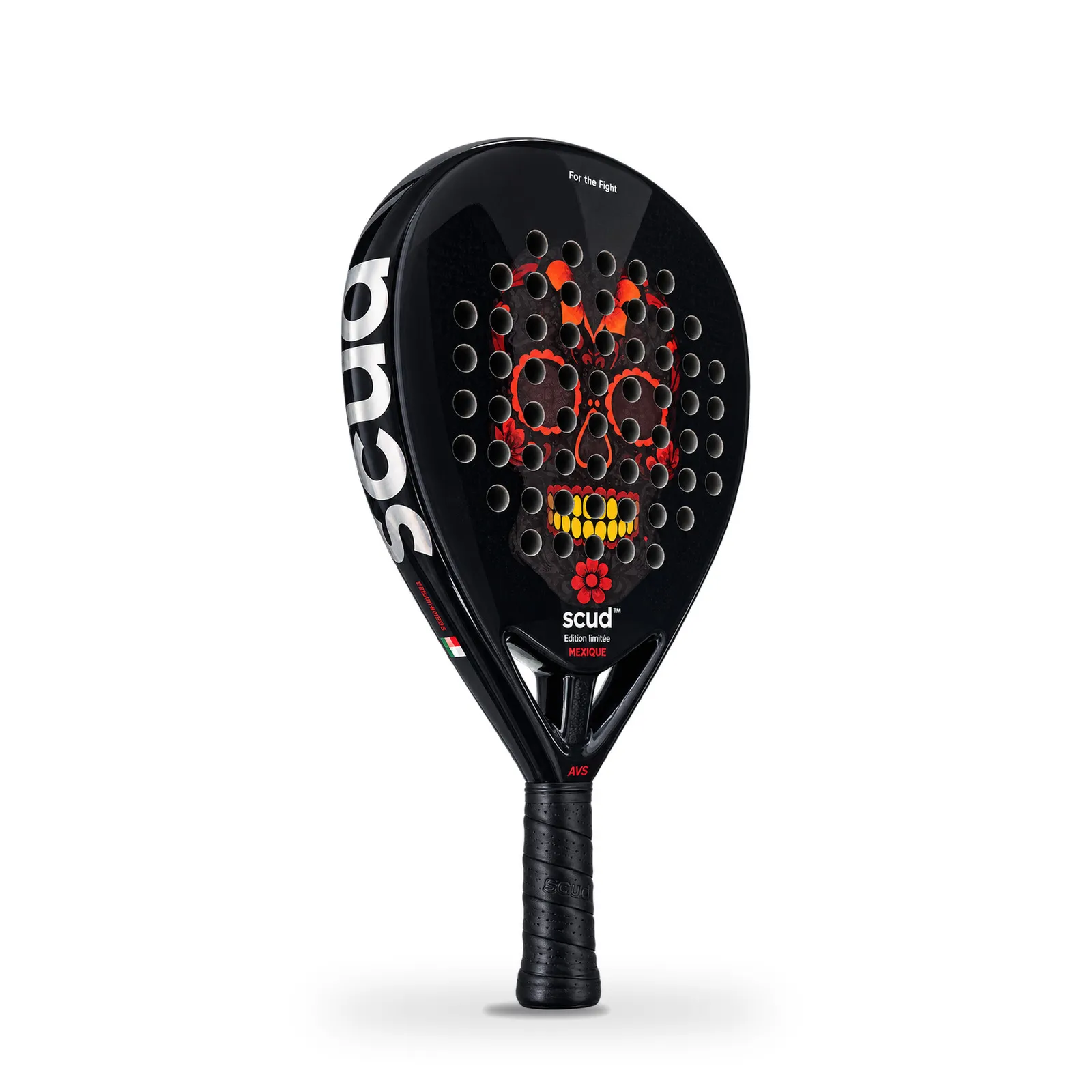
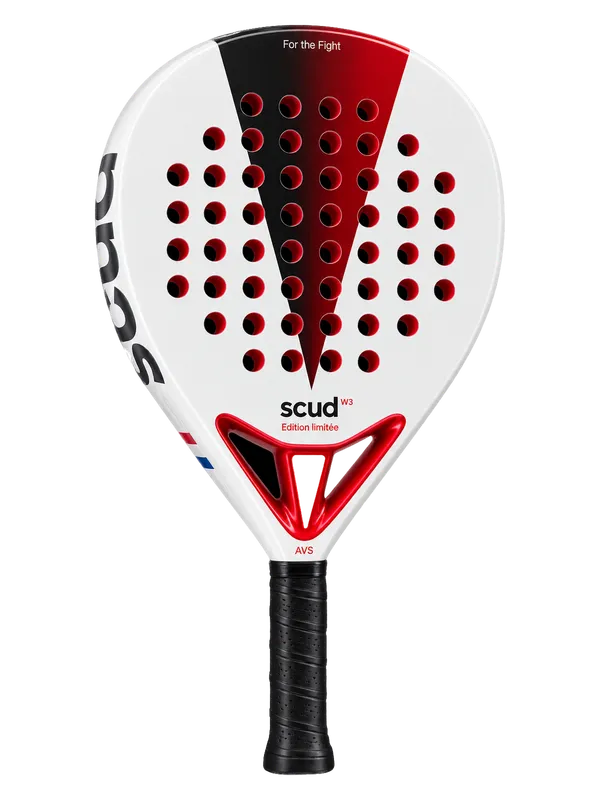
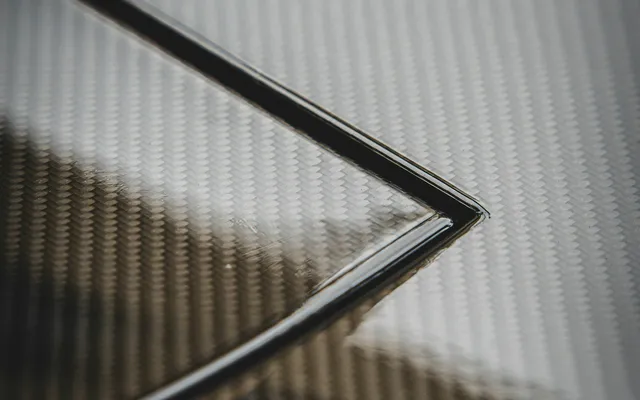
What we confirm. The Mexique M1 does pair a firm EVA foam with 12K carbon, in a 365 g, head-heavy diamond shape, with the AVS anti-vibration system and hand-applied sanding. Its foam gives a crisp return, slightly less dry than the EVA Hard Power of our power models. It will be available in January 2027; its page is already online.
What we would qualify. Stability across altitude and humidity is the author’s analysis; we have not published a lab measurement on this point. Two facts make it plausible: EVA is a closed-cell foam that does not absorb water, and what changes most with altitude is the ball, to the point that the rules allow a reduced-bounce ball above 500 m. The factor that changes any foam most, firm or not, is still temperature: they all stiffen in the cold.
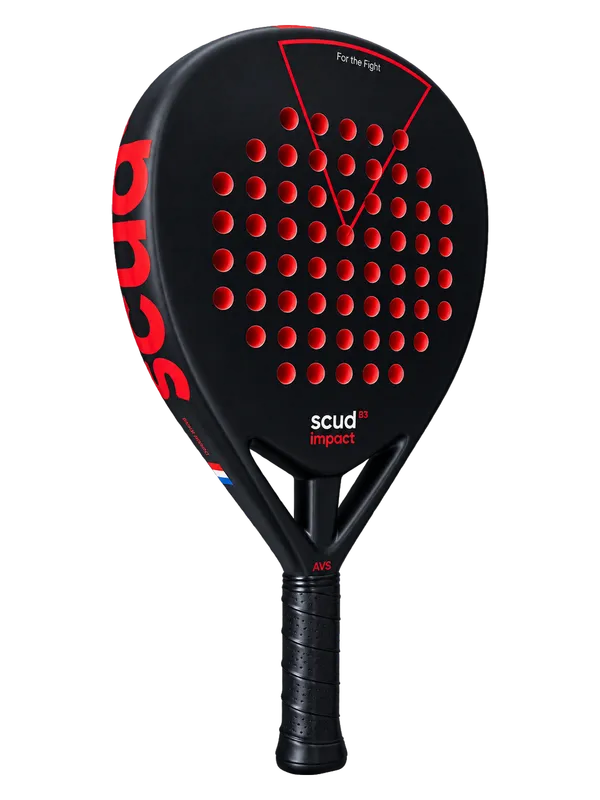
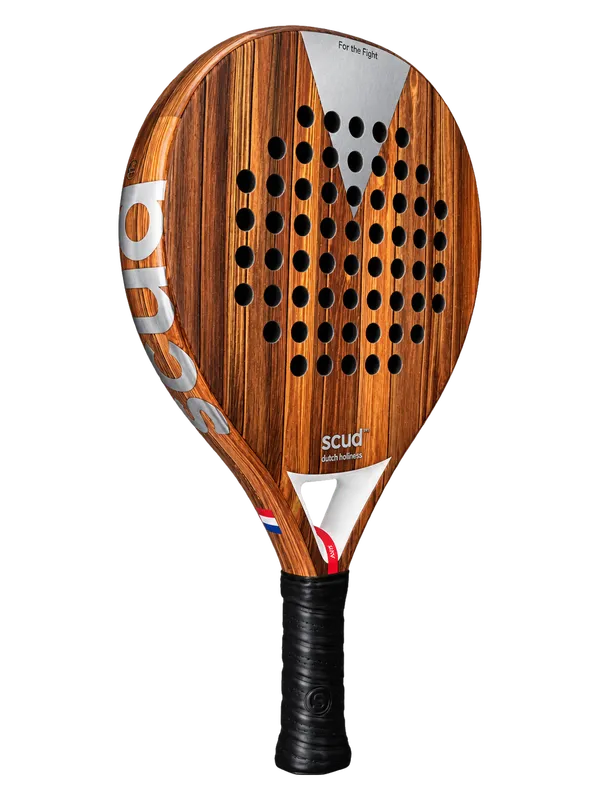
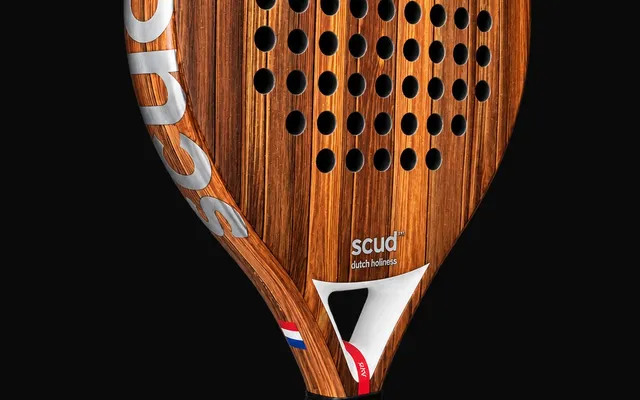
To place the M1 in the range: EVA Hard Power is found in the SCUD Black Impact B3 and the SCUD White S3, soft EVA in the SCUD Wood W1.
Polyethylene and Power Foam: the comfort family
Polyethylene is the second route. The author cites two brands very focused on comfort, Royal Padel, one of the oldest names on the market, and the more recent Zyclon, whose rackets suit even players with tendon or joint problems: tennis elbow, bursitis, rotator cuff. These cores absorb vibration very well; they are soft and light, help ball exit and comfort, at the cost of less power.
Power Foam derives from it, built differently and for another purpose: clearly more power, while staying light and comfortable. Head has used it from its older Delta models to its recent Extreme, paired with its Auxetic technology.
Over time, the author notes that with comparable use, care and hours played, EVA generally holds up better and keeps its properties longer than polyethylene, while adding that “it is not set in stone”. That matches our own experience, and it is why our whole range uses EVA.
A note on health: a softer core reduces vibration, it does not cure tennis elbow. If your elbow hurts, our article on tennis elbow in padel explains what the racket can change, and when to see a professional.
Two foams in one racket
The end of the video shows two ways of not choosing.
Two stacked densities. Starvie, a craft manufacturer based near Madrid, puts two EVAs in its Metheora Dual: a softer outer layer that reacts to slow balls and eases ball exit, and a harder intermediate layer that takes over when the ball comes in fast and heavy. The core responds progressively. The author calls it “absolutely brilliant”.
One density per face. The Siux Inferno, renamed Infernal in 2022, has two faces in different colours and, above all, two foams: a harder one on one side to attack, a softer one on the other to defend and handle slow balls. Interesting technically, he grants, but confusing in practice: you would have to turn the racket in your hand depending on the shot, with the risk of using the wrong face at the wrong moment.
The eight cores at a glance
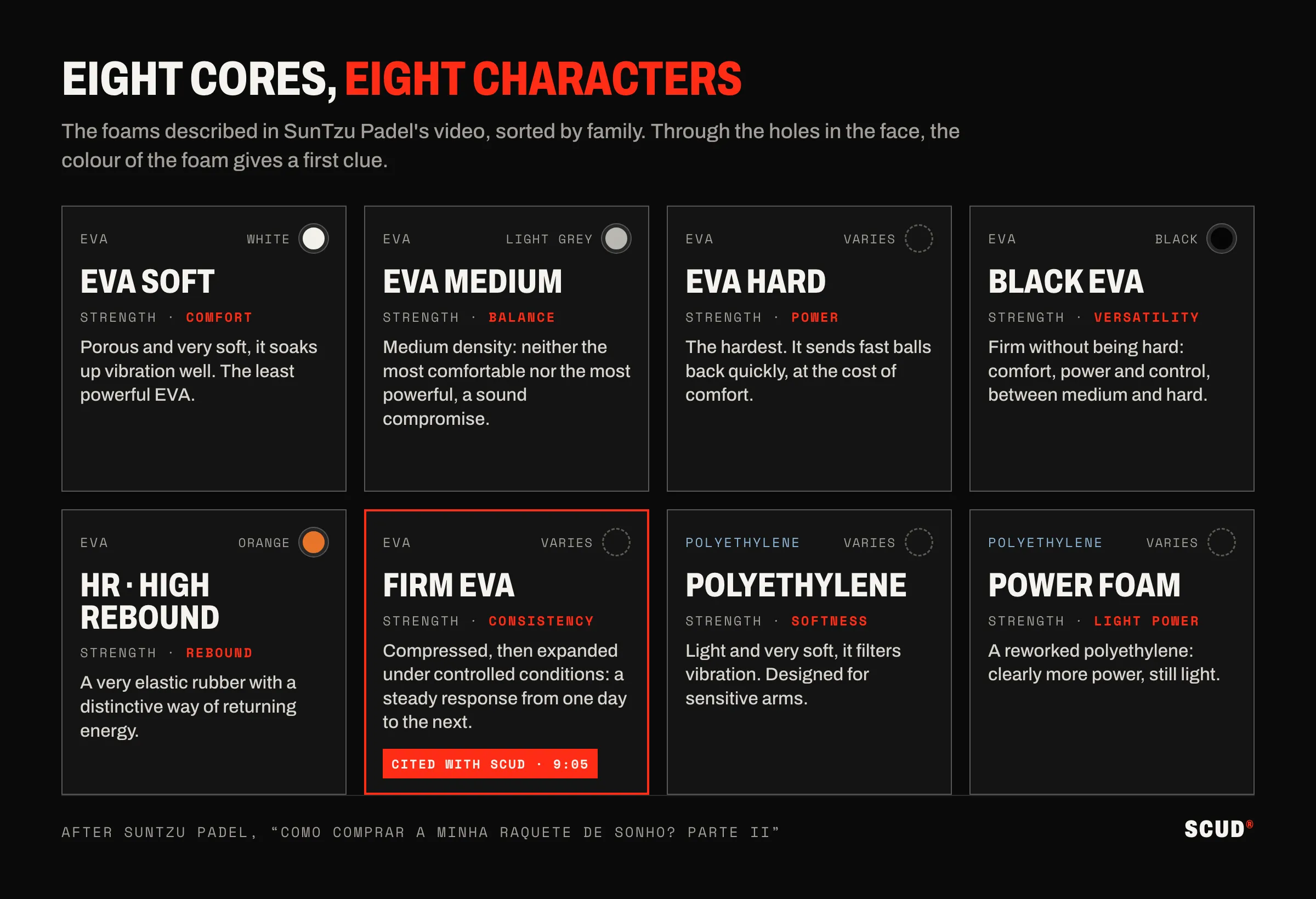
| Core | Family | Visual clue | Strength | Trade-off | Cited in the video |
|---|---|---|---|---|---|
| Soft EVA | EVA | White | Comfort, ball exit | Little power | — |
| Medium EVA | EVA | Light grey | Balance | Nothing exceptional | — |
| Hard EVA | EVA | Varies | Power on fast balls | Less comfort | Competition versions |
| Black EVA | EVA | Black | Versatility | Less forgiving than soft | Recent rackets |
| HR | EVA | Orange | Rebound | A very particular feel | Nox HR3 |
| Firm EVA | EVA | Varies | Consistent response | Less touch than soft | Wilson, SCUD Mexique M1 |
| Polyethylene | Polyethylene | Varies | Softness, sensitive arms | Less power and lifespan | Royal Padel, Zyclon |
| Power Foam | Polyethylene | Varies | Power while staying light | Less durable than EVA | Head |
What we take from it when choosing
Start from the ball you play most. If you build your points in defence, with plenty of slow balls to send back, a soft or medium foam gives you ball exit without forcing. If you finish at the net on balls that arrive fast, a firm or hard foam returns what you give it.
Listen to your arm. A sensitive arm or a comeback from injury points to soft EVA or polyethylene, never to hard EVA.
Look through the holes, then read the spec sheet. The colour gives a clue; the spec sheet confirms it.
At SCUD, that gives three paths: the Wood W1 in soft EVA for comfort and control, the Black Impact B3 and the White S3 in EVA Hard Power for power, the Mexique M1 in firm EVA for a more versatile attacking game. To weigh foam against shape, weight and carbon, how to choose a padel racket and our free guide cover every criterion.
Thanks to SunTzu Padel for this explainer: the full video is worth its seventeen minutes.
In short
- SunTzu Padel’s video reviews three face finishes and eight padel racket cores.
- Ball exit and power are not the same thing: soft EVA returns slow balls, hard EVA returns fast ones.
- Black EVA, HR and firm EVA are newer EVAs; polyethylene and Power Foam make up the comfort family.
- The author cites SCUD for its firm EVA, which he finds stable from one playing condition to another; it is the foam of the Mexique M1.
- The colour seen through the holes is a clue; the spec sheet is what counts.
Frequently asked questions
What is firm EVA in a padel racket?
It is an EVA made under controlled compression and expansion, with a firmness between medium and hard. According to SunTzu Padel, it keeps a very consistent response whatever the altitude and humidity. At SCUD, it is the foam of the Mexique M1.
How can I tell which foam my racket has?
Look inside one of the holes in the face: white foam often means soft EVA, light grey medium EVA, black Black EVA, orange an HR rubber. Colours vary between suppliers, though: the “core” line of the spec sheet remains the reference.
Black EVA or hard EVA: what is the difference?
Hard EVA is the hardest: maximum power on fast balls, little comfort. Black EVA is firm without going that far: it keeps comfort and control while still offering power.
Polyethylene or EVA for a sore elbow?
A polyethylene or soft EVA core passes on less vibration and eases the arm day to day. It does not replace a proper warm-up, or medical advice if the pain persists.
Is the SCUD Mexique M1 available?
Not yet: it will be available in January 2027. Its page already lists its specs: 12K carbon, firm EVA, diamond shape and 365 g.
The four foams in our range are listed on every product page: compare them on the padel rackets page.