
Contents — 10 parts
- What is an Americano in padel?
- The rules of the Americano
- Example rotation: 8-player Americano on 2 courts
- Americano or Mexicano: what is the difference?
- The variants: Team Americano and Mixed Americano
- Organising an Americano at your club
- Americano etiquette
- Why the Americano is ideal for beginners and for meeting players
- In short
- Frequently asked questions
An Americano is a social padel format: you play doubles, but you change partner every round, and each player scores for themselves the points their team wins. Matches are played to a number of points set in advance (16, 21, 24 or 32 depending on the organiser), and at the end of the evening, the player with the most points wins. With eight players and two courts, everyone partners each of the other seven once.
This guide covers the rules of an Americano, how points are counted, a complete rotation grid for eight players, the variants (Mexicano, Team Americano, Mixed Americano) and how to organise one at your club. One thing to be clear about from the start: there is no official Americano rulebook. Neither the International Padel Federation (FIP) nor the FFT (French Tennis Federation) publishes one; what follows is the most widespread practice, and each organiser sets their own parameters.
What is an Americano in padel?
The Americano is a match format, not a variant of the rules of the game. On court, everything stays the same: underarm serve, ball that can come back off the glass, net, lines. What changes is the organisation around the matches:
- Partners rotate: every round, you play with a new partner, against new opponents.
- Matches are short: you play to a points total, not sets.
- The standings are individual: each player adds up their points, round after round.
The padel.how site sums it up well: there is “no single universal Americano rulebook”. The origin of the format and its name is not documented by any reliable source we have found; today you come across it in clubs in many countries under the same name.
That is also what sets it apart from a P25 tournament: an Americano earns no FFT ranking points, needs no licence and is played without a set pair. You come on your own and leave knowing seven people.
The rules of the Americano
Points per match
Before the first round, the organiser sets the points total for each match. Sources disagree on the most common value: PadelCompass presents 24 points as the standard, while Padeli cites 8 or 16 points instead. The usual options are 16, 21, 24 or 32. An odd total, such as 21, avoids draws; an even total can end 12-12.
You do not count 15, 30, 40: each rally won is worth one point, and the match stops when the total is reached. At 24 points, a score of 15-9 or 13-11 is possible, and even 24-0.
Some organisers prefer to play on time: a round lasts a fixed number of minutes, and the score at the whistle counts. You then need to announce what happens to the rally in progress when time runs out.
The serve
The serving rules are those of padel: underarm, after a bounce, diagonally, two attempts. If the basics escape you, our article on padel rules for beginners goes over them. What varies is who serves, and how many times. PadelCompass says the custom is to change server every four points in “points” mode, or as the players agree. The important thing is to agree before the first rally.
Counting points and the standings
Each player scores the points won by their team in the match. The example given by the Americano Padel site: if your pair wins 15-9, you score 15 points, so does your partner, and each of your two opponents scores 9. Every point played is distributed.
| Round 1, court 1 | Score | Points scored |
|---|---|---|
| A + B vs C + D | 15-9 | A: 15 · B: 15 · C: 9 · D: 9 |
At the end of the evening, each player’s points are added up. The highest total wins. To break ties, the sources suggest slightly different orders:
- PadelCompass: total points, then number of wins, then points difference.
- padel.how: head-to-head, number of rounds won, points difference, then fewest points conceded, and as a last resort a short play-off match or a draw.
The method matters less than announcing it before you start. padel.how’s advice is unequivocal: “Do not invent a tie-break after seeing the final table”.

Example rotation: 8-player Americano on 2 courts
Eight players make 28 possible pairings. Each round, two courts host four pairs: so it takes seven rounds for everyone to have played once with each of the other seven. The grid below does exactly that, and it has one more property: each player faces each of the others exactly twice. We checked it pair by pair.
| Round | Court 1 | Court 2 |
|---|---|---|
| 1 | A + B vs C + D | E + F vs G + H |
| 2 | A + C vs E + G | B + D vs F + H |
| 3 | A + D vs E + H | B + C vs F + G |
| 4 | A + E vs B + F | C + G vs D + H |
| 5 | A + F vs C + H | B + E vs D + G |
| 6 | A + G vs D + F | B + H vs C + E |
| 7 | A + H vs B + G | C + F vs D + E |
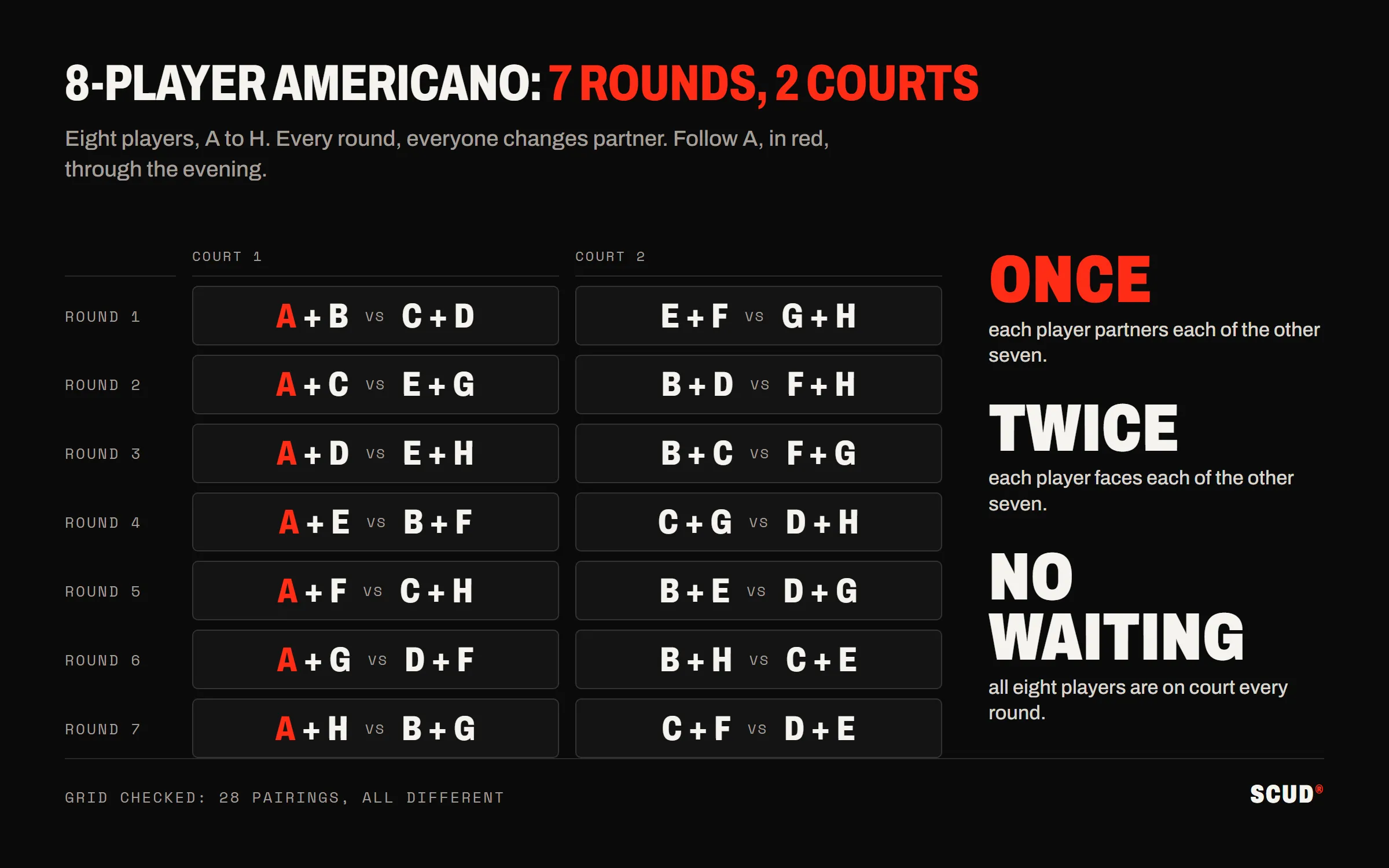
A practical tip: assign the letters by drawing lots, and post the grid near the courts. That way everyone knows where they are playing and with whom, without waiting for the organiser.
Americano with 12 or 16 players
The principle scales up. For each player to partner every other player once, you need as many rounds as there are players minus one:
| Players | Courts | Rounds for a full rotation | Matches played by each |
|---|---|---|---|
| 8 | 2 | 7 | 7 |
| 12 | 3 | 11 | 11 |
| 16 | 4 | 15 | 15 |
Eleven or fifteen rounds is a long evening. So many organisers play fewer rounds, without a full rotation: everyone still changes partner, but does not play with everyone. Online generators calculate these partial grids while avoiding repeats; PadelCompass says that between 8 and 16 players, pairings generally do not repeat at all.
What about an odd number of players?
With 9, 11 or 13 players, some players sit out each round. The fairness rule given by PadelCompass: nobody sits out a second time before everyone has sat out once. You still need to decide what the resting player scores. PadelCompass gives them no points; padel.how advises against giving them the maximum score and suggests instead their average over the rounds played, a neutral score announced in advance, or standings based on average points per round. Here again, announce the rule before you start.
Americano or Mexicano: what is the difference?
The Mexicano takes everything from the Americano, except how the teams are formed. The Americano Padel site describes the most common rule: in the first round, teams are drawn at random; from the second round on, players are ranked by their cumulative points and grouped in fours, one group per court. In each group, first plays with fourth, against second and third. Fifth to eighth meet on the next court, and so on.
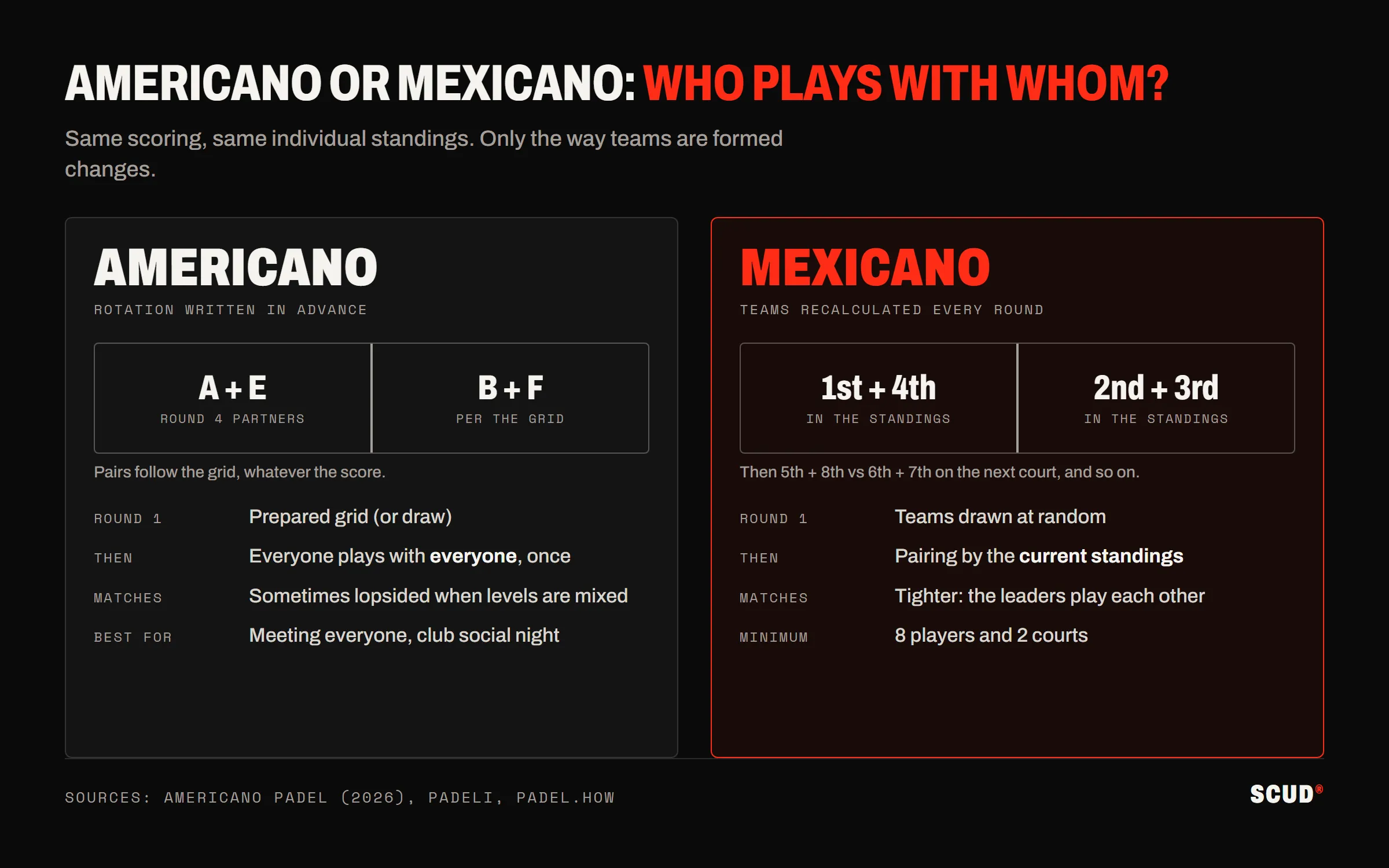
| Americano | Mexicano | |
|---|---|---|
| Team formation | Rotation grid set in advance | Recalculated each round from the standings |
| First round | According to the grid | Random draw |
| Match balance | Variable if levels are mixed | Tighter: the top-ranked play each other |
| Minimum | 4 players on one court | 8 players and 2 courts, according to Americano Padel |
| Preparation | Printable grid before the evening | Calculation after each round |
| Best for | Meeting everyone | A group that wants competitive matches |
The Americano is better suited to a discovery evening with mixed levels: everyone plays with the best and with the beginners. The Mexicano suits a more even group that wants close matches right to the end. Padeli sums it up as “essentially an Americano with smarter matchmaking”.
The variants: Team Americano and Mixed Americano
- Team Americano: pairs are fixed from start to finish, only the opponents change. According to PadelCompass, it is a classic round-robin tournament. Useful when players come as a duo.
- Mixed Americano: each team has one woman and one man. The rotation is then done in two groups: the women rotate among themselves, and so do the men.
- Timed Americano: a fixed time per round instead of a points total. Handy when the court slot is booked to the minute.

Organising an Americano at your club
How much time should you allow?
PadelCompass gives indicative match durations: 7 to 10 minutes at 16 points, 9 to 13 minutes at 21 points, 10 to 15 minutes at 24 points, 14 to 20 minutes at 32 points. For an eight-player Americano over seven rounds of 24 points, allow between 1 hr 10 and 1 hr 45 of play, plus court changes and the warm-up. A two-hour slot on two courts is usually enough.
The organiser’s checklist
- Set the parameters: number of players, points total or time per round, serving rule, tie-break rule, rule for players sitting out.
- Book the courts: one court for every four players, for the whole session.
- Prepare the grid: on paper or with an online generator (PadelCompass, Americano Padel and others offer them). Draw the letters at random.
- Get the equipment ready: balls in good condition for each court, a score sheet or an app, a stopwatch if you are playing on time, water. Our advice on choosing padel balls helps you avoid balls that have gone flat.
- Brief the players in two minutes: how scoring works, who serves, where you play in the next round.
- Enter the scores after each round, and post the provisional standings: that is a big part of the fun.
The score sheet
An Americano sheet fits on one page: one row per player, one column per round, one total column. After each match, the team’s score goes into the box of each of its two players. Apps do the maths and show the standings live, but a sheet and a pencil work perfectly well.
Americano etiquette
An Americano is a social occasion; a few habits keep it pleasant:
- Be on time: one late player holds up the whole grid.
- Call the score out loud, regularly: with no umpire, it is the best way to avoid disagreements.
- Judge the balls on your side honestly, and give your opponents the benefit of the doubt.
- Adapt your game to your partner of the moment: play for them, not instead of them. Our guide to positioning in padel helps you quickly find your bearings with someone you do not know.
- Do not systematically target the weakest player: next round, they may be your partner.
- Clear the court quickly between rounds.
Why the Americano is ideal for beginners and for meeting players
The Americano solves the two problems facing a beginner: finding three partners, and playing matches at their level. You sign up on your own, you play with everyone, and the rotation evens out differences in level: a beginner who loses one match can win the next with a more experienced partner. Short matches limit frustration, and the individual standings give you a goal without the pressure of a sanctioned tournament.
It also reveals a lot about your game. Changing partner every round forces you to communicate, to reposition, to play on the right as well as the left. For those still torn between two sports, it is a good illustration of what sets padel apart: we discuss it in padel or tennis, which to choose.
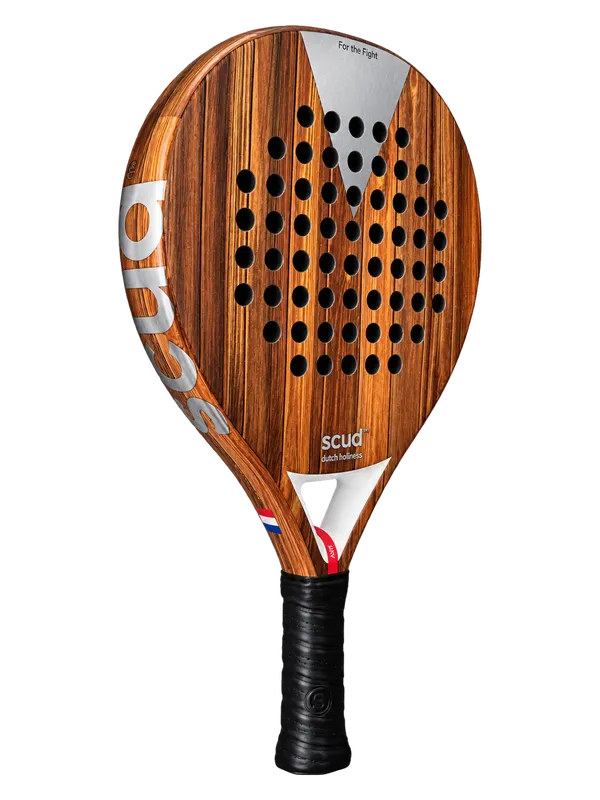
Two precautions. Playing seven to fifteen matches in an evening puts strain on calves, shoulders and elbows: warm up before the first round, with our warm-up and injury prevention routine. And if you are playing with a borrowed racket, go for a forgiving one: in our range, the SCUD Wood W1, with its teardrop shape and soft EVA foam, forgives the off-centre hits that changing partners inevitably brings. For what comes next, our learning padel path guides you step by step.
In short
- An Americano is played in doubles, with a new partner every round, and each player accumulates the points won by their team.
- Matches are played to a points total set in advance (16, 21, 24 or 32) or on time; the highest individual total wins.
- With 8 players on 2 courts, 7 rounds are enough for everyone to play once with everyone; 11 are needed with 12 players and 15 with 16.
- The Mexicano re-forms the teams every round according to the standings: first with fourth against second and third.
- There is no official rulebook: before you start, announce the points total, the serving rule, the tie-break and what happens to players sitting out.
Frequently asked questions
How does an Americano work in padel?
You play doubles, but change partner every round according to a rotation grid. Each match is played to a points total set in advance, and each player scores the points won by their team. At the end, the player with the most points overall wins.
How many points per match in an Americano?
There is no official rule: organisers most often choose 16, 21, 24 or 32 points. Sources disagree on the most common value: 24 according to PadelCompass, 8 or 16 according to Padeli. An odd total such as 21 avoids draws.
How many rounds for an 8-player Americano?
Seven rounds on two courts, if you want everyone to play once with each of the other seven. With the grid in this article, each player also faces each of the others exactly twice. Allow between 1 hr 10 and 1 hr 45 of play with 24-point matches.
What is the difference between Americano and Mexicano?
In the Americano, the partner rotation is set in advance. In the Mexicano, teams are recalculated after each round according to the provisional standings: first plays with fourth against second and third. The Mexicano gives closer matches, but needs at least eight players and two courts.
Do you need a licence to play an Americano?
No, unless the club requires one for its own events. An Americano is not a competition sanctioned by the FFT and earns no ranking points. To get into the ranking, you need to play a sanctioned tournament, such as a P25.
What do you do with an odd number of players?
One or more players sit out each round, in turn, with nobody sitting out twice before the others. Decide before you start what they score: no points, their average over the rounds played, or a neutral score. Standings based on average points per round avoid penalising, or favouring, those who sit out.
To discover padel’s history and culture beyond club formats, read our page on padel culture: history, figures and legends.