Contents — 14 parts
- Why padel-specific shoes?
- Herringbone, omni or hybrid sole: which should you choose?
- What cushioning for a padel shoe?
- Lateral support and reinforcements: what protects your footwork
- Weight and breathability
- What size, and what if you have wide feet?
- Can you play padel in tennis or running shoes?
- Padel shoes and injuries: what we know
- How much does a pair of padel shoes cost?
- Lifespan: when to replace your padel shoes?
- Caring for your padel shoes
- Shoes, racket and positioning
- In short
- Frequently asked questions
For padel, choose a shoe designed for the sport, with a sole suited to your club’s court: herringbone on well-sanded artificial grass, omni (pimpled) on a new, indoor or lightly sanded court, hybrid if you often change clubs. Add good cushioning, solid lateral support, a reinforced toe and half a size of room. Running shoes or plain canvas trainers are not made for the footwork padel demands.
This guide takes each criterion in the order it matters: sole, cushioning, support, size, budget, wear and care, along with what you risk in tennis or running shoes. SCUD does not sell shoes: this guide recommends no brand.
Why padel-specific shoes?
Because the court and the movement are unlike any other sport. The surface is usually artificial grass weighted with sand, on which you string together side steps, braking, sudden starts and small controlled slides. A 20 × 10 m court is covered in short, quick steps, almost always sideways, rarely in a straight line.
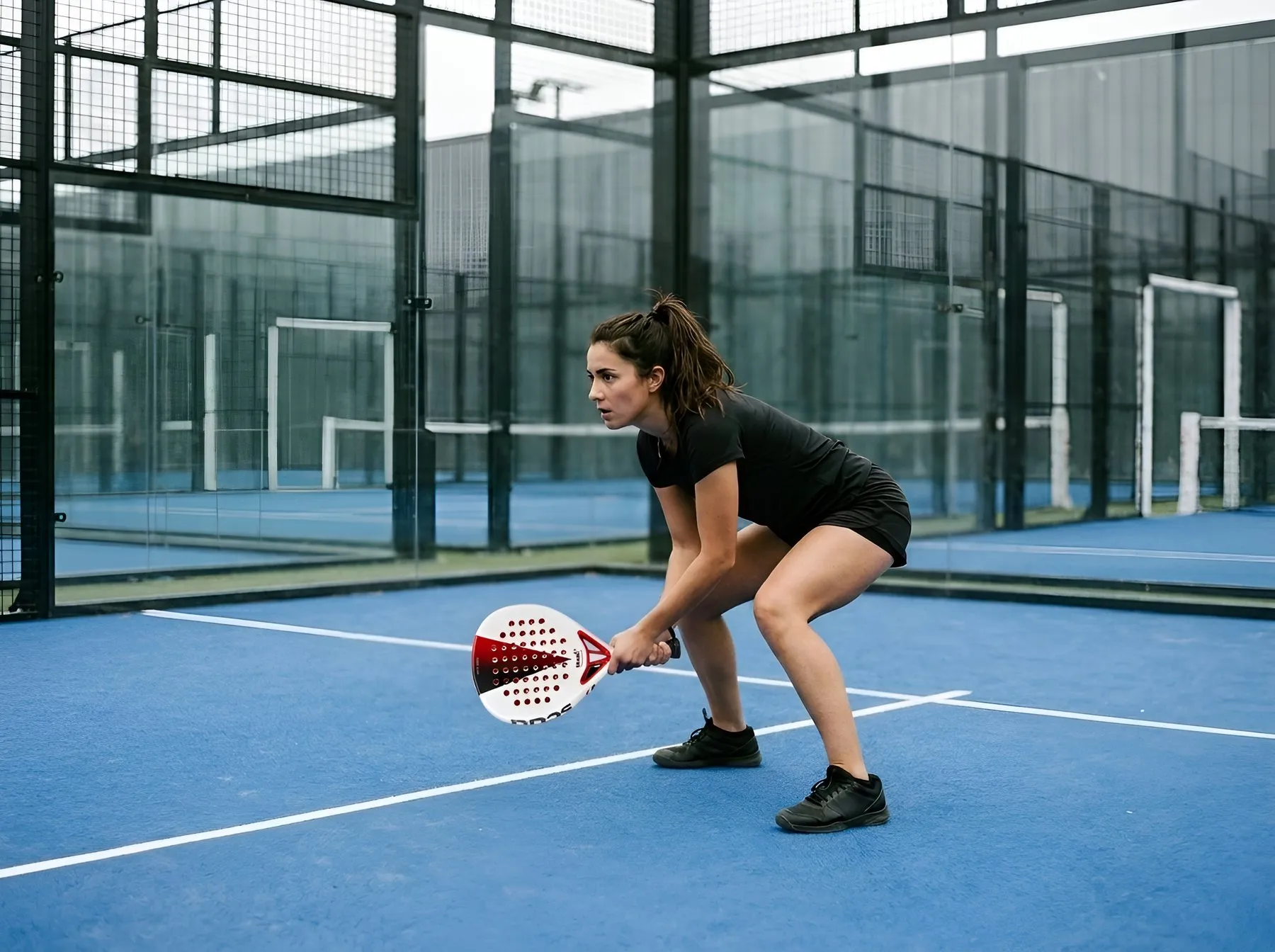
A padel shoe is built for this footwork: a sole that grips the sand without locking the foot, an upper reinforced on the sides, cushioning in the midsole.
If you are new to the sport, shoes are one of the three first purchases along with the racket and the balls: our learning padel guide puts them in order of priority.
Herringbone, omni or hybrid sole: which should you choose?
This is the first criterion, and it depends on the court, not on you. Three sole patterns share the market.
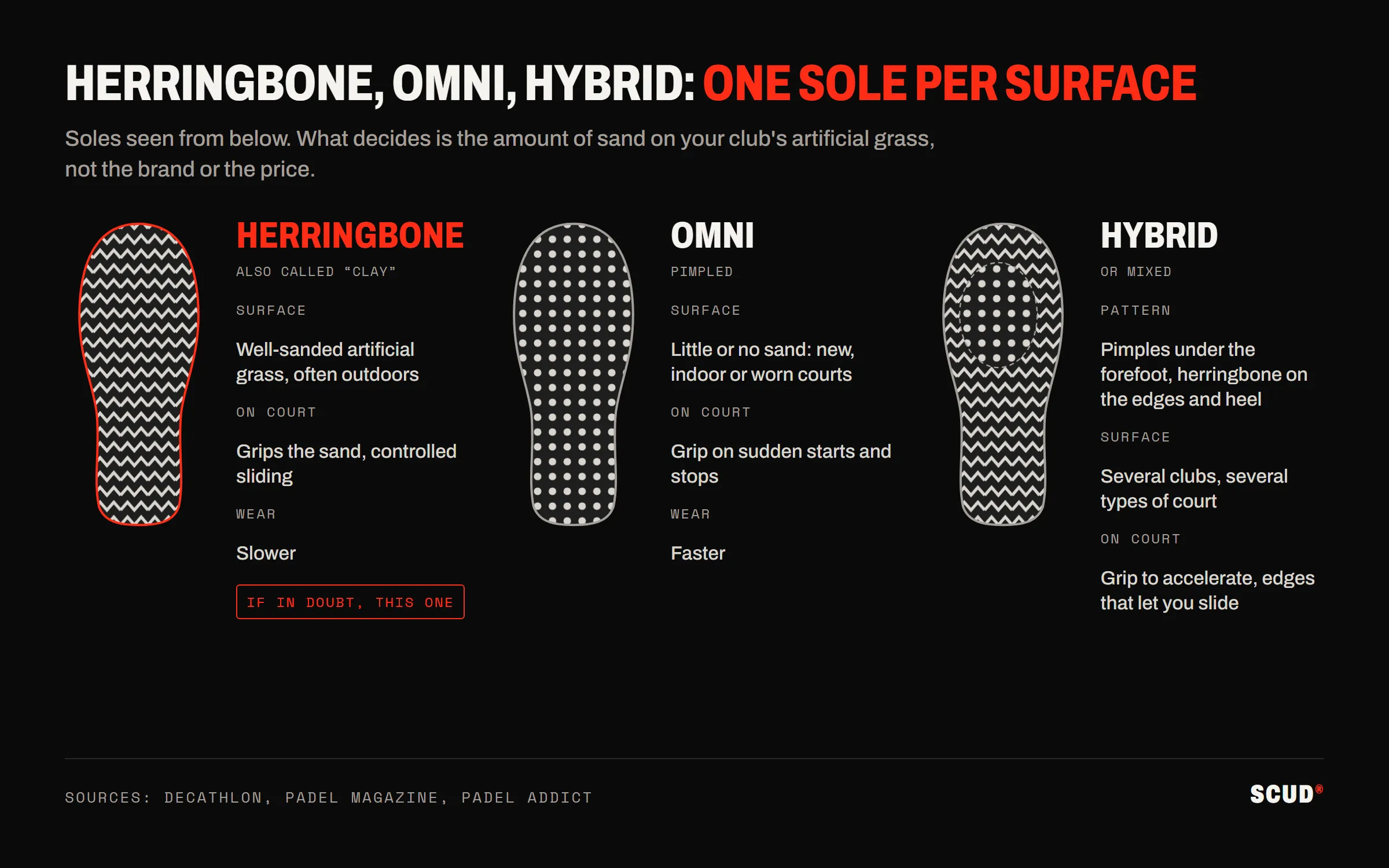
The herringbone sole (or “clay”)
A zigzag pattern of parallel wave-shaped lines. Decathlon presents it as “the benchmark for padel” and adds: “If you don’t know what kind of sand covers your usual padel court, go for a clay sole.” Padel Addict recommends it for courts carrying “a good amount of sand”, often outdoors, and Padel Magazine notes that it “comes to us from tennis, as it is often used on clay courts”. The two outlets agree on one point: it wears more slowly than the omni sole.
The word “clay” is not used the same way everywhere: trust the pattern under the shoe, not the label.
The omni sole (pimpled)
A surface covered in small round pimples. Decathlon intends it for surfaces “with little or no sand”, such as new or indoor courts; Padel Magazine recommends it “on damaged surfaces or those with little sand”, Padel Addict on lightly sanded or worn courts. Its pimples grip hard on sudden starts and stops. The trade-off noted by Padel Magazine and Padel Addict: faster wear.
The hybrid (or mixed) sole
A blend of the two. Padel Magazine describes the principle: “The centre is formed by the omni sole to give good grip when accelerating”, while the edges and the back use the herringbone pattern so you can slide. It is the choice for people who play at several clubs, on different courts.
Which sole for which surface?
| Your court | Recommended sole | Why |
|---|---|---|
| Well-sanded artificial grass, often outdoors | Herringbone | Grips in the sand, controlled sliding, slower wear |
| New or indoor grass, little or no sand | Omni | Strong grip on a lightly sanded surface |
| Worn, damaged grass | Omni | The pimples make up for the surface’s lack of grip |
| Several clubs, varied surfaces | Hybrid | A compromise between grip and slide |
| You don’t know | Herringbone | The default choice recommended by Decathlon |
Not everyone agrees on omni: depending on the source, it is better on new, clean courts, or on worn ones. Both readings agree on the essential point: omni is for courts with little sand. The simplest approach is still to look at your club’s court, or ask at reception which type of sole the regulars wear.
What cushioning for a padel shoe?
Cushioning sits in the midsole, the layer of foam between the outsole and the foot, “often EVA foam” according to Decathlon. The same guide warns: “Insufficient cushioning quickly shows up as fatigue, or even chronic pain after a match.” More expensive models put cushioning at both the front and the back of the foot. The more often and the longer you play, the more this criterion counts.
Lateral support and reinforcements: what protects your footwork
A padel shoe must hold the foot when it moves sideways. Decathlon warns against “a shoe that lets the foot move sideways inside the upper”: with every side step, the ankle absorbs whatever the shoe fails to hold.
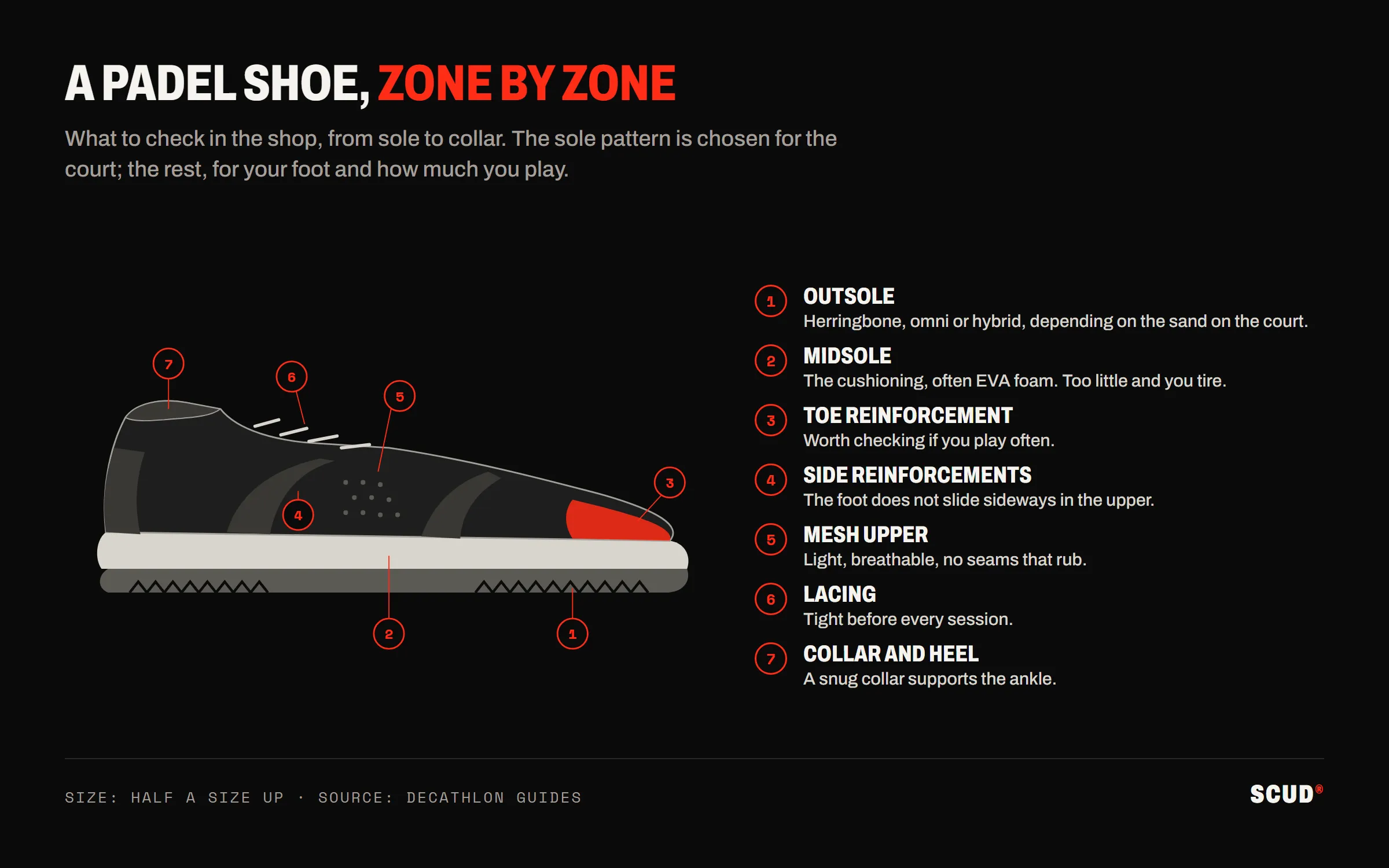
What to check in the shop:
- The side reinforcements. Stiffer bands along the sides of the upper. Decathlon notes that “the higher the level of play, the more these reinforcements benefit from being stiff and precise”.
- The toe reinforcement. In padel, the toe of the shoe often scrapes the ground in low lunges, digs and slides. For intensive play, Decathlon advises checking for “reinforcements at the front of the foot”.
- The collar and heel. A collar that wraps the ankle and a well-locked heel keep the foot in the shoe.
- The lacing. The best support in the world is useless if the shoe is laced loosely. Decathlon’s advice is simple: “Take the time to lace your shoes properly before every session.”
Weight and breathability
Decathlon lists lightness among the key criteria and recommends uppers in soft materials such as mesh, which also let the foot breathe. No ideal weight is published: the right shoe is the lightest one that keeps the support you need. Also check the inside seams, which can quickly become a nuisance.
What size, and what if you have wide feet?
Decathlon gives a clear rule: “Go for half a size above your usual size.” The reason fits in one sentence from the same guide: “When you brake sharply, your toes must not bang against the front of the shoe.” In padel, you are constantly braking forwards and sideways.
A few pointers for trying them on:
- try the shoes with the sports socks you will wear when playing;
- standing up, your toes should not touch the end of the shoe;
- do some side steps and stops: the heel should not lift, and the foot should not slide sideways.
For wide feet, Decathlon simply says that shoes must be “suited to the width of your foot”. Don’t make up for a shoe that is too narrow by going up a size: the foot would float lengthways and lose support. Look instead for a wider fit, and try several models.
Men’s or women’s padel shoes?
Many models come in a men’s and a women’s version, with different size ranges and colourways. The selection criteria stay exactly the same: sole for the court, cushioning, support, fit. Choose the pair that fits your foot best, whatever the label on the shelf.
Can you play padel in tennis or running shoes?
In running shoes: no
A running shoe is made for running straight ahead. Decathlon explains: it is optimised for vertical cushioning, not for lateral footwork. It doesn’t hold the foot during side steps, and its sole isn’t designed for sand. Padel Magazine advises against playing “padel in running shoes or unsuitable shoes”, and our guide to warming up and injury prevention says the same.
In tennis shoes: better, but not equivalent
This is more nuanced. Herringbone soles come precisely from clay-court tennis shoes, and a tennis shoe offers the lateral support that running shoes lack. But Decathlon also lists the tennis shoe among the risks: even top of the range, it doesn’t offer the same grip on sanded artificial grass. A pair of clay-court tennis shoes can do for a taster session; as soon as you play regularly, switch to a dedicated pair. The differences between the two sports are covered in our padel or tennis comparison.
In everyday trainers: never
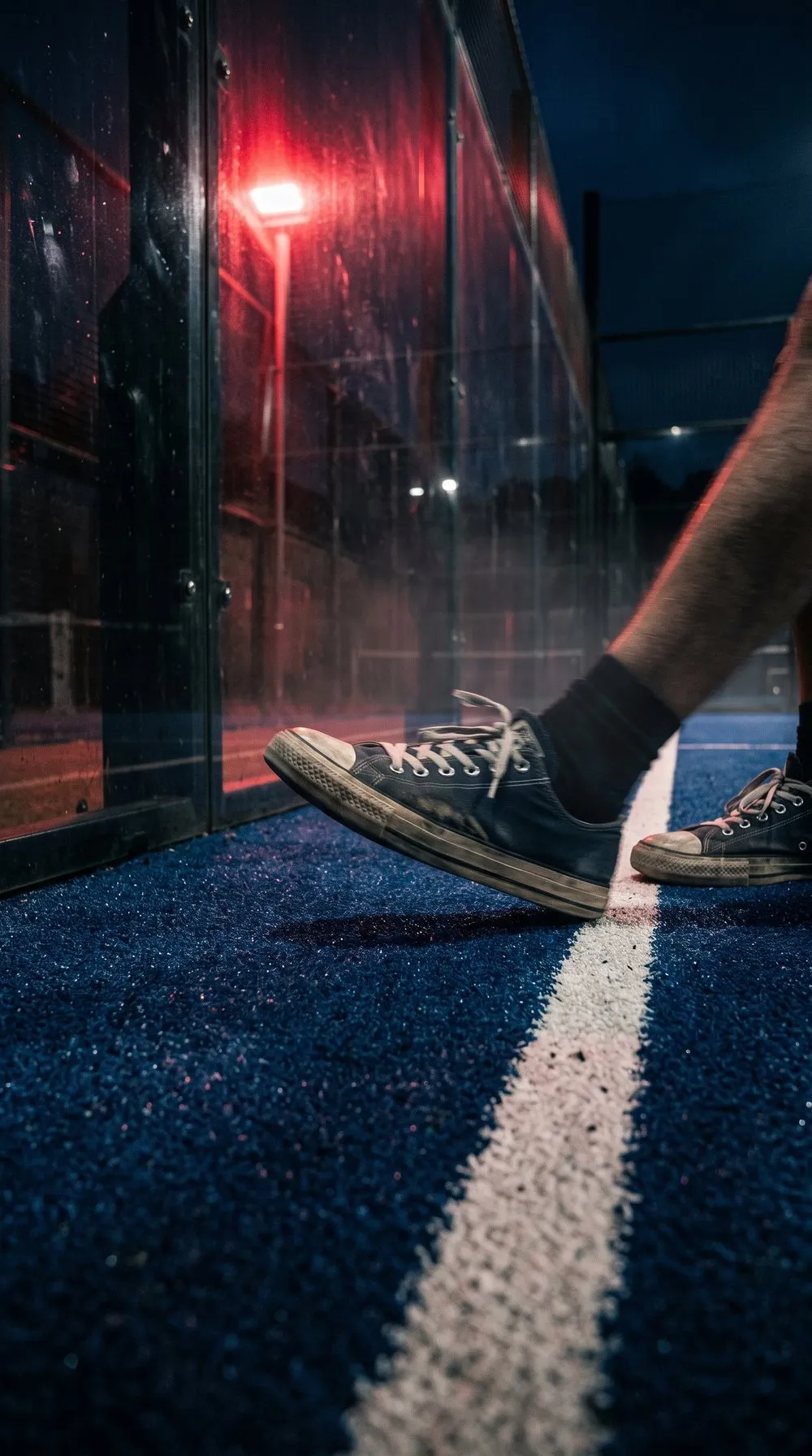
Canvas trainers with flat soles, so common on recreational courts, have every flaw: no grip in the sand, no cushioning, no lateral support, an upper that loses its shape at the first push-off.
Padel shoes and injuries: what we know
Padel injuries often affect the lower limbs. A systematic review published in 2023 in BMJ Open Sport & Exercise Medicine, which brings together the available studies, found that two of the four studies covering this point put the lower limbs at the top of the list of injury sites. Depending on the study, ankle sprains account for 7.8% to 9.8% of injuries; calf injuries (partial tear of the gastrocnemius, “tennis leg”) weigh heavily in some series, up to 22.1% in one of them. Across all the studies, however, the elbow remains the most frequent site.
This review does not measure the effect of shoes or of the surface: none of the studies included analysed it. The Instituto de Biomecánica de Valencia (IBV), which tests padel shoes and surfaces, points out for its part that friction between foot and ground changes the load on the lower limbs, and that a balance must be struck between stability and fluid movement to reduce the risk of injury without hampering play. That is exactly what a good sole aims for: enough grip to brake, enough slide to pivot.
In practice, a suitable shoe replaces neither a warm-up nor a gradual return to play. If you feel pain in your ankle, calf or Achilles tendon, stop playing and see a doctor or physiotherapist: this guide is no substitute for professional advice. Our article on warming up and injury prevention suggests a routine for ankles and calves.
How much does a pair of padel shoes cost?
There is no published average price. As a guide, the six models featured by Padel Magazine in its October 2022 selection cost between €65 and €125. Decathlon stresses for its part that “an entry-level pair designed for padel protects better and often costs less than you might think”.
| Profile | What matters | What you can skip |
|---|---|---|
| Beginner, once a week or less | Sole suited to the court, decent cushioning, good fit | Stiff competition reinforcements |
| Regular player, two to three times a week | Front and rear cushioning, toe reinforcement, durable sole | Featherweight build |
| Competitor | Precise support, stiff reinforcements, two pairs in rotation | Nothing: you wear them out fast |
The big racket brands also offer shoes, alongside the sports footwear specialists. A “cheap” pair with the right sole is better than an expensive pair whose sole doesn’t match your court. To put shoes into the full budget for a season, courts and racket included, read how much padel costs.
Lifespan: when to replace your padel shoes?
There is no agreed lifespan figure: it depends on how much you play, your weight, the way you slide and the surface. Decathlon makes a point that is often overlooked: “Insoles wear out before the shoe itself.” The signs that it’s time to replace them are easy to spot:
- the sole pattern is worn smooth under the forefoot or heel, and you slip where you used to grip;
- the midsole is compressed: you feel impacts more, and your feet or calves tire faster;
- the upper is misshapen or worn through at the front, and the foot moves in the shoe;
- the reinforcements are coming unstuck.
A pair can last much longer with a little care: Decathlon reckons that by following its care advice, you keep your shoes “for several years rather than just several months”.
Caring for your padel shoes
- Only wear them on court. Decathlon points out that herringbone or omni soles “wear quickly on tarmac or hard floors”. Come to the club in another pair.
- Empty out the sand and brush the sole after the session: a clogged pattern grips less.
- Let them air-dry after every match, insoles out, away from any heat source.
- Wash them by hand, not in the machine, so as not to damage the bonding.
- Replace the insoles when they are compressed: they wear out before the rest.
Your racket doesn’t like heat either: see caring for your padel racket.
Shoes, racket and positioning
Good shoes won’t make you play better, but they help you get back into position quickly after every shot. Positioning, for its part, can be learned: our guide to positioning in padel explains where to stand at every phase of the point.
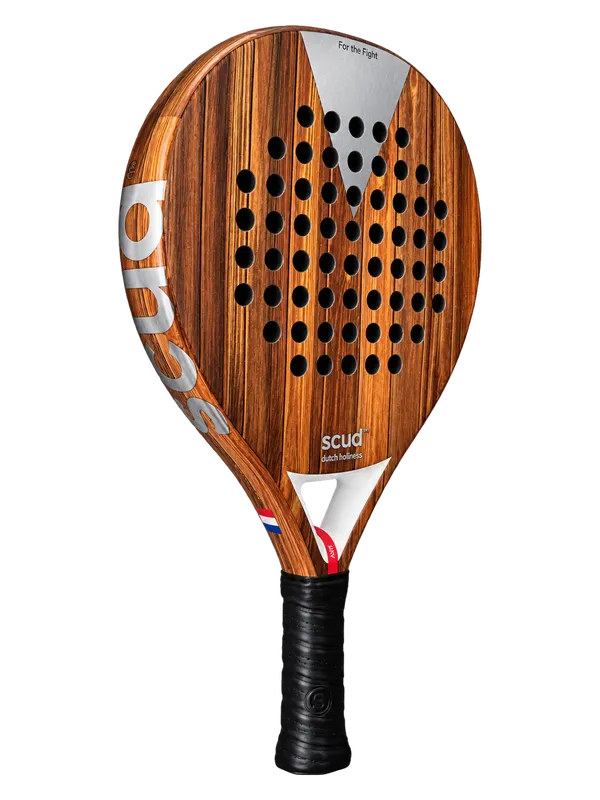
On the racket side, the logic is the same as for shoes: a beginner progresses faster with forgiving equipment than with a competition model. Our guide to the padel racket for beginners details that profile; in our range, the SCUD Wood W1, teardrop-shaped on soft EVA foam, is its embodiment.
In short
- Choose the sole for the court: herringbone on well-sanded grass, omni on a lightly sanded, new or worn court, hybrid if you change clubs; if in doubt, herringbone.
- Cushioning in the midsole, side reinforcements and a toe reinforcement protect your footwork; tight lacing does the rest.
- Go half a size above your usual size, with a fit suited to the width of your foot.
- Running shoes and canvas trainers are out; a tennis shoe will do at a pinch, without matching a padel shoe on sand.
- Replace your pair when the pattern is smooth or the cushioning compressed, and only wear your padel shoes on court.
Frequently asked questions
Which sole should you choose for padel shoes?
It depends on the court. A herringbone sole suits well-sanded artificial grass, often outdoors; an omni, pimpled sole suits new, indoor or worn courts with little sand; a hybrid sole suits people who play on varied surfaces. If you don’t know, choose herringbone.
Can you play padel in running shoes?
It is not advisable. A running shoe is designed for vertical cushioning and running in a straight line, not for the side steps and lateral braking of padel. It holds the foot poorly sideways, and its sole isn’t made for sand.
Should you go up a size for padel?
Decathlon advises half a size above your usual size, so that your toes don’t bang against the front of the shoe when you brake sharply. Try them on with your sports socks and do a few side steps: the heel should not lift.
How long do padel shoes last?
No standard lifespan is published: it all depends on how often you play, the player’s weight and the surface. Replace them when the sole pattern is smooth, the cushioning compressed or the upper no longer holds the foot. Insoles often wear out before the rest and can be replaced.
What budget should you plan for padel shoes?
There is no published average price; the six models featured by Padel Magazine in 2022 cost between €65 and €125. For a beginner, a pair designed for padel with the right sole is plenty; competition reinforcements are only worth it if you play a lot.
Do padel shoes prevent injuries?
No study has measured their direct effect on injuries. A suitable sole and good support limit slips and twists, but they replace neither a warm-up nor a gradual return to play. If you have pain in your ankle or calf, see a health professional.
For the rest of the journey, from your first session to advanced shots, follow our guide to learning padel.
Sources
- Comment choisir ses chaussures de padel ?
- Quelles chaussures avoir pour le padel ?
- Les chaussures de padel : comment choisir ?
- Comment choisir sa paire de chaussures de padel
- ¿Cuántos tipos de suelas hay en las zapatillas de pádel?
- The role of biomechanics in padel: applied research to enhance performance and safety
- Incidence, prevalence and nature of injuries in padel: a systematic review