Contents — 13 parts
- What is a P25 in padel?
- P25 padel tournament: what level do you need?
- Who can enter? The licence and the partner
- Match formats, deciding point and Star Point
- How a P25 day unfolds
- How many points does a P25 earn?
- How much does it cost to enter a P25?
- How do I find a P25 near me and enter?
- Umpiring and etiquette: you umpire yourselves
- Preparing for your first tournament: gear and tips
- After the P25: P50, P100 and beyond
- In short
- Frequently asked questions
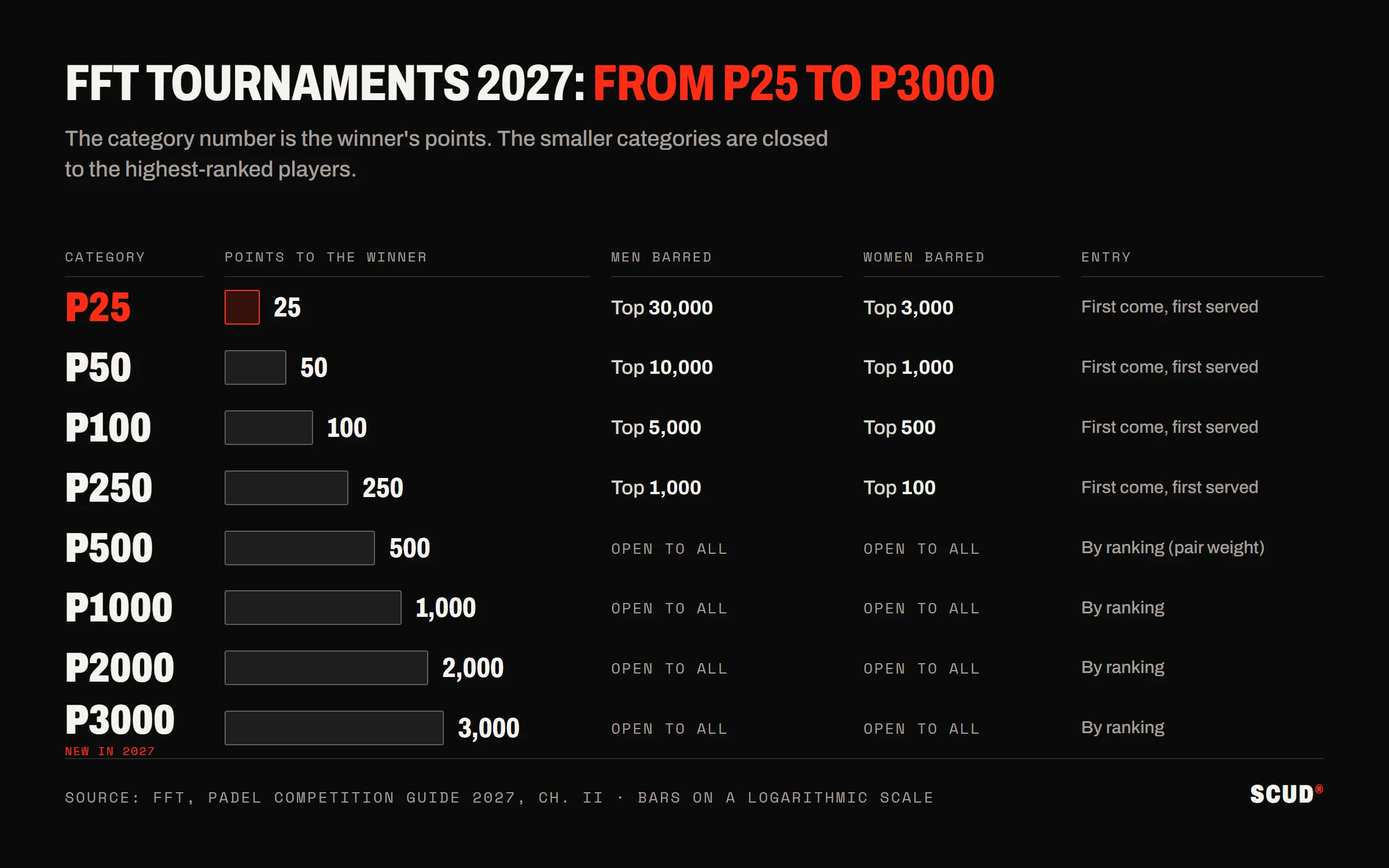
A P25 padel tournament is the smallest competition category sanctioned by the FFT (French Tennis Federation): the pair that wins it earns 25 ranking points, each player receives them, and it is closed to the best-ranked players (the top 30,000 men and the top 3,000 women). All you need to enter is an FFT licence and a partner. It is the gateway to competition, the door you push open for your first tournament.
This guide follows the rules for the 2027 season, in force since 1 September 2026: who can play, which match formats, how many points depending on where you finish, what entry costs, how to find a P25 near you, and how the day unfolds. At the end, a few tips for a first tournament, and the logical next step: P50, P100 and beyond.
What is a P25 in padel?
In France, padel tournaments sanctioned by the FFT are grouped into eight categories, from P25 to P3000. The number is the points awarded to each player of the winning pair: 25 points for a P25, 100 for a P100, 3,000 for a P3000. The P3000 category was created for the 2027 season: the former P2000s became P3000s, and the former P1500s became P2000s (we cover this change in padel in France: figures and courts).
The P25 is therefore the lowest rung. It is organised by an affiliated club with at least one approved court, overseen by a padel referee (a level-1 JAP, juge-arbitre de padel, is enough), and its results count towards the national ranking, just like those of a P1000. That is what sets it apart from an internal club tournament or an Americano: you play for fun, but also for points.
P25 padel tournament: what level do you need?
The rules set no minimum level. They set a ceiling: to keep P25s as tournaments for modest-level players, the FFT bars the best-ranked from entering. For the 2027 season, chapter II of the competition guide sets these limits, known as cuts:
| Category | Men barred | Women barred | Mixed barred |
|---|---|---|---|
| P25 | Top 30,000 inclusive | Top 3,000 inclusive | Top 30,000 men, top 3,000 women |
| P50 | Top 10,000 inclusive | Top 1,000 inclusive | Top 10,000 men, top 1,000 women |
| P100 | Top 5,000 inclusive | Top 500 inclusive | Top 5,000 men, top 500 women |
| P250 | Top 1,000 inclusive | Top 100 inclusive | No limit |
| P500 and above | Open | Open | No mixed event |
In practice, if you are ranked below 30,000th among men, or not ranked at all, the P25 is open to you. An unranked player is given, for the tournament, a ranking equal to that of the last ranked player plus one: you do not start from zero, you start from the bottom of the list. Junior tournaments, for their part, have no ranking limit.
One exception is worth knowing for tennis players. The FFT automatically gives an “assimilated” padel ranking to players ranked 15 or better in tennis: a player ranked between 3/6 and 15 during the current season or any of the five previous ones is assimilated to 7,500th place among men. That ranking puts them out of P25s and P50s: they will start in P100. If that tennis ranking is older, the assimilation drops to 12,500th or 20,000th place, still within the top 30,000: the P25 remains closed. At 15/1 or below in tennis, there is no assimilation: the P25 is open.
To understand how your ranking is calculated and how it changes, read our article on the FFT padel ranking.
Women’s and mixed P25s
A club can sanction up to three events at the same tournament: men’s, women’s and mixed. Women’s P25s are closed to the top 3,000; mixed P25s, with one woman and one man per pair, apply both limits. Some men’s events also accept women players, if the club has allowed it: their ranking is then converted using an equivalence table in the rules.
Who can enter? The licence and the partner
To play a pairs tournament, the FFT guide sets three conditions:
- Hold an FFT licence for the current season (club or web licence) by the entry deadline. There is no club or nationality requirement.
- Be the right age for the event: seniors, over-45s, over-55s or junior categories.
- Form a complete pair by the deadline: you cannot enter alone.
The 2027 adult licence costs €33 taken out through an FFT club, €51 online; the junior licence €23 through a club for ages 7 to 18. It is valid from 1 September 2026 to 31 August 2027. All the details are in our article on the FFT padel licence and its price.
Match formats, deciding point and Star Point
A P25 is not played over three sets of six games. The specifications for senior tournaments (February 2026 version) allow formats C1, C2, D1, D2, E and F in P25, with a stated preference for formats E or F, the shortest. The 2027 guide defines them as follows:
| Format | What you play |
|---|---|
| C1 | 2 sets of 4 games, tie-break at 4-4; 3rd set replaced by a 10-point super tie-break |
| C2 | Same as C1, with a deciding point at 40-40 |
| D1 | 1 set of 9 games, tie-break at 8-8 |
| D2 | Same as D1, with a deciding point |
| E | 1 super tie-break to 10 points |
| F | 1 set of 4 games, with a deciding point, tie-break at 3-3 |
The deciding point is the golden point: at 40-40, a single point settles the game, and the receiving team chooses the side. The Star Point of the professional circuit, on the other hand, appears in no FFT format; we explain it in our article on the Star Point. The referee announces the format at the start of the tournament: remember it, because it changes how you manage every game. If the basics of scoring still escape you, start with padel rules for beginners.
The rules also govern the pace: every pair must be offered at least three matches, and five if the tournament is played in formats E or F. They impose a minimum rest time between two matches: 30 minutes after a C or D format, 15 minutes after an F format or after three consecutive matches in format E. All four players can waive this in writing, with the referee’s agreement.
How a P25 day unfolds
A P25 takes one day at most, according to the specifications. Many are played on a weekday evening or over a weekend day: the women’s P25 at the Kaz a Padel club, for example, was announced from 6 pm to 10 pm on Friday 23 October 2026.
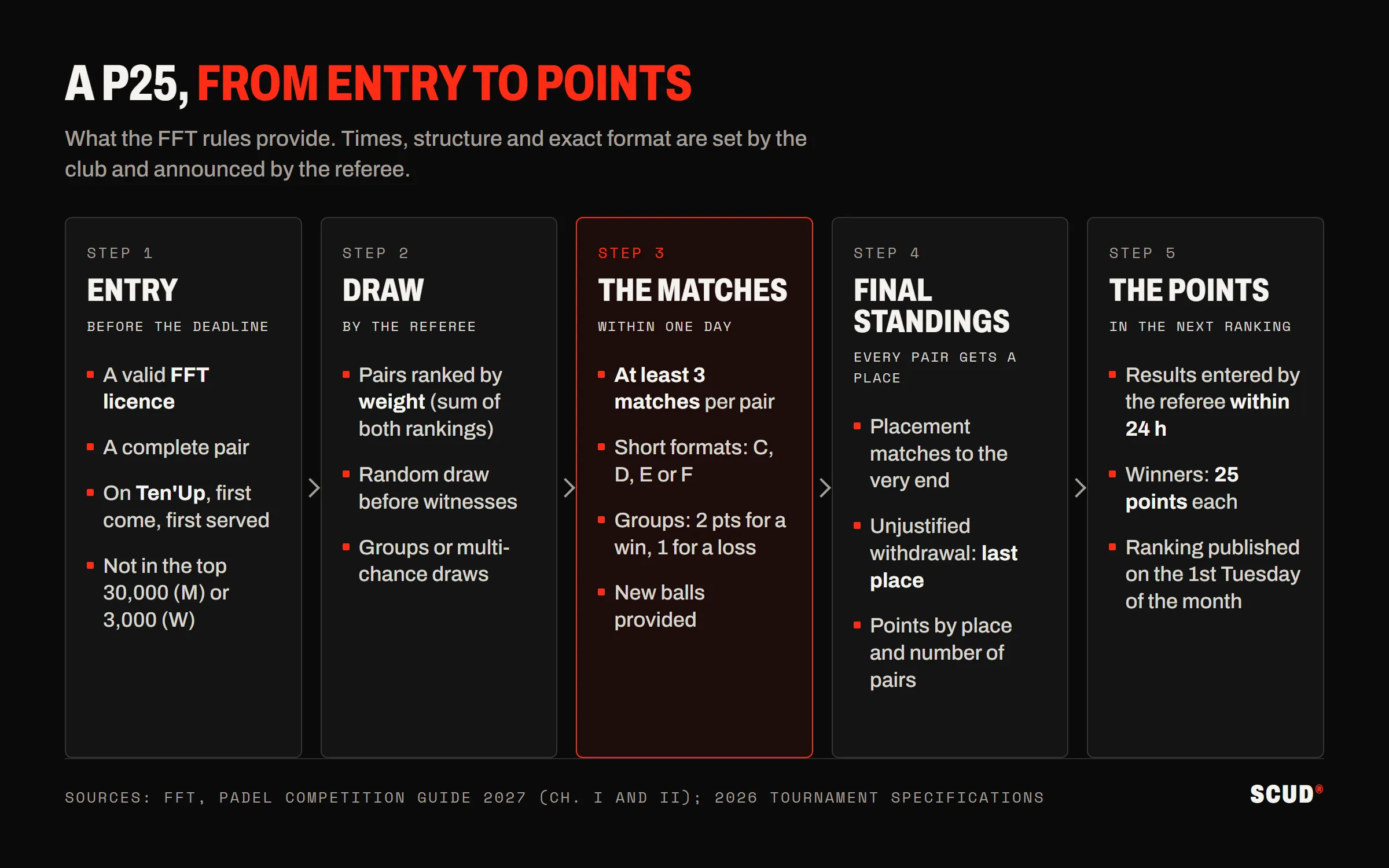
- The draw. Pairs are ranked by weight: you add up the rankings of both players, and the lower the weight, the stronger the pair. The referee places the pairs in groups or in a multi-chance draw, with one seed per group, and holds the draw in front of witnesses.
- The groups. A win is worth 2 points, a defeat 1 point, a defeat by disqualification -1 and a walkover -2. In case of a tie, it is decided on set difference, then game difference.
- The final draw and placement matches. The organiser must have all the placement matches played that give each pair a distinct place. A pair that refuses a placement match without good reason, when it has not played its three matches, is ranked last in the tournament. Stay until the end.
- The results. The referee enters the results and closes the tournament within 24 hours. The points appear in the next ranking calculation, published on the first Tuesday of each month (1 December 2026, then 5 January 2027).
Two rules avoid nasty surprises: it is forbidden to play two tournaments on the same day, and one player’s withdrawal means the whole pair withdraws.
How many points does a P25 earn?
The winner always earns 25 points, whatever the number of pairs. For the other places, the scale depends on how many pairs entered: the bigger the draw, the more the places of honour are worth. Here is an extract from the official points scale for P25 tournaments for the 2027 season:
| Place | 4 to 8 pairs | 13 to 16 pairs | 29 pairs or more |
|---|---|---|---|
| 1st | 25 | 25 | 25 |
| 2nd | 20 | 20 | 22 |
| 3rd | 15 | 17 | 19 |
| 4th | 9 | 15 | 17 |
| 5th | 6 | 14 | 15 |
| 8th | 1 | 11 | 12 |
| 12th | — | 5 | 7 |
| 16th | — | 1 | 3 |
Points go to each player of the pair. If the lack of placement matches makes it impossible to separate several pairs, they receive the same place, the least favourable one. The ranking keeps your 12 best results over the last 12 months: a lost P25 does not make you drop, it simply does not count if it is not among your twelve best.
How much does it cost to enter a P25?
The FFT does not set a fee: the entry fee is decided by each club’s tournament committee. Padel Alert, a site that lists sanctioned tournaments, puts it at “generally between 15 and 30 euros per player”. These are benchmarks, not a rule: check the fee on each tournament’s page.
The fee covers the organisation and the balls: the specifications require three new balls per court for the main event of a P25 (they are not compulsory for placement matches). There is no prize money in P25. The club, for its part, pays the FFT €32 in sanctioning fees for the 2027 season.
How do I find a P25 near me and enter?
Sanctioned tournaments are published on Ten’Up, the FFT’s platform, as an app and on the web. That is where you look for them and enter. The steps:
- Check your licence: without a licence valid on the entry deadline, you cannot enter.
- Search for tournaments in your region on Ten’Up and select the P25 category, in your event (men’s, women’s or mixed).
- Enter your pair before the deadline set by the club. From P25 to P250, entries are accepted on a first-come, first-served basis, within the places available in each phase: the most popular P25s fill up fast.
- Pay if the club asks you to: it can make online payment compulsory at entry. If you withdraw, any refund depends on the policy the club has announced.
- Keep an eye on your emails: if you are on the waiting list, an automatic message tells you when a place becomes free.
If your partner withdraws before the deadline, you can re-enter with someone else, but you go back to the end of the list.


Umpiring and etiquette: you umpire yourselves
In P25, umpiring matches is not compulsory, and neither is having court supervisors. The referee is on site, but their job is to run the tournament, not to sit in a chair beside your court. So it is the four players who call the score and judge the balls. A few simple habits avoid most disputes:
- Call the score out loud before every serve, especially at 40-40 if the format uses the deciding point.
- Judge the balls on your side honestly, and when in doubt, give your opponents the benefit.
- Be on time: the schedule is tight, and one delay slows down every court.
- If you disagree, do not argue on court: go and see the referee, whose job it is to sort out players’ problems.
Coaching is allowed from P25 to P3000. A pair can declare one or two coaches to the referee before its first match; they give advice during rest periods, never at the same time.
Preparing for your first tournament: gear and tips
The gear
Your usual racket is the right one: a tournament is not the time to break in a new one. Add a fresh overgrip (hands sweat more under pressure), a water bottle, a change of kit if you are playing for several hours, and shoes with soles suited to artificial grass. The balls are provided by the club; our guide to padel balls, pressure and approval explains why new balls bounce higher and faster than the ones from your practice games.
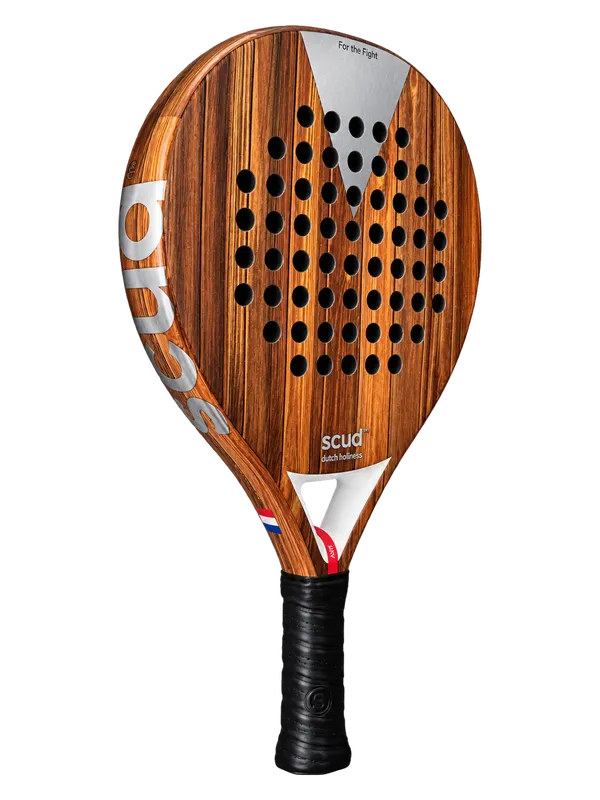
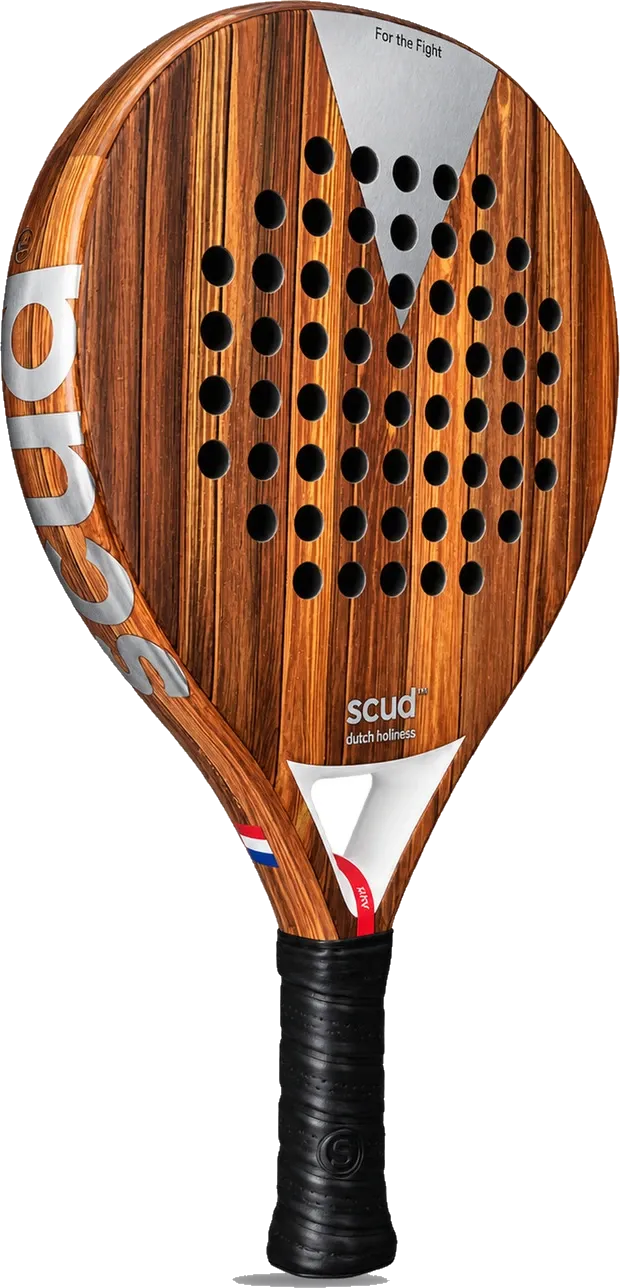
If you do not have a racket of your own yet, choose a forgiving one rather than a powerful one. In our range, the SCUD Wood W1, teardrop shape, soft EVA foam and 350 g, forgives off-centre hits; our guide to the padel racket for beginners goes through the criteria.
The tips
- Arrive early, to check in with the referee and see the draw.
- Warm up properly: playing three to five matches in a day, cooling down between group games, puts strain on calves, shoulders and elbows. Follow our warm-up and injury prevention routine.
- Eat and drink between matches, in small amounts.
- Know the format: in a 10-point super tie-break, a bad start is hard to recover from; with a deciding point, every 40-40 counts double.
- Talk to your partner: who takes the lobs down the middle, who serves first, how you reposition. Our advice on learning padel covers these automatic responses.
- Play all your placement matches, even after a defeat: they are points, and an unjustified withdrawal ranks you last.
After the P25: P50, P100 and beyond
Once you have played a few P25s and established your ranking, progression follows naturally: the P50 gives the winner 50 points and remains closed to the top 10,000 men and top 1,000 women, the P100 to the top 5,000 and top 500, the P250 to the top 1,000 and top 100. From P500 upwards, there is no ranking limit any more: pairs are selected by weight, with an entry deadline seven days before the tournament.
The moment to leave P25s behind often makes itself clear: when your ranking enters the top 30,000 men or the top 3,000 women, the door closes. That is rather a good sign.
In short
- The P25 is the smallest category of FFT tournaments: 25 points for each winner, and the first step towards a ranking.
- You need a valid FFT licence and a partner; it is closed to the top 30,000 men and the top 3,000 women.
- Matches are played in short formats (C, D, E or F), with or without a deciding point, never with the Star Point; at least three matches per pair.
- Entry is on Ten’Up, first come, first served; the fee is set by each club, often between €15 and €30 per player according to tournament listings.
- With no chair umpire, players umpire themselves; the referee settles disputes and enters the results within 24 hours.
Frequently asked questions
What level do you need to play a P25 tournament?
No minimum level is required: you need to be able to serve, keep a rally going and know the rules. The rules only set a ceiling, barring men in the top 30,000 and women in the top 3,000 from P25s. An unranked player can therefore enter as soon as they have their licence.
How many points does a P25 earn?
The winner earns 25 points, with each player of the pair receiving them. The other places depend on the number of pairs: with 13 to 16 pairs, the runner-up earns 20 points and 16th place one point. The ranking keeps your 12 best results over 12 months.
How much does it cost to enter a P25?
The organising club sets the fee; the FFT does not impose an amount. Tournament listings generally show between €15 and €30 per player. Add the FFT licence if you do not have one yet: €33 through a club or €51 online for an adult in 2027.
How long does a P25 tournament last?
One day at most, according to the FFT specifications. Many are played on a weekday evening or over a weekend day. Each pair plays at least three matches, five if the tournament uses the shortest formats.
Is there an umpire at a P25 tournament?
There is a referee who runs the tournament, but umpiring matches is not compulsory in P25. Players call the score and judge the balls themselves. If there is a disagreement, you call on the referee.
Can you play a P25 without a ranking?
Yes. An unranked player is given, for the tournament, the ranking of the last ranked player plus one, and earns points from their very first result. Tennis players ranked 15 or better should take care, though: the FFT gives them an assimilated padel ranking that puts them in the top 30,000, and therefore out of men’s P25s.
To progress from one tournament to the next, our guide to learning padel takes you through the technique step by step.
Sources
- Le guide de la compétition padel 2027, chapitre I : règles générales
- Le guide de la compétition padel 2027, chapitre II : classements, barèmes et assimilations
- Le guide de la compétition padel 2026, chapitre III : cahiers des charges des tournois (mise à jour de février 2026)
- FFT : tout ce qui change dans le règlement padel pour la saison 2027
- Tournoi padel P25 : grille de points, conditions et alertes
- Tournoi P25 padel : points, cut et inscription 2026