Contents — 11 parts
- How does the FFT padel ranking work?
- When is the padel ranking updated?
- Where can you check your padel ranking?
- How many points is a tournament worth? The P25 to P3000 scale
- Who can play which category? The cuts
- Men’s and women’s padel rankings: the differences
- Tennis players: what padel ranking do you start with?
- What changes in 2027
- How do you climb the padel ranking?
- In short
- Frequently asked questions
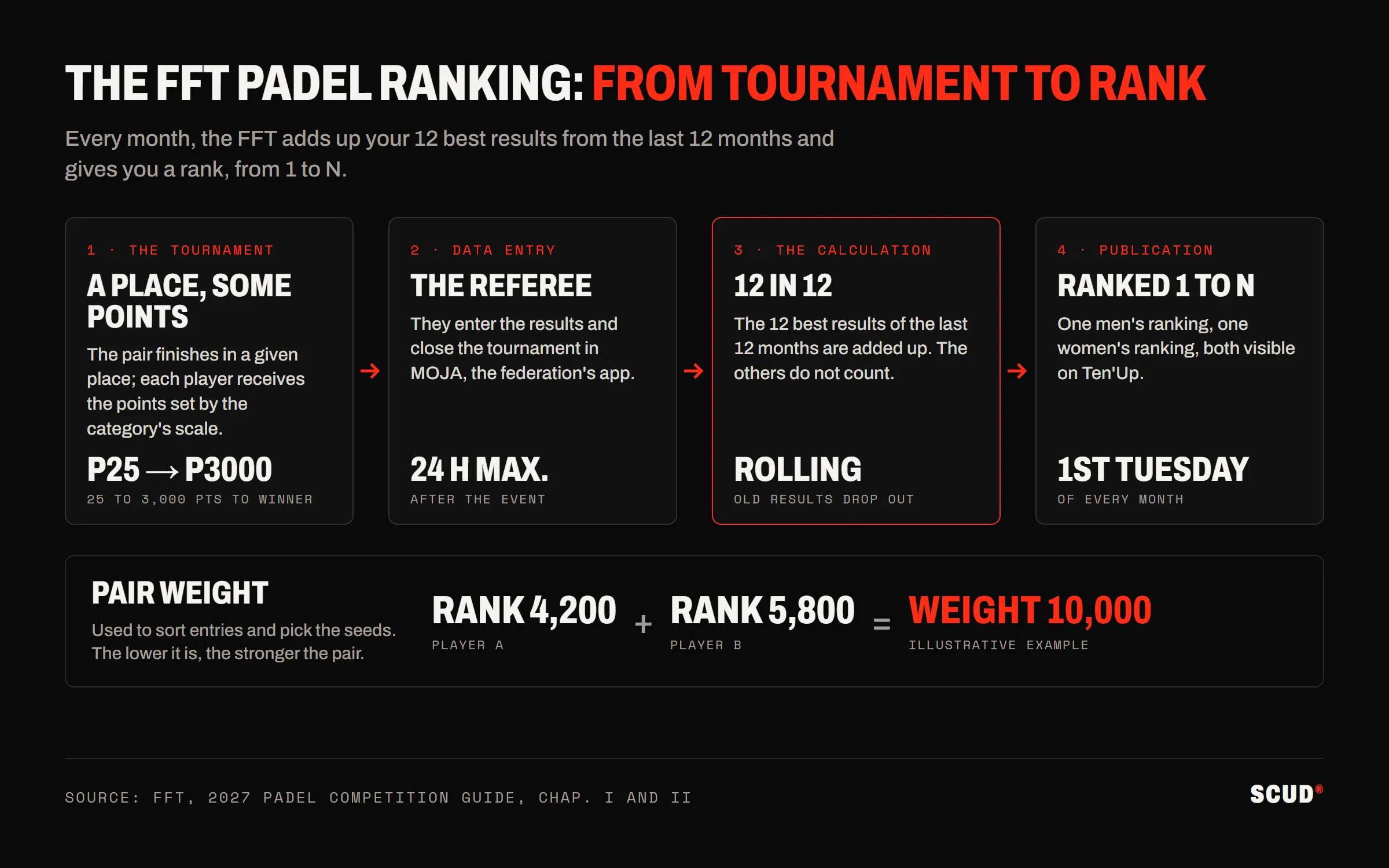
The padel ranking of the French Tennis Federation (FFT) is a national rank, from 1 to N, calculated from your 12 best results of the last 12 months in sanctioned competition. It is recalculated and published on the first Tuesday of every month, with separate men’s and women’s rankings. Each tournament awards points according to its category, from P25 to P3000, and according to your pair’s final placing: the number in the category name is the number of points the winner gets.
This article sets out the mechanics as described in the federation’s guide for the 2027 season (1 September 2026 – 31 August 2027): the calculation, the update dates, the points scale by placing, the entry thresholds for tournaments, how tennis players are slotted in, the differences between men and women, what changes this season, and a few principles for climbing.
How does the FFT padel ranking work?
The 2027 “Rankings, scales and assimilations” guide sets out the rules in a few lines:
- There is a men’s ranking and a women’s ranking, both individual and computerised.
- The ranking is a rank from 1 to N, not a grade as in French tennis: you are 1,250th or 48,000th.
- It is rolling: for each player, it takes into account the 12 best results obtained over the last 12 months.
- Mixed events count towards both the men’s and the women’s ranking.
- It is calculated and published on the first Tuesday of every month.
In practice, the FFT adds up the points from your twelve best performances over a year and ranks you according to that total. A thirteenth tournament is not added on: it only counts if it beats the weakest of the twelve retained, which it then replaces. And a result more than twelve months old drops out of the calculation, however good it was.
Both partners in a pair each receive the same points: the guide specifies that the category sets the maximum awarded “to each player in the pair”. There is therefore no doubles coefficient to apply: in padel everything is played as doubles, and the scale is designed for that.
Pair weight
The rank is mainly used to build the draws. To enter, a pair is assessed by its weight, the sum of both players’ rankings: a player ranked 4,200th paired with a player ranked 5,800th makes a pair with a weight of 10,000. “The lower the pair’s weight, the stronger the pair,” as the guide puts it. This weight determines the seeds and, from P500 upwards, which pairs are accepted.
What if you are unranked?
An unranked player (NC, non classé) is given a rank equal to the last rank in the ranking plus one, taking ties into account. The guide’s example: if 25 players are tied at 13,000th, an unranked player will be numbered 13,026. Referees find this rank directly in their app. To give a sense of scale, the October 2026 ranking listed more than 152,000 men and 22,000 women, as we noted in our review of the 2026 French Championships.
When is the padel ranking updated?
On the first Tuesday of every month. The 2027 guide publishes the full calendar for the season:
| Ranking | Release date |
|---|---|
| November 2026 | Tuesday 3 November 2026 |
| December 2026 | Tuesday 1 December 2026 |
| January 2027 | Tuesday 5 January 2027 |
| February 2027 | Tuesday 2 February 2027 |
| March 2027 | Tuesday 2 March 2027 |
| April 2027 | Tuesday 6 April 2027 |
| May 2027 | Tuesday 4 May 2027 |
| June 2027 | Tuesday 1 June 2027 |
| July 2027 | Tuesday 6 July 2027 |
| August 2027 | Tuesday 3 August 2027 |
| September 2027 | Tuesday 7 September 2027 |
Between two releases, nothing moves. After a tournament, the referee has 24 hours to enter the results and close the event in MOJA, the federation’s app; the results then feed into players’ records but, the guide specifies, they “will only be visible in Ten’Up once the ranking has been calculated”. A corrected error is taken into account in the following month’s calculation.
A new ranking can also land between the close of entries and the start of a tournament. From P25 to P250, the referee tries, as far as possible, to use the latest one published; from P500 to P3000, they take it into account to place pairs in their stage of the draw. A pair never changes stage because of a new release.
Where can you check your padel ranking?
On Ten’Up, the FFT’s website and app, in your personal area: that is where your rank and results appear once the monthly calculation has been done. For an error in a result, the guide first points you to the tournament referee, the only person authorised to correct the entry; for any other ranking problem, the federation gives a dedicated address, classementpadel@fft.fr.
How many points is a tournament worth? The P25 to P3000 scale
The guide distinguishes two families.
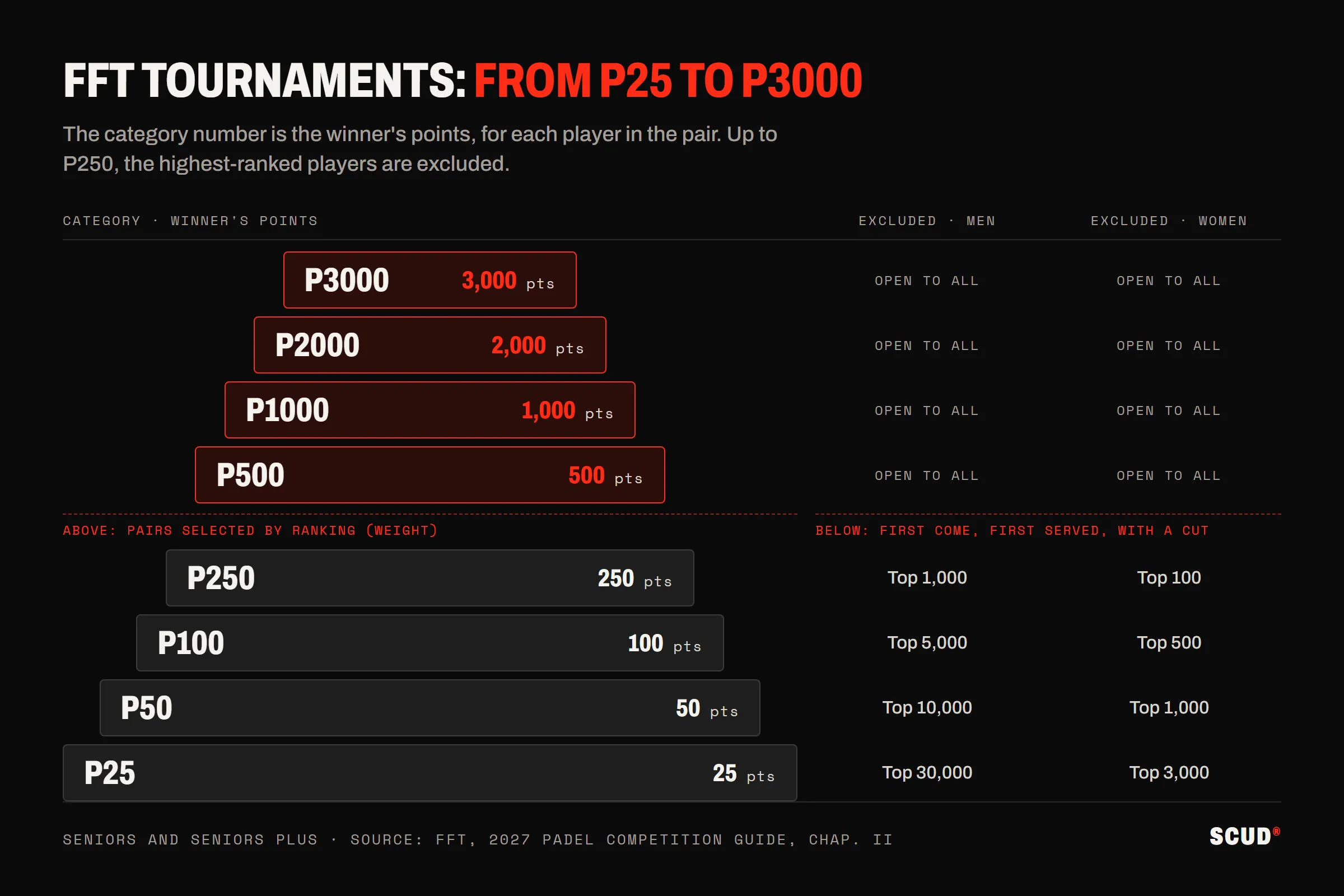
From P25 to P250, the winner’s points are fixed (25 for a P25, 50 for a P50, 100 for a P100, 250 for a P250), but the points for other placings depend on the number of pairs entered: the bigger the draw, the better each placing pays. In a P25 with 4 to 8 pairs, the scale gives 25, 20, 15, 9, 6, 4, 2 and 1 point from first to eighth; in a P25 with 29 pairs or more, the runner-up takes 22 points, third place 19, eighth place 12, and it stays at 1 point from 24th place onwards. Our guide to the P25 tournament covers this first rung in detail.
From P500 to P3000, there is a single scale, whatever the number of pairs. The P1000 is worth exactly twice the P500; the P2000 is worth four times the men’s P500, and the P3000 one and a half times the P2000.
| Placing | Men’s P500 | Men’s P1000 | P2000 | P3000 |
|---|---|---|---|---|
| Winner | 500 | 1,000 | 2,000 | 3,000 |
| Runner-up | 425 | 850 | 1,700 | 2,550 |
| 3rd | 375 | 750 | 1,500 | 2,250 |
| 4th | 350 | 700 | 1,400 | 2,100 |
| 5th | 300 | 600 | 1,200 | 1,800 |
| 8th | 270 | 540 | 1,080 | 1,620 |
| 16th | 155 | 310 | 620 | 930 |
| 24th | 100 | 200 | 400 | 600 |
| 32nd and beyond | 15 | 30 | 60 | 90 |
The guide publishes only one scale for P2000 and P3000 events, with no distinction between men and women. The senior French Championships are valued as a P3000; since the final placing match on the Sunday is not played there, all the pairs concerned are ranked in the higher position.
One last rule matters for your points: placing matches. The organiser must offer them, and they determine your final placing. From P25 to P500, a pair that has not played three matches and refuses a placing match without justification is put in last place in the tournament; if it has played at least three, in last place of the round it was in. The losers of P1000 quarter-finals and semi-finals, and those in the main draw of P2000 and P3000 events, may refuse without penalty. On court, these matches are played with the golden point or advantage, not with the Star Point of the professional tour.
Who can play which category? The cuts
To keep tournaments even, the best players are barred from the smaller categories. From P25 to P250, in the seniors and seniors plus categories, entries are first come, first served, subject to this “cut”. From P500 upwards there is no ranking limit: pairs are selected by weight, with entries closing seven days before for P500 and P1000 events, and fourteen days before for P2000 and P3000 events.
| Category | Men: closed to | Women: closed to | Mixed: closed to |
|---|---|---|---|
| P250 | Top 1,000 inclusive | Top 100 inclusive | No limit |
| P100 | Top 5,000 inclusive | Top 500 inclusive | Top 5,000 men, top 500 women |
| P50 | Top 10,000 inclusive | Top 1,000 inclusive | Top 10,000 men, top 1,000 women |
| P25 | Top 30,000 inclusive | Top 3,000 inclusive | Top 30,000 men, top 3,000 women |
| P500 to P3000 | No limit (selection by weight) | No limit (selection by weight) | No event |
Junior events have no ranking limit.
Men’s and women’s padel rankings: the differences
The two rankings are separate, and their scales are very different: there are roughly seven times as many ranked men as ranked women. The cuts reflect this (top 1,000 men, top 100 women for a P250). The P500 and P1000 scales also diverge beyond fifth place: an eighth place in a P500 is worth 270 points for men and 225 for women; a sixteenth place, 155 against 120; the last bracket, 15 points for men from 32nd place, 20 points for women from 25th.
Some men’s events accept women players. To calculate their pair’s weight, an equivalence converts the women’s ranking: a woman ranked between 11 and 30 counts as her rank + 2,000 on the men’s side, a woman ranked between 101 and 200 as her rank + 10,000, and so on up to 15,000. The guide’s example: the 23rd-ranked Frenchwoman is ranked 1,023 on the men’s ranking. In mixed events there is no conversion: the weight is simply the sum of the woman’s and the man’s ranks.

Tennis players: what padel ranking do you start with?
A good tennis player does not start at the bottom of the ladder. The 2027 guide provides automatic assimilation for any player ranked 15 or better in French tennis at any point in the last twenty years (“presumed” rankings do not count). It applies from entry into the first tournament, with no paperwork. The rank awarded depends on the best tennis ranking achieved and how long ago it was, counted in sporting seasons:
| Best tennis ranking | Men, 0 to 5 seasons ago | 6 to 15 seasons | 16 seasons or more | Women, 0 to 5 seasons | 6 to 15 seasons | 16 seasons or more |
|---|---|---|---|---|---|---|
| 15/1 and below | No assimilation | — | — | No assimilation | — | — |
| 3/6 to 15 | 7,500 | 12,500 | 20,000 | 1,500 | 5,000 | 7,500 |
| +2/6 to 0 | 5,000 | 7,500 | 12,500 | 500 | 2,500 | 5,000 |
| -2/6 to -15 | 2,500 | 5,000 | 7,500 | 300 | 1,500 | 2,500 |
| Numbered 2nd series | 1,500 | 2,500 | 5,000 | 150 | 500 | 1,500 |
| 1st series | 600 | 1,500 | 2,500 | 100 | 250 | 500 |
At each monthly calculation, the player receives the best rank among several possibilities: tennis assimilation, padel assimilation (for formerly ranked players), FIP or A1 Padel assimilation awarded manually by the federation’s padel department, and the ranking calculated from their FFT results. Beware of a one-way rule: a player assimilated through tennis who has played 12 tournaments in 12 months and obtained a padel ranking loses “for life” the possibility of being assimilated again on the basis of their tennis ranking.
Formerly ranked padel players (top 15,000 men or top 1,000 women since the ranking was computerised in October 2018) also benefit from a grid, which depends on the best rank reached and the number of seasons that have passed. A former 101st to 300th-ranked man, for example, is assimilated at 750th if that rank dates from two seasons ago at most, and at 2,500th if it was three to five seasons ago. For women, beyond 1,000th place, no re-ranking is possible. As for the best French players on the international tour, they are ranked separately: men in the FIP top 300 and women in the FIP top 200 are numbered at the top of the FFT ranking, from 1 to N.
What changes in 2027
Padel Magazine went through the new rules in detail as soon as they were published, in July 2026. For the ranking, four points matter.
- A new category, the P3000. The former P2000s become P3000s and the former P1500s become P2000s. The pyramid now has eight steps: P25, P50, P100, P250, P500, P1000, P2000 and P3000. We mentioned this in padel in France in figures.
- A new assimilation grid for formerly ranked players, based on the best ranking achieved and the number of seasons that have passed, according to Padel Magazine.
- Coaching is allowed from P25 to P3000: a pair can declare one or two coaches for the whole competition, who take turns stepping in during rest breaks.
- The single Club FFT licence, which now covers all disciplines, has “no impact” on how rankings are calculated, the FFT says. For prices and how to get one, see our article on the padel licence.
How do you climb the padel ranking?
The rules themselves suggest a few principles. They are no substitute for playing level, but they stop you losing points needlessly.
- Aim for twelve good results, not fifty tournaments. Only the twelve best count: one more tournament only helps if it beats your weakest retained result.
- Weigh the category as much as the result. A 5th place in a men’s P500 (300 points) is worth more than a P250 win (250 points), and so is a 16th place in a P1000 (310 points). Once the cut shuts you out of the smaller categories, or your wins there no longer improve your best twelve, it is time to move up.
- Favour well-filled draws up to P250. For the same placing, a P25 with 30 pairs pays better than a P25 with 6.
- Play your placing matches. They set your final placing, and therefore your points, and an unjustified refusal can send you to last place.
- Keep an eye on the rolling calendar. A big result from last year is about to drop out of the calculation: plan to replace it rather than suffer a fall.
- Choose your partner with their rank in mind. The pair’s weight decides whether you get into P500 events and above, and whether you are seeded anywhere.
- Never play two tournaments on the same day. It is forbidden, and withdrawing from one of them can lead to disciplinary sanctions.
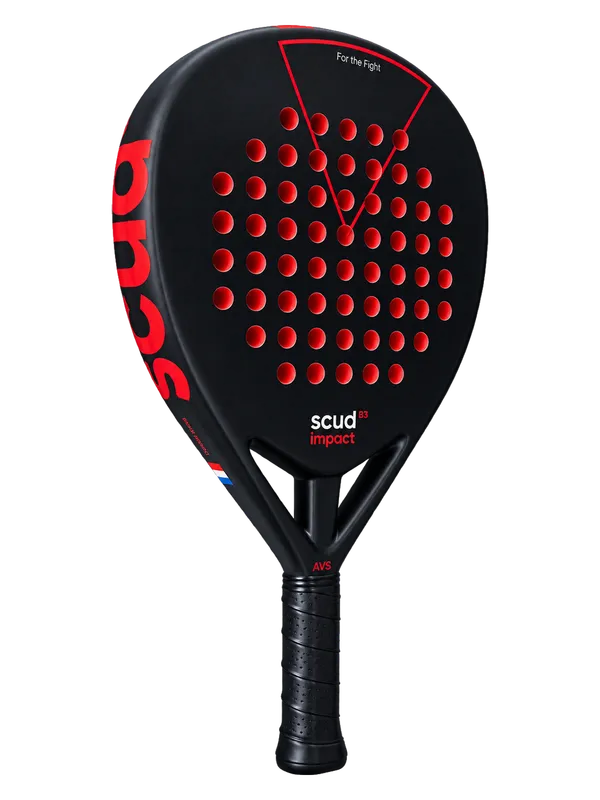
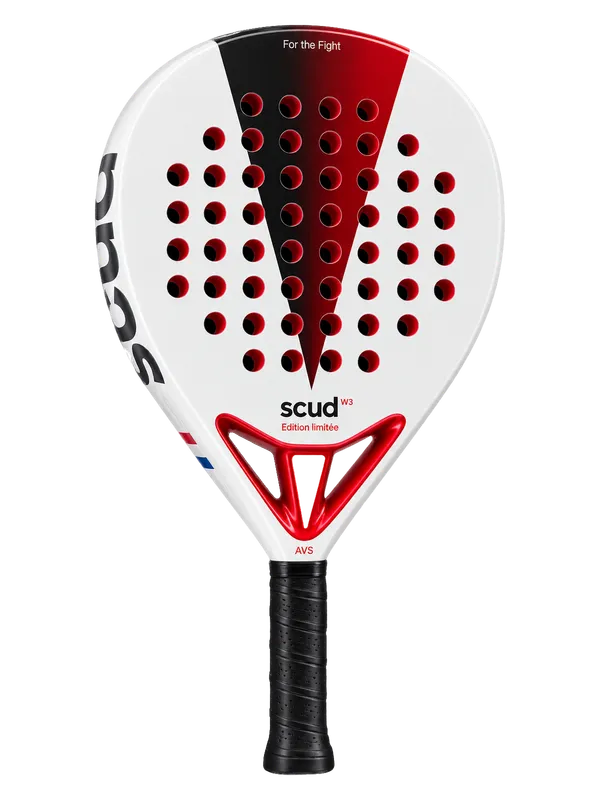
Equipment follows level, not the other way round. When your matches are being played at P500 and above, a more demanding racket can pay off: our article on the racket for advanced players explains when to make the step up, and the SCUD Black Impact B3 is our model designed for big hitters. For players who win their points through consistency, the SCUD White S3 remains the best all-rounder in the range.
In short
- The FFT padel ranking is a rank from 1 to N, with men and women ranked separately, calculated on the 12 best results of the last 12 months.
- It is published on the first Tuesday of every month; the next releases are on 3 November and 1 December 2026.
- The category number (P25 to P3000) is the number of points the winner gets; up to P250, the other placings depend on the number of pairs.
- From P25 to P250, a cut excludes the highest-ranked players; from P500 upwards, pairs are selected by weight.
- Players ranked 15 or better in tennis receive automatic assimilation, from 600th to 20,000th for men depending on their best ranking and how long ago it was.
Frequently asked questions
How is the FFT padel ranking calculated?
The FFT adds up the points from your 12 best results in sanctioned competition over the last 12 months, then gives you a rank from 1 to N. Each result is worth the points set by the scale for the tournament’s category, according to your pair’s final placing, and both partners receive the same points.
What day does the padel ranking come out?
The first Tuesday of every month. For the 2027 season, the next releases are Tuesday 3 November 2026, Tuesday 1 December 2026 and Tuesday 5 January 2027. A tournament’s results only appear on Ten’Up after this monthly calculation.
How many points is a P25 worth?
25 points for each player in the winning pair. The following placings depend on the number of pairs: in a P25 with 4 to 8 pairs, the runner-up takes 20 points and the last pair 1 point; in a P25 with 29 pairs or more, the runner-up takes 22.
I had a tennis ranking: what will my padel ranking be?
If you were ranked 15 or better in French tennis at any point in the last twenty years, you automatically receive an assimilation from your first tournament. A former 15 ranked within the last five seasons, for example, starts at 7,500th among men and 1,500th among women. Below 15/1, there is no assimilation.
Can you play a P25 if you are highly ranked?
No, beyond a certain rank. The P25 is closed to the top 30,000 men and the top 3,000 women, and the P250 to the top 1,000 men and the top 100 women. From P500 upwards, however, no ranking limit applies.
What is a pair’s weight?
It is the sum of the two players’ rankings. The lower it is, the stronger the pair: it is used to determine the seeds and, from P500 to P3000, to select the pairs accepted into the draw.
The ranking measures what you do in matches; to improve on court, our complete guide to learning padel goes through every step, from your first shot to your first tournament.