Contents — 13 parts
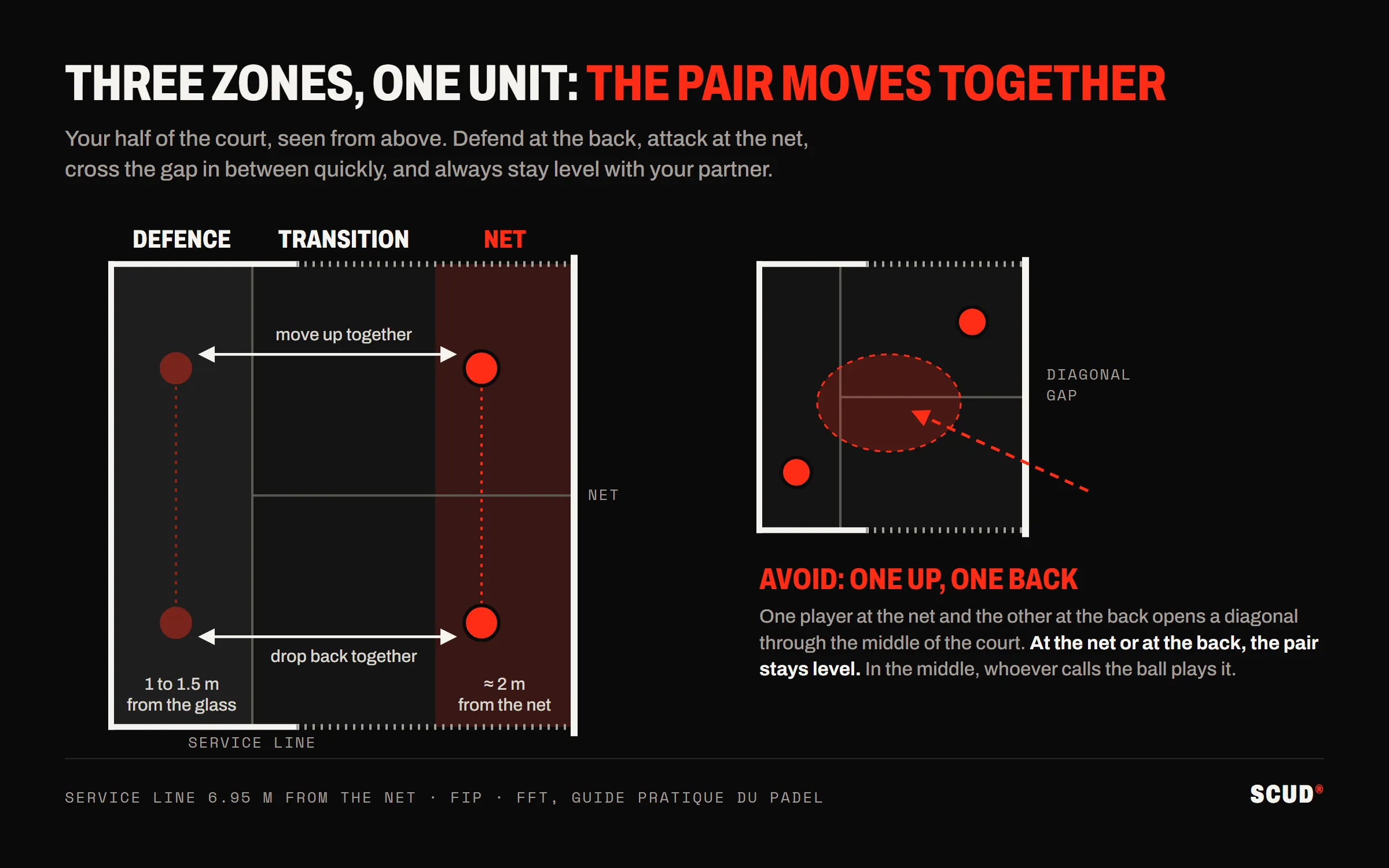
- The three zones of the court
- Where to stand on serve
- Where to stand to return serve
- Moving to the net, and doing it as a pair
- At the net: the right distance and moving as a unit
- Who takes the ball down the middle?
- Defending at the back
- Right-side or left-side player: which roles?
- The most common positioning mistakes
- Drills to improve your positioning
- Which racket for your position?
- In short
- Frequently asked questions
Positioning in padel starts with a choice between two places: at the net to attack, at the back to defend, crossing the space between them as quickly as possible. Then it means holding those places as a pair: partners move forward together, drop back together and stay level, about two metres from the net in attack, one to one and a half metres from the back glass in defence. Everything else — who stands where on serve and on return, and which side to play — follows from those two principles.
This guide covers the zones of the court, where the four players stand on serve and on return, moving up to the net, covering the middle, defending at the back, how roles split between the right-side and left-side player, the left-hander’s case, the most common positioning mistakes and drills to fix them.
The three zones of the court
A padel court measures 20 metres by 10, and each team has a 10 × 10 metre half. The rules of the International Padel Federation (FIP) put the service line 6.95 m from the net, a little over three metres from the back glass. Those lines matter for the serve; during a rally, it is three zones that count.
| Zone | Where | What you do there |
|---|---|---|
| Defence | Between the back glass and the service line | Let the ball come, play off the glass, lob to win back the net |
| Transition | Between the service line and the volley zone | Cross it quickly: this is where balls land at your feet |
| Net | About two metres from the net | Volley, hold the position, finish |
Belgian player Laura Bernard summed it up for DH Les Sports+ in March 2024: “There are two positions: defensive and offensive. When you defend, you stand near the glass. The aim then is to push the opponents back so you can move up to the net, into the offensive position.”
The transition zone is not a position, it is a passage. Too far back to volley above the net, too close to let the ball reach the glass, the player who stops there gets low balls at their feet.
Where to stand on serve
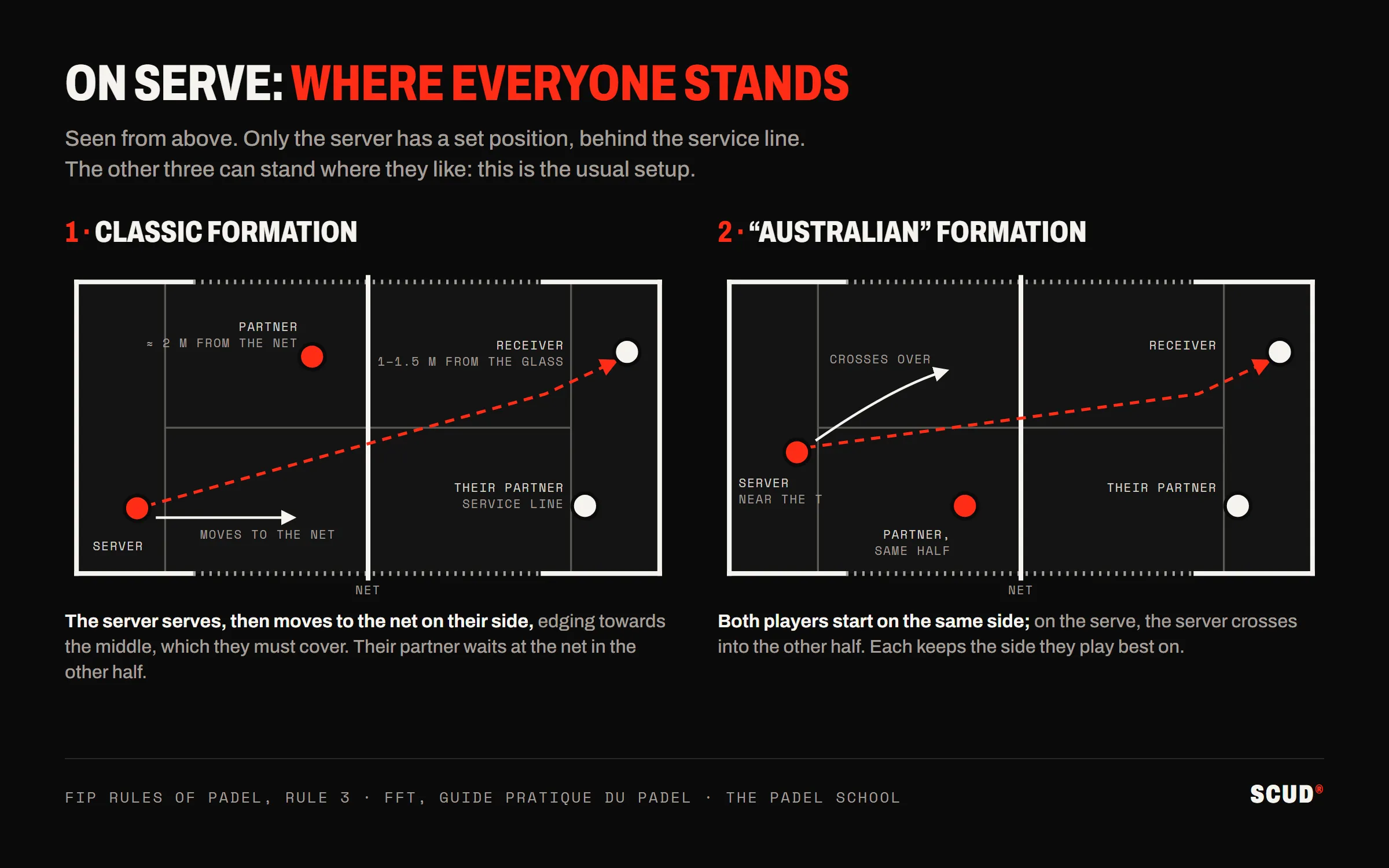
The rules fix only one position: the server’s. They stand behind the service line, between the extension of the centre line and the side glass, without touching the lines, until they strike the ball. The receiver, the receiver’s partner and the server’s partner can stand wherever they like in their half (FIP rule 3).
The server
In the simplest formation, the server starts from the middle of their half-court, serves, then moves up to the net, edging towards the centre line. The Padel School, a British padel academy, gives the reason: in this formation, covering the middle is the server’s responsibility. The technique and targets of the serve are covered in our guide to the padel serve.
The server’s partner
They wait at the net in the other half, about two metres from the net: the volley position. They do not watch their partner serve; they watch the receiver, ready to intercept a return that comes back too high or too central.
The “Australian” formation
The practical padel guide from the French Tennis Federation (FFT) recommends keeping the same side as much as possible: “Unlike tennis doubles, it is advisable to keep your side as much as possible and therefore to serve ‘Australian style’ (serving ‘Australian style’ lets each player in a pair keep the same side).”
In practice, both players start on the same side. The server stands near the “T”, where the service line meets the centre line; their partner stands at the net in front of them. As they serve, the server crosses into the other half, and the partner takes charge of the middle. The Padel School notes that most professional players use it when serving, and that at club level it becomes useful as soon as one of the two players is clearly more comfortable on one side.
Where to stand to return serve
The receiver
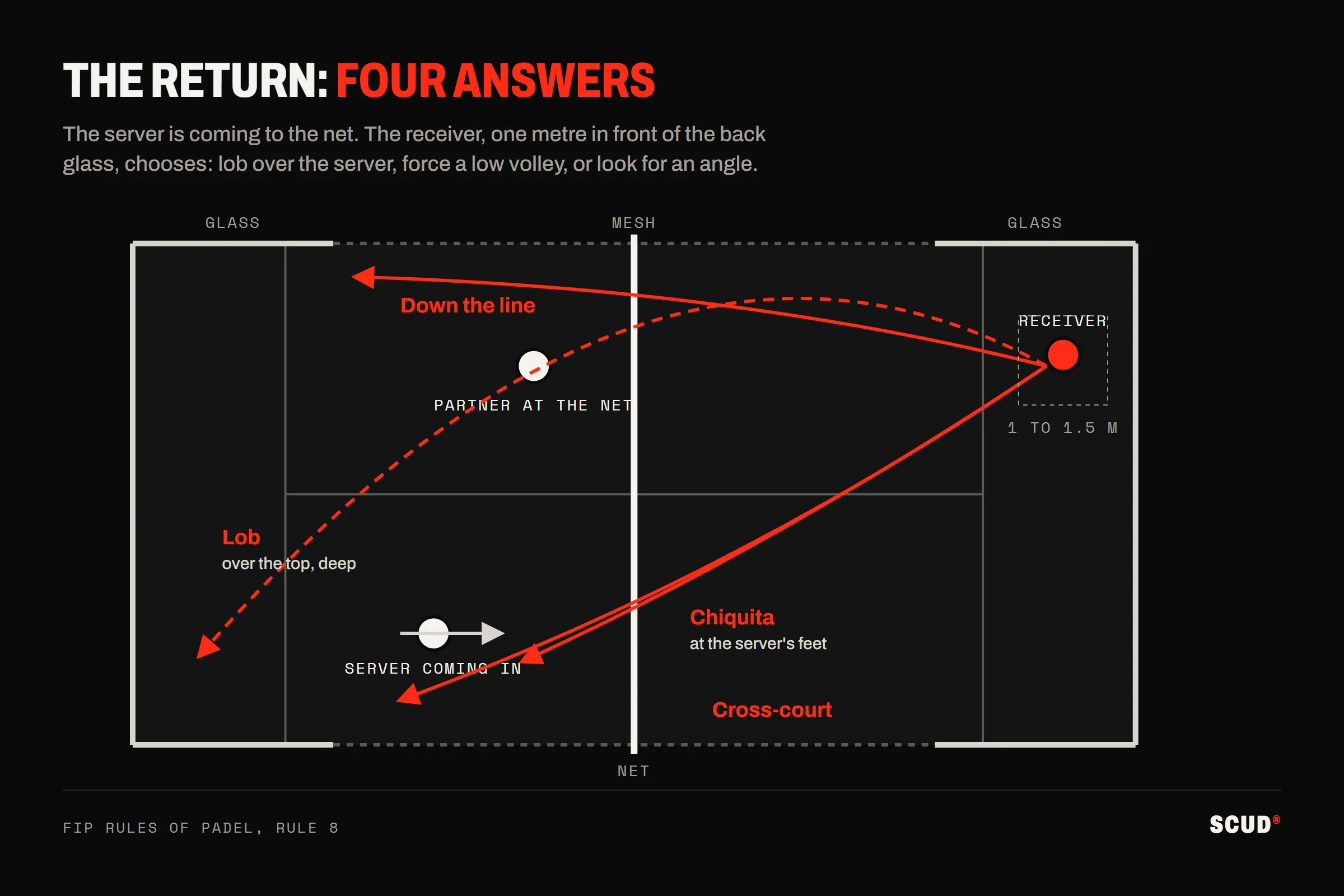
Stand about one to one and a half metres in front of the back glass, slightly shifted towards the side glass, where the most common serve goes. The Padel School describes a similar starting position, two steps from the side glass. Our guide to the return of serve covers the stance and the four possible returns.
The receiver’s partner
They can stand wherever they like, including at the net, but the most common choice is to stand near the service line, on their own side. From there they can move forward if the return is good, drop back if the opponents attack, and above all tell their partner what the opposing players are doing. The Padel School is clear on this: after the return, both receiving players should move up together.
Who receives on the right, who receives on the left?
The order is decided in the first game of each set: the player who receives the first serve receives it in every game until the end of the set, and the order only changes in the next set (FIP rule 8). On the deciding point of a game — the golden point in FFT tournaments or the Star Point on the professional tour — the receiving team chooses the side.
Moving to the net, and doing it as a pair
The FFT guide puts the rule in a single sentence: “You must try to take the net, as a team, as early as possible.” It also gives the means: “To take the net, using the lob is fundamental.”
The two classic opportunities are well known:
- After your serve. The server moves forward two or three steps, pauses (the split step) as the receiver strikes, then joins their partner.
- After a good lob. If your lob goes over the opponents and forces them back, both of you move forward while they retreat. Our guide to the padel lob explains how to play it.
A lob that falls short, on the other hand, is not one to follow: stay at the back and get ready to defend the smash.


At the net: the right distance and moving as a unit
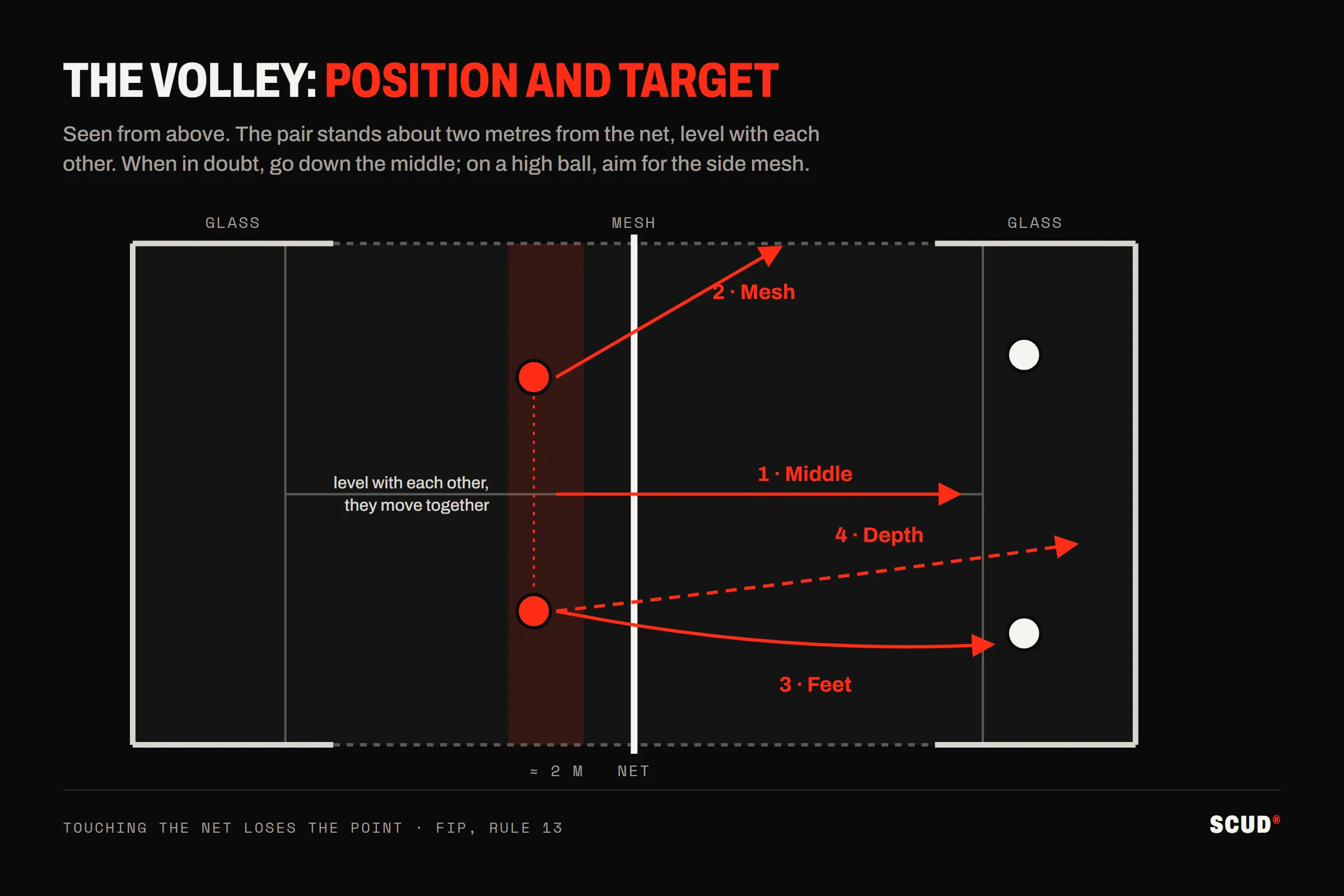
The volley position is about two metres from the net. Glued to the net, you are at the mercy of the lob, and touching the net with your body or racket loses the point (FIP rule 13). Too far back, towards the service line, you face dipping balls. The volleys themselves are covered in our guide to the padel volley.
The most important principle of positioning fits into one sentence from the FFT guide: “You move forward and back on the same line as your partner.” Laura Bernard puts it this way: “In padel, you play as two. You move as two. You go forward to the net as two and back to the glass as two. If your partner takes a step sideways, you follow.”
Imagine a three-metre rope between you. When the ball goes right, the pair slides right; when the opponent lobs and forces one of you back, the other drops back too. If one stays at the net while the other defends at the back, a diagonal opens through the middle of the court — exactly what the FFT says to avoid: “You must avoid ending up with one player at the net and the other at the back of the court.”
There is one exception: on a lob that does not push you all the way back, The Padel School notes that one of you can take a step back, play a bandeja and return straight to the net. The bandeja is explained in our article on padel shots, and the smash in our guide to the smash por 3 and por 4.
Who takes the ball down the middle?
This is the question that loses the most points between friends. There is no single rule, but there is a convention and a condition.
- The convention: each player covers their own side, and a ball down the middle usually goes to the player who has it on their forehand. The Padel School is precise about it: “usually but not always”.
- The condition: call it. An early “mine” or “yours” is worth more than any principle. The FFT guide points out that “communication is important to tell your partner where the opposing players are”.
- The cover: when your partner is pulled wide, you shift towards the middle to close the gap.
Defending at the back
In defence, the pair stands at the back, one to one and a half metres from the glass, level with each other. The aim is not to win the point from there, but to win back the net. Most balls that bounce behind the service line are played after the glass, and defence relies on the lob and on playing off the glass, covered in our guide to playing the walls in padel.
The partner who is not playing the ball has an active role: they watch the opponents and call out their position. The player coming off the glass, with their back to the net, has no other way of knowing whether to lob or play low.
Right-side or left-side player: which roles?
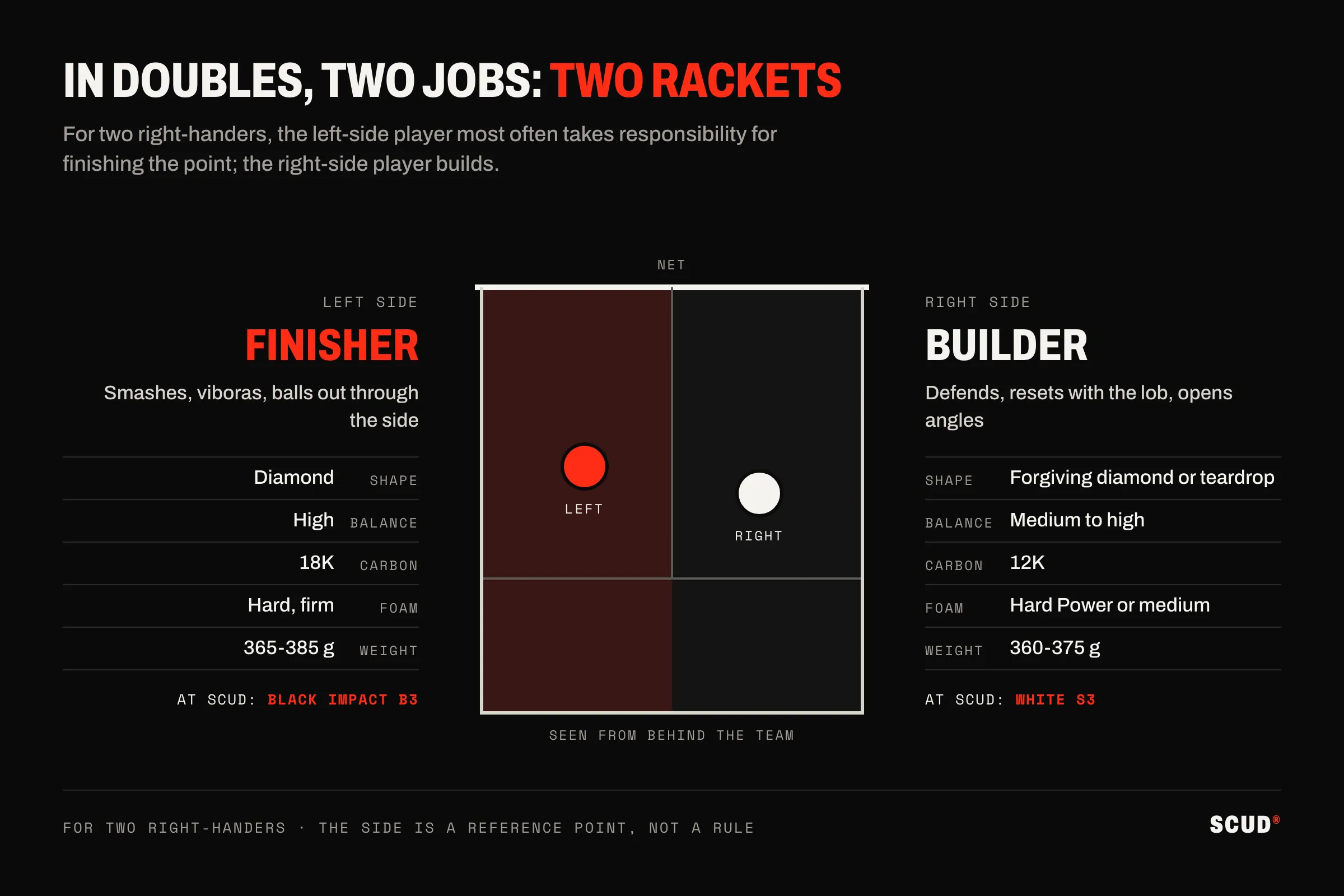
In padel, each player usually keeps their side for the whole set: one player on the right, one on the left. The roles are not symmetrical. In Laura Bernard’s words: “On the left, you put the most powerful player, the one who finishes points. On the right, you put the one who builds the point, who has tactical sense, good hands and defends well.”
For two right-handers, the left-side player has their forehand in the middle of the court and takes most lobs as smashes; the right-side player has their forehand along the glass and their backhand in the middle. Padel Addict suggests several criteria for choosing, in an article from December 2025:
| Criterion | Recommended side |
|---|---|
| The best overhead game (smash, víbora, bandeja) | Left |
| The best backhand volley | Right |
| The clearly stronger player | Left |
| The player with the most stamina, over a long match | Left, which often covers more ground |
| The left-hander, in a pair with a right-hander | Right |
Padel Addict adds a return criterion: with traditional scoring, the better receiver should play on the left, because that is the side on which advantage points are received. This criterion no longer applies with the deciding point, since the receiving team then chooses its receiver. The criteria can contradict each other: it is up to the pair to decide.
The left-hander’s case
In a right-hander/left-hander pair, Padel Addict is categorical: the left-hander plays on the right. They then have their forehand and smash towards the middle, like a right-hander on the left, and both players can take the middle on their forehand. The flip side, as the same site points out: since both can take the ball down the middle, the pair must decide clearly who plays it. We cover this case, and what it changes for the racket, in our guide to the left-handed player’s racket.
The most common positioning mistakes
- One up, one back. The diagonal between the two players is the first place a savvy opponent aims for.
- Stopping in the transition zone. That is where balls land at your feet.
- Hugging the net. The lob goes over, and touching the net costs the point.
- Backing up against the glass in defence. The ball coming off it ends up in your body.
- Serving and staying at the back. The serve is only worth something if it wins you the net.
- Saying nothing. A ball down the middle that nobody calls is often a lost ball, or a clash of rackets.
Drills to improve your positioning
- The rope. Each partner holds one end of a rope or towel and they move to the net, then to the back, without letting go, while the coach feeds balls left, right and as lobs.
- Moving up on the lob. Rally from the back against a pair at the net: as soon as a lob gets through, both defenders move up together. The point only counts if they reach the net level with each other.
- The called middle. The coach feeds balls between the two players; whoever plays it must have called it before the bounce.
- Australian serve-volley. The server starts near the “T”, crosses on the serve and volleys the return on the other side, while their partner covers the middle.
- The positions game. In a practice match, a point lost with one player at the net and the other at the back counts double. The drill makes the rule visible very quickly.
Which racket for your position?
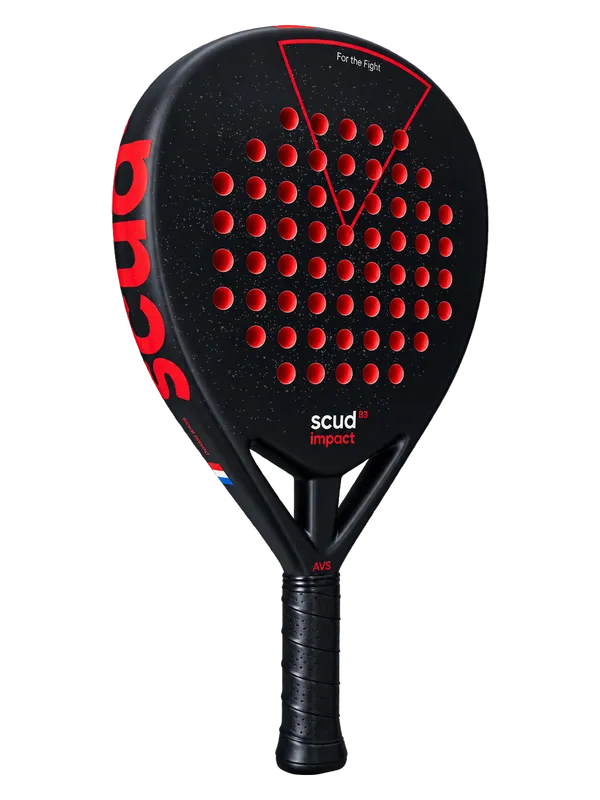
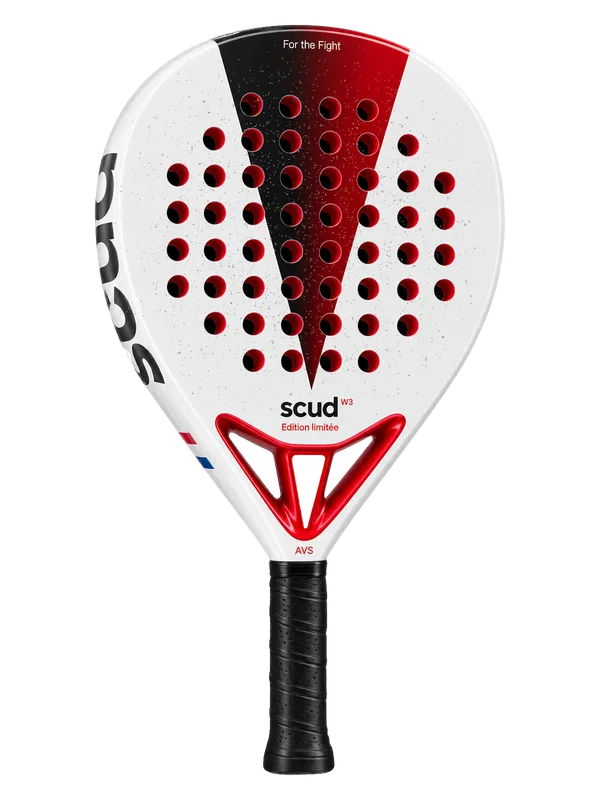
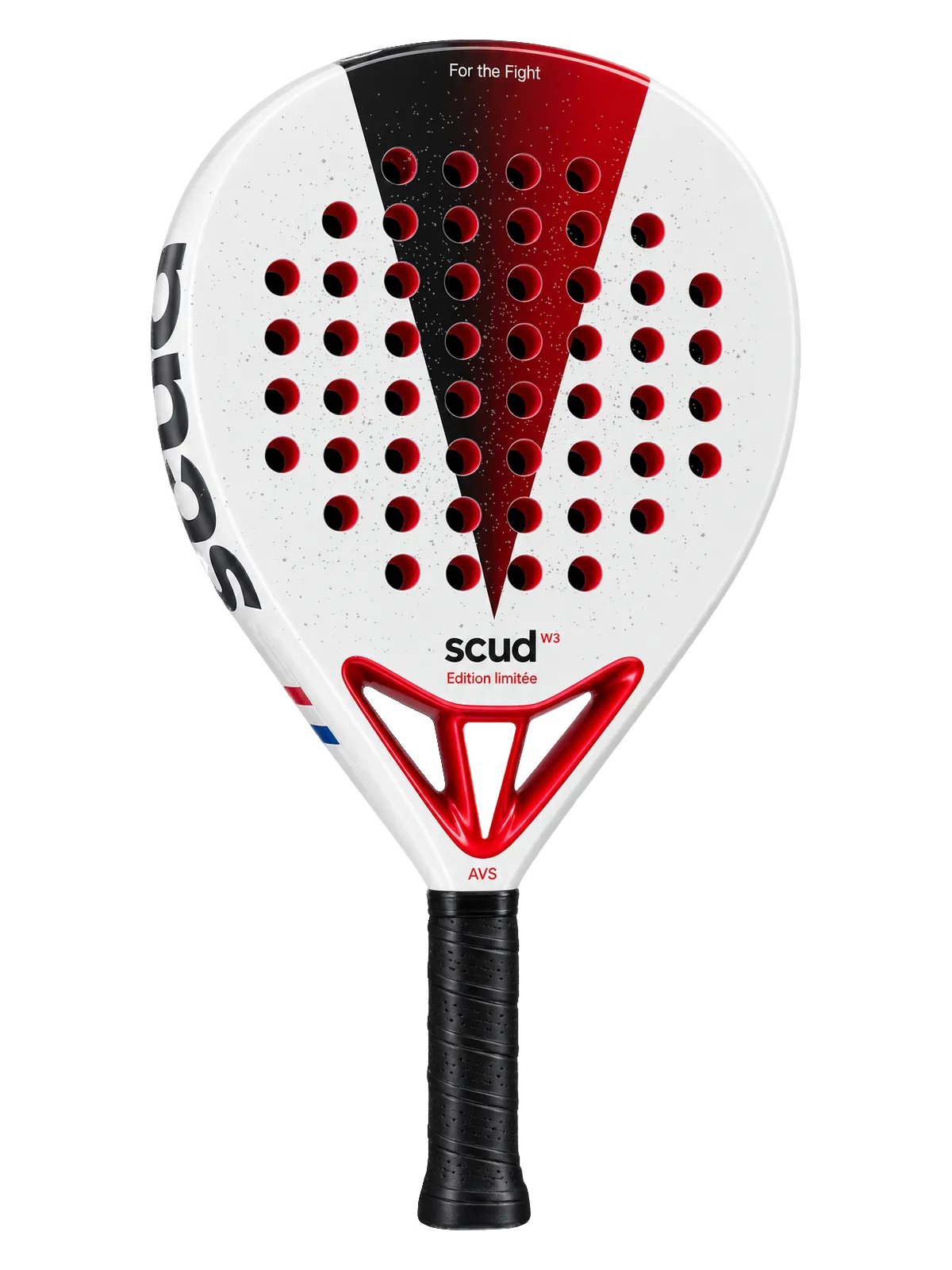
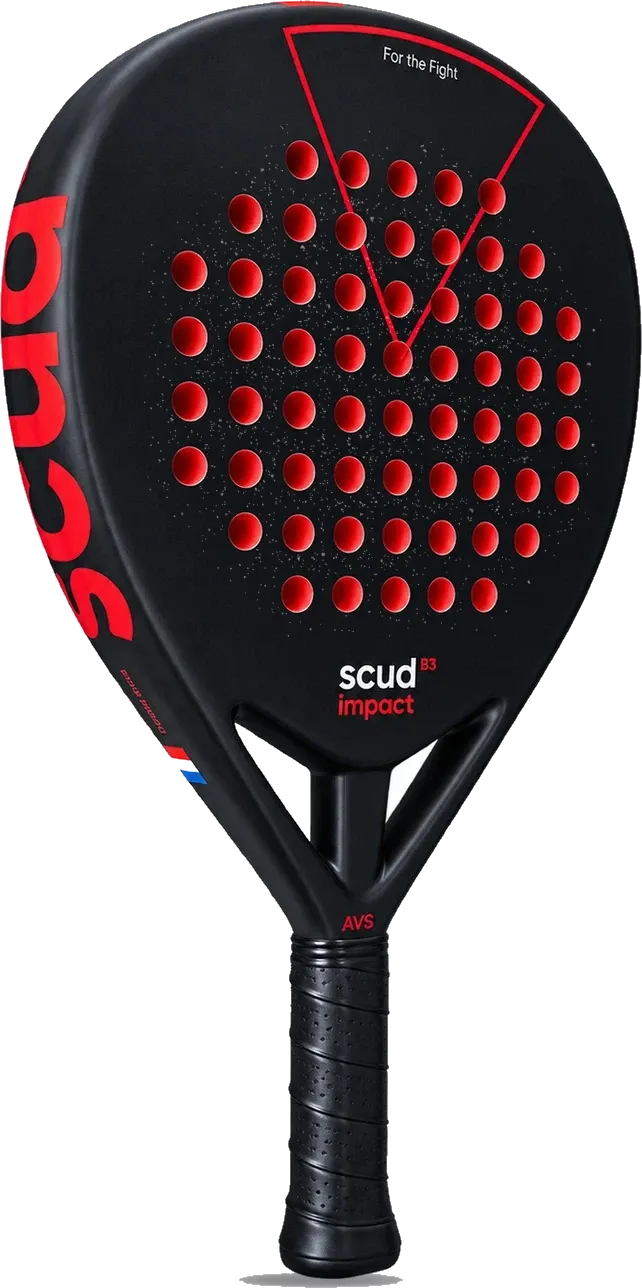
Your side of the court is reflected in your choice of racket. The left-side player, who finishes points, benefits from a power racket: the SCUD Black Impact B3, with 18K carbon, EVA Hard Power foam, a diamond shape and high balance, is designed for that role. The right-side player, who builds and defends, looks more for control and forgiveness: the SCUD White S3, our 12K carbon control reference, is the all-round choice in the range.
In short
- Two positions to hold, the net to attack and the back to defend, and a transition zone to cross quickly.
- On serve, only the server has a set position; their partner waits at the net, about two metres away.
- On return, the receiver stands one to one and a half metres from the glass, their partner near the service line.
- The pair moves forward and back together, level with each other: one player at the net and the other at the back opens a diagonal.
- For two right-handers, the left-side player finishes and the right-side player builds; a left-hander most often plays on the right.
Frequently asked questions
Where should I stand in padel as a beginner?
At the back, one to one and a half metres from the glass, when your team is defending; about two metres from the net when it is attacking. In both cases, stay level with your partner and avoid stopping in between.
Where does the server’s partner stand?
At the net, usually in the other half of the court, about two metres from the net. The rules let them stand wherever they like on their side. In the Australian formation, they stand on the same side as the server, who crosses over as they serve.
Can the receiver’s partner stand at the net?
Yes, the rules allow it. The most common choice, though, is to stand near the service line, ready to move up if the return is good or drop back if the opponents attack, then to move up to the net with the receiver.
Who should play the ball down the middle?
Most often, whoever has it on their forehand, but the real rule is to call it. The player who says “mine” plays it, the other repositions. In a right-hander/left-hander pair, both have their forehand in the middle: agree before the match.
Should I play on the right or the left in padel?
For two right-handers, the left-side player is usually the more attacking one, with the best smash; the right-side player the more consistent in defence and on the backhand volley. A left-hander paired with a right-hander most often plays on the right.
Can you switch sides during a set?
Not for the receiving order: it is set in the first game of each set and only changes in the next one. During rallies nothing stops you from crossing over, but keeping your side makes it easier to cover the court.
Positioning is one of the fundamentals, along with the shots and the walls: find every step in our complete guide to learning padel.
Sources
- Rules of Padel
- Guide pratique du padel
- Déplacements, mouvements de raquette, service, construction du point : les dix commandements pour les débutants au padel
- Serve Formation – Where to Stand?
- Moving As A Pair
- ¿Drive o revés? ¿Qué lado viene mejor para mi juego?
- Jugar con un zurdo al pádel: ¿Qué debemos saber?